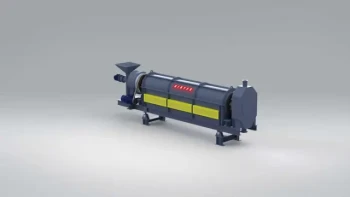
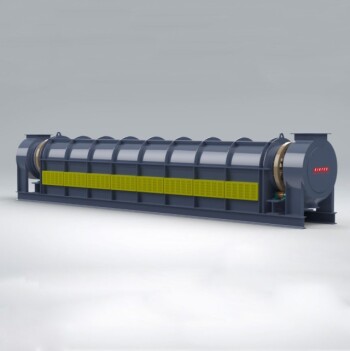
The primary function of a rotary kiln in processing Radioactive Solid Organic Waste (RSOW) is to execute a multi-stage thermal treatment that drastically reduces waste volume while stabilizing its chemical structure. Through a process called oxidative pyrolysis at approximately 550°C, the kiln converts complex organic solids into pitch-like intermediates and eventually into inorganic ash. This transformation prepares the hazardous material for safe, long-term disposal via geopolymer solidification.
By combining high operating temperatures with continuous mechanical rotation, the rotary kiln ensures the thorough decomposition of organic matter, transitioning waste from unstable solids into a concentrated, stable ash ready for solidification.
The Mechanics of Thermal Decomposition
To understand why the rotary kiln is effective, one must look at the specific chemical and physical changes facilitated by the equipment.
Oxidative Pyrolysis
The core mechanism driving volume reduction is oxidative pyrolysis. The kiln maintains a controlled environment at approximately 550°C.
At this specific temperature, the complex chemical bonds of the organic waste are broken down. This is the first step in stripping away the volatile components of the waste.
Phase Transition to Intermediates
Before the waste becomes ash, it undergoes a distinct phase change. The thermal treatment initially converts the solid organic waste into pitch-like intermediates.
This transition is critical for densifying the material. It bridges the gap between the raw, bulky waste and the final, concentrated residue.
Achieving Thorough Concentration
The physical rotation of the kiln is as important as the heat. The continuous rotation ensures that the waste is evenly exposed to the high-temperature environment.
This movement facilitates thorough pyrolysis, preventing cold spots or incomplete reactions. The result is a consistent "volume concentration," leaving behind only the non-combustible material.
Critical Operational Factors
While the rotary kiln is effective, its success depends on maintaining precise conditions throughout the multi-stage process.
Reliance on Temperature Stability
The process is calibrated for 550°C. Deviating significantly from this temperature can disrupt the formation of the pitch-like intermediates.
If the temperature is too low, the breakdown of complex organics may be incomplete. This results in a final product that is not yet ready for solidification.
The Necessity of Continuous Motion
The system relies heavily on the kiln's mechanical rotation. Without this continuous motion, the volume concentration becomes inefficient.
Stationary heating would likely result in uneven pyrolysis, leaving some waste untreated while other portions degrade into ash, compromising the stability of the final output.
Implications for Waste Management Strategy
The output of the rotary kiln is not the final disposal method, but rather a preparation for it. The quality of the ash directly impacts the success of the subsequent encapsulation steps.
- If your primary focus is volume reduction: Prioritize the efficiency of the oxidative pyrolysis phase to ensure maximum conversion of solids to gas and ash.
- If your primary focus is long-term safety: Ensure the kiln achieves thorough pyrolysis to produce stable inorganic ash, which is required for effective geopolymer solidification.
The rotary kiln serves as the critical bridge between raw radioactive organic waste and a stable, solidifiable inorganic residue.
Summary Table:
| Feature | Process Detail |
|---|---|
| Core Process | Oxidative Pyrolysis |
| Operating Temperature | Approximately 550°C |
| Key Transformation | Organic Solids → Pitch-like Intermediates → Inorganic Ash |
| Primary Objective | Drastic Volume Reduction & Chemical Stabilization |
| Mechanical Role | Continuous rotation for thorough heat exposure and pyrolysis |
Streamline Your Hazardous Waste Management with KINTEK
Handling Radioactive Solid Organic Waste (RSOW) requires precision, safety, and durability. KINTEK specializes in advanced laboratory and industrial solutions, providing high-performance rotary kilns, muffle furnaces, and crushing systems designed to meet the rigorous demands of thermal decomposition and volume reduction.
Our equipment ensures uniform heating and consistent oxidative pyrolysis, transforming complex waste into stable residues ready for geopolymer solidification. Whether you are optimizing battery research, refining ceramics, or managing hazardous materials, KINTEK offers the technical expertise and comprehensive toolset—from high-pressure reactors to specialized crucibles—to enhance your facility's efficiency.
Ready to upgrade your waste processing capabilities? Contact KINTEK experts today to find the perfect thermal solution for your laboratory or industrial needs!
References
- Andrea Santi, Mario Mariani. Design of sustainable geopolymeric matrices for encapsulation of treated radioactive solid organic waste. DOI: 10.3389/fmats.2022.1005864
This article is also based on technical information from Kintek Solution Knowledge Base .
Related Products
- Electric Rotary Kiln Small Rotary Furnace Biomass Pyrolysis Plant
- Electric Rotary Kiln Small Rotary Furnace for Activated Carbon Regeneration
- Electric Rotary Kiln Pyrolysis Furnace Plant Machine Calciner Small Rotary Kiln Rotating Furnace
- Electric Rotary Kiln Continuous Working Small Rotary Furnace Heating Pyrolysis Plant
- Vacuum Sealed Continuous Working Rotary Tube Furnace Rotating Tube Furnace
People Also Ask
- What is the temperature of a rotating kiln? It Depends on Your Material and Process Goal
- What are the principles of a rotary kiln? Master the Mechanics of High-Temperature Processing
- What are the different types of calciners? A Guide to Selecting the Right Thermal Processing Equipment
- How are rotary kilns heated? Direct vs. Indirect Heating Methods Explained
- Is rotary kiln a furnace? Discover the Key Differences for Industrial Processing