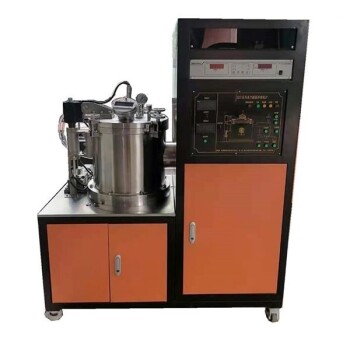
The primary function of a vacuum distillation furnace is to create a specific high-temperature, low-pressure environment that physically separates magnesium from aluminum based on their volatility. By heating the alloy to a molten state between 973 K and 1373 K, the furnace utilizes a vacuum to widen the difference in saturated vapor pressure between the two metals, forcing magnesium to evaporate while aluminum remains in the crucible.
The furnace leverages vacuum conditions to significantly increase the vapor pressure gap between the metals, allowing magnesium to preferentially evaporate from the mix and achieving separation rates as high as 99.98%.
The Mechanics of Separation
Manipulating Vapor Pressure
The fundamental principle driving this furnace is the manipulation of saturated vapor pressure.
Under standard atmospheric conditions, separating these metals is difficult; however, applying a vacuum alters their physical behavior.
This low-pressure environment significantly widens the gap between the vapor pressures of aluminum and magnesium, making physical separation thermodynamically favorable.
The Phase Change Process
Once the furnace heats the alloy to the required range (973 K to 1373 K), the magnesium becomes volatile.
Because of the widened vapor pressure gap, magnesium preferentially transitions from a liquid to a gas phase.
Simultaneously, the aluminum retains a lower vapor pressure, causing it to remain in the crucible as a liquid residue.
Critical Operational Parameters
Precise Temperature Control
Temperature is the single most critical variable influencing the rate of evaporation and final recovery.
The furnace must execute specific heating rates, such as 13 K/min, to bring the alloy to the target temperature efficiently.
Furthermore, it must maintain stable isothermal periods—for example, holding at 1373 K for 120 minutes—to ensure the magnesium has sufficient time to evaporate completely.
The Role of the Crucible
The crucible inside the furnace is not merely a container; it is an active component in maintaining purity.
It must demonstrate exceptional thermal stability and chemical inertness to withstand temperatures up to 1373 K under vacuum.
If the crucible material reacts with the active molten metals, it will introduce new impurities, defeating the purpose of the purification process.
Understanding the Trade-offs
Process Sensitivity
While this method allows for high purity, it is extremely sensitive to process variables.
Inconsistent heating or an inability to hold stable isothermal temperatures will directly result in lower magnesium recovery rates.
Material Compatibility Risks
The requirement for high temperatures creates a risk of chemical contamination.
Standard crucible materials may degrade or react with molten aluminum and magnesium.
Therefore, operators must invest in specialized, inert materials to prevent the re-introduction of impurities into the refined aluminum.
Optimizing the Separation Process
To ensure the highest efficiency and purity in your alloy separation operations, align your process controls with your specific outcome goals.
- If your primary focus is maximum magnesium recovery: Strictly adhere to stable isothermal holding times (e.g., 120 minutes) to allow near-total evaporation of the volatile phase.
- If your primary focus is aluminum purity: Verify the chemical inertness of your crucible material to ensure no reaction occurs with the molten residue at peak temperatures.
The vacuum distillation furnace transforms a complex metallurgical challenge into a clean, physical separation process through the precise manipulation of pressure and heat.
Summary Table:
| Parameter | Operating Specification | Impact on Separation |
|---|---|---|
| Temperature Range | 973 K - 1373 K | Drives volatile phase evaporation |
| Heating Rate | ~13 K/min | Ensures efficient thermal ramp-up |
| Isothermal Period | Up to 120 minutes | Maximizes magnesium recovery rates |
| Vacuum Level | High Vacuum | Widens saturated vapor pressure gap |
| Separation Rate | Up to 99.98% | Achieves ultra-high metal purity |
| Crucible Property | Chemical Inertness | Prevents secondary contamination |
Elevate Your Metallurgical Precision with KINTEK
Maximize your recovery rates and ensure unparalleled material purity with KINTEK’s advanced vacuum distillation solutions. Whether you are refining aluminum-magnesium alloys or conducting specialized battery research, our comprehensive range of vacuum, tube, and atmosphere furnaces, along with our high-performance crucibles and ceramics, provide the thermal stability and chemical inertness your lab demands.
From high-temperature high-pressure reactors to precision crushing and milling systems, KINTEK specializes in laboratory equipment designed for the most rigorous industrial standards. Contact us today to discover how our tailored equipment solutions can optimize your separation processes and drive your research forward!
Related Products
- Vacuum Heat Treat and Molybdenum Wire Sintering Furnace for Vacuum Sintering
- 2200 ℃ Tungsten Vacuum Heat Treat and Sintering Furnace
- Small Vacuum Heat Treat and Tungsten Wire Sintering Furnace
- Vacuum Heat Treat and Pressure Sintering Furnace for High Temperature Applications
- Ultra-High Temperature Graphite Vacuum Graphitization Furnace
People Also Ask
- What is the pressure for vacuum sintering? Achieve Optimal Material Purity and Density
- What is vacuum hardness? Unlock Superior Material Performance with Vacuum Processing
- What are the critical functions of the vacuum system in a sintering furnace for Cu/Ti3SiC2/C/MWCNTs composites?
- How does a vacuum environment benefit the purification of matrix powders? Optimize Diamond Tool Sintering Efficiency
- What critical process conditions does a vacuum sintering furnace provide for titanium? Expert Diffusion Bonding Guide