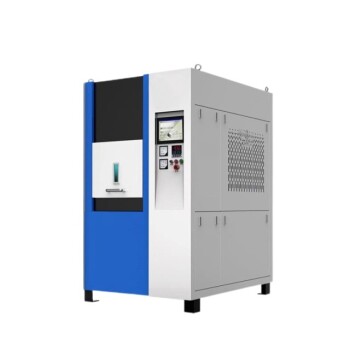
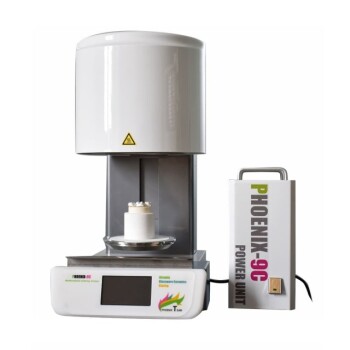
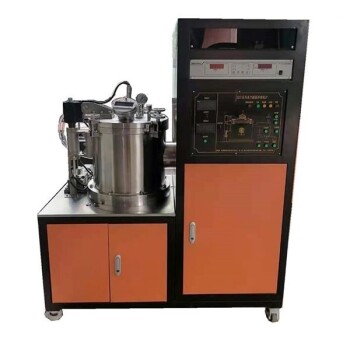
The primary function of a vacuum sintering furnace in this specific synthesis phase is to convert a raw mixture of Titanium (Ti), Aluminum (Al), and Titanium Nitride (TiN) powders into a cohesive Ti2AlN bulk material. Its most critical operational role is to maintain a rigorous oxygen-free environment during heating. This prevents the oxidation of highly reactive metal powders, ensuring the chemical integrity of the final precursor.
The vacuum sintering furnace serves as the "purity gatekeeper" for the material; by eliminating oxygen, it ensures the raw powders maintain the precise stoichiometric ratio required to form the MAX phase, preventing the chemical degradation that inevitably occurs when active metals are exposed to air at high temperatures.
The Critical Role of Environmental Control
Preventing Aluminum Oxidation
The synthesis of Ti2AlN involves high temperatures where metal powders become extremely reactive. Aluminum, in particular, is highly susceptible to rapid oxidation.
If oxygen is present, the aluminum will form unwanted oxides rather than reacting with the titanium. The vacuum environment acts as a shield, preserving the metallic aluminum so it remains available for the intended reaction.
Maintaining Stoichiometric Precision
To successfully create Ti2AlN, the ratio of the starting ingredients must be exact.
Any oxidation effectively "steals" material from the reaction, altering the chemical balance. By operating in a vacuum, the furnace ensures that the input ratio of Ti, Al, and TiN matches the output composition, guaranteeing high purity.
Facilitating the Solid-Phase Reaction
Controlled High-Temperature Synthesis
Beyond atmospheric control, the furnace provides the thermal energy necessary to trigger the reaction between the mixed powders.
This process transforms the loose powder mixture into a synthesized bulk solid. The furnace allows the materials to reach the specific temperatures required for the atoms to align into the characteristic layered structure of the MAX phase.
Creating the Precursor for Functionally Graded Materials
This synthesis step is often the foundation for subsequent processing.
By producing a high-purity Ti2AlN bulk first, you establish a reliable baseline material. This bulk material can then be layered with other materials (like TiN) in later stages to create the final functionally graded structure.
Understanding the Trade-offs
Sintering vs. Densification
It is important to distinguish the function of this furnace from that of a hot-pressing furnace.
A standard vacuum sintering furnace focuses on chemical synthesis and consolidating the powder into a bulk form. However, without the application of external pressure (uniaxial force), it may not achieve full densification.
The Risk of Residual Porosity
While the material will be chemically pure, pressureless sintering can leave behind pores.
To achieve the fully dense, robust bonding required for high-performance applications, this synthesis phase is often followed by or integrated with a hot-pressing stage, where pressure is applied to eliminate voids and facilitate plastic flow.
Making the Right Choice for Your Process
Depending on your specific manufacturing stage, the utility of the vacuum furnace changes.
- If your primary focus is chemical purity: Rely on the vacuum sintering furnace to prevent oxidation and strictly maintain the stoichiometry of your Ti2AlN precursor.
- If your primary focus is mechanical density: Be aware that vacuum sintering alone may yield porous results; you will likely need a subsequent hot-pressing step to fully densify the layers.
Success in synthesizing Ti2AlN begins with absolute control over the atmospheric conditions during the initial heating phase.
Summary Table:
| Feature | Function in Ti2AlN Synthesis | Key Benefit |
|---|---|---|
| Vacuum Environment | Eliminates oxygen and contaminants | Prevents aluminum oxidation and ensures purity |
| Thermal Control | High-temperature solid-phase reaction | Facilitates atom alignment into layered MAX structures |
| Stoichiometric Guard | Preserves raw powder ratios | Guarantees precise chemical composition of precursors |
| Consolidation | Transforms powder mixture into bulk solid | Creates the foundation for functionally graded materials |
Elevate Your Advanced Material Synthesis with KINTEK
Precision is the heartbeat of material science. At KINTEK, we specialize in high-performance laboratory equipment designed to meet the rigorous demands of research and industrial production. Whether you are synthesizing complex MAX phases like Ti2AlN or developing functionally graded materials, our comprehensive range of vacuum and atmosphere furnaces, hot-pressing systems, and isostatic presses ensures absolute control over environment and density.
Why choose KINTEK?
- Unmatched Purity: Our vacuum furnaces act as the ultimate gatekeeper against oxidation.
- Total Solutions: From crushing and milling systems for powder preparation to high-temperature reactors and PTFE consumables, we provide the full workflow.
- Expert Support: We help researchers select the right tools for densification, from hydraulic pellet presses to advanced CVD/PECVD systems.
Ready to eliminate porosity and achieve stoichiometric perfection? Contact KINTEK today to find the ideal thermal processing solution for your laboratory.
Related Products
- Vacuum Heat Treat and Molybdenum Wire Sintering Furnace for Vacuum Sintering
- Vacuum Heat Treat and Pressure Sintering Furnace for High Temperature Applications
- Vacuum Heat Treat and Sintering Furnace with 9MPa Air Pressure
- 2200 ℃ Tungsten Vacuum Heat Treat and Sintering Furnace
- Small Vacuum Heat Treat and Tungsten Wire Sintering Furnace
People Also Ask
- What is the pressure for vacuum sintering? Achieve Optimal Material Purity and Density
- What is vacuum hardness? Unlock Superior Material Performance with Vacuum Processing
- What critical process conditions does a vacuum sintering furnace provide for titanium? Expert Diffusion Bonding Guide
- What are the critical functions of the vacuum system in a sintering furnace for Cu/Ti3SiC2/C/MWCNTs composites?
- How does a vacuum environment benefit the purification of matrix powders? Optimize Diamond Tool Sintering Efficiency