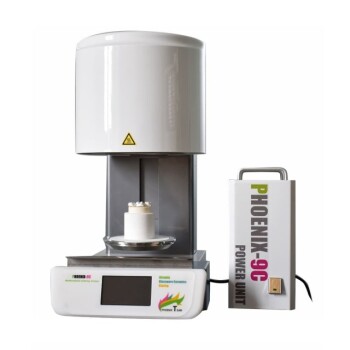
The primary function of an industrial atmosphere sintering furnace is to transform a fragile, debound powder structure into a solid, dense stainless steel component. By employing a controlled high-temperature environment under inert gases—typically argon or argon-hydrogen mixtures—the furnace facilitates atomic diffusion. This process eliminates internal voids and bonds powder particles together to achieve the necessary mechanical properties and dimensional accuracy.
Sintering is the defining moment where a printed geometry becomes a functional material; without precise atmospheric and thermal control, the component remains porous and mechanically useless.
The Mechanics of Densification
Facilitating Atomic Diffusion
The core mechanism at work within the furnace is atomic diffusion. High thermal energy causes atoms to migrate across the boundaries of debound powder particles.
Formation of Sintering Necks
As atoms diffuse, they form bridges between particles known as sintering necks. This bonding process creates the initial structural integrity of the component.
Eliminating Voids
Continued exposure to heat expands these necks, gradually filling the empty spaces between particles. This elimination of voids is critical for achieving high metal densification and removing porosity.
The Role of Atmosphere Control
Protection via Inert Gases
Stainless steel is highly reactive at sintering temperatures. The furnace utilizes inert atmospheres, specifically argon or argon-hydrogen mixtures, to envelope the part.
Preserving Chemical Purity
This controlled atmosphere prevents oxidation and other chemical reactions that would degrade the steel. It ensures the material retains the specific chemical composition required for its target mechanical properties.
Critical Challenges and Trade-offs
Managing Dimensional Shrinkage
The densification process inherently involves a reduction in volume. As voids are eliminated, the part shrinks; precise temperature control is required to ensure this shrinkage results in the correct final dimensions rather than warping.
Temperature Sensitivity
Achieving full density requires a specific thermal window. If the temperature is too low, sintering is incomplete, leaving weak points; if too high, the material may distort or lose its intended microstructure.
Making the Right Choice for Your Goal
To maximize the performance of additive manufactured stainless steel, focus on the specific parameters of your sintering cycle.
- If your primary focus is Mechanical Strength: Prioritize longer hold times at peak temperature to ensure maximum atomic diffusion and complete void elimination.
- If your primary focus is Dimensional Accuracy: strictly calibrate the thermal ramp-up and cool-down rates to manage shrinkage stress and prevent distortion.
The success of your additive manufacturing project relies on the furnace's ability to deliver consistent, contamination-free densification.
Summary Table:
| Feature | Function in Sintering | Benefit |
|---|---|---|
| Atomic Diffusion | Facilitates atom migration between particles | High-strength bonding & structural integrity |
| Atmosphere Control | Uses Argon or Argon-Hydrogen mixtures | Prevents oxidation and maintains chemical purity |
| Void Elimination | Closes internal pores during heating | Maximizes metal densification and durability |
| Thermal Precision | Regulates ramp rates and hold times | Ensures dimensional accuracy and manages shrinkage |
Elevate Your Additive Manufacturing with KINTEK Precision
Don't let porosity compromise your engineering goals. KINTEK specializes in advanced thermal solutions, offering high-performance atmosphere furnaces, vacuum systems, and CVD equipment designed to deliver perfect densification for stainless steel components.
Whether you are refining mechanical properties or ensuring strict dimensional tolerances, our laboratory and industrial-grade equipment provides the contamination-free environment your materials require. From crushing and milling for powder preparation to high-pressure reactors and dental furnaces, we support your entire research and production workflow.
Ready to achieve superior material density? Contact KINTEK today to discuss your sintering needs!
References
- Guillermo Guerrero‐Vaca, M.J. Martín. Performance and Durability of Non-Stick Coatings Applied to Stainless Steel: Subtractive vs. Additive Manufacturing. DOI: 10.3390/ma16175851
This article is also based on technical information from Kintek Solution Knowledge Base .
Related Products
- Mesh belt controlled atmosphere furnace
- Controlled Nitrogen Inert Hydrogen Atmosphere Furnace
- Vacuum Heat Treat and Sintering Furnace with 9MPa Air Pressure
- 1200℃ Controlled Atmosphere Furnace Nitrogen Inert Atmosphere Furnace
- Spark Plasma Sintering Furnace SPS Furnace
People Also Ask
- What are some of the reasons why a controlled atmosphere furnace is desirable in sintering? Achieve Superior Sintering Results
- What role does a controlled atmosphere furnace with argon gas flow play in the production of reduced graphene oxide (rGO)?
- Why is a furnace equipped with a controlled atmosphere necessary for the preparation of active metal catalysts?
- What is the process of a mesh belt furnace? Achieve Consistent, High-Volume Heat Treatment
- How does a mesh belt furnace work? Achieve High-Volume, Repeatable Heat Treatment