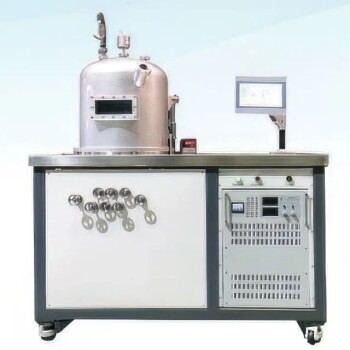
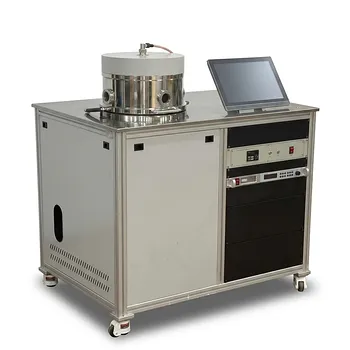
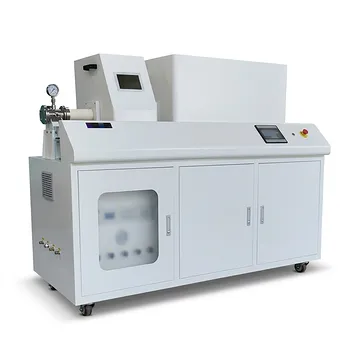
The primary function of Chemical Vapor Deposition (CVD) equipment is to orchestrate the precise chemical reaction of gaseous precursors to grow thin films on a substrate. By rigorously controlling reaction rates, flow dynamics, and chamber pressure, this equipment dictates the film's final composition and doping levels—factors that are critical for the performance of Transparent Conductive Oxide (TCO) films.
CVD equipment acts as the central control unit for film synthesis, ensuring that volatile gases are transformed into solid, high-quality films with specific electrical and optical properties. Its ability to fine-tune doping and microstructure ensures the uniformity and repeatability required for large-scale industrial production.
The Mechanics of Control
Precision Regulation of Reaction Rates
The core task of CVD hardware is to manage the environment where chemical reactions occur. By stabilizing the temperature and pressure, the equipment controls how fast gaseous precursors react.
This control prevents uncontrolled precipitation, ensuring that the film grows layer by layer rather than as a disorganized cluster of particles.
Accurate Doping and Composition
For TCO films, conductivity and transparency are determined by the specific mixture of elements (stoichiometry) and the introduction of impurities (doping).
CVD equipment allows for the exact metering of these elements during the growth phase. This ensures the doping levels are consistent throughout the thickness of the film, rather than just on the surface.
Flow Rate and Transport Management
The equipment utilizes carrier gases, such as nitrogen or argon, to transport volatile precursors to the substrate.
By precisely adjusting the flow rates of these carriers, the system controls the concentration distribution of reactants. This guarantees that fresh reactants are constantly available at the substrate surface for uniform growth.
Impact on Film Quality and Scale
Microstructural Integrity
High-quality TCOs require a sound microstructure with minimal defects to ensure electrons flow freely and light passes through without scattering.
CVD systems create a controlled environment—often under vacuum—that promotes dense grain arrangement. This results in films that are microstructurally sound and mechanically robust.
Uniformity and Repeatability
In industrial applications, a film must be identical from the center of the substrate to the edge, and from batch to batch.
The primary value of advanced CVD equipment is its ability to deliver this exceptional repeatability. It ensures that large-scale production yields consistent films suitable for commercial electronics.
Understanding the Trade-offs
Sensitivity to Process Variables
Because CVD relies on gas-phase reactions, the process is highly sensitive to fluctuations in pressure and flow.
A minor deviation in the carrier gas flow or chamber pressure can alter the local concentration of precursors. This can lead to uneven doping or thickness variations across the substrate.
Complexity of Parameter Management
Achieving the "precise control" mentioned requires balancing multiple variables simultaneously, including temperature, pressure, and gas ratios.
Operators must carefully calibrate these parameters. If the thermal environment is not uniform, heterogeneous reactions may occur at different rates across the workpiece, compromising coating uniformity.
Making the Right Choice for Your Goal
To maximize the effectiveness of CVD equipment for TCO preparation, align your equipment settings with your specific objectives:
- If your primary focus is Optoelectronic Performance: Prioritize systems with high-precision pressure and flow controllers to manage atomic-level doping and minimize defect density.
- If your primary focus is Industrial Scalability: Focus on equipment designed for exceptional repeatability and uniform gas distribution to ensure consistency across large batches.
The ultimate value of CVD equipment lies not just in depositing material, but in its ability to architect the material's internal structure through precise environmental control.
Summary Table:
| Feature | Function in TCO Film Growth | Impact on Film Performance |
|---|---|---|
| Precursor Regulation | Precise metering of gaseous elements | Determines stoichiometry and doping levels |
| Flow Dynamics | Managed transport via carrier gases | Ensures uniform film thickness across substrate |
| Reaction Environment | Stabilized temperature & pressure | Promotes dense microstructure and transparency |
| Process Repeatability | Consistent chamber conditions | Guarantees batch-to-batch industrial quality |
Elevate Your Thin Film Research with KINTEK
Precision is the heartbeat of high-performance TCO film synthesis. KINTEK specializes in advanced laboratory equipment, offering high-precision CVD and PECVD systems designed to deliver the exact environmental control your research demands. Whether you are optimizing optoelectronic performance or scaling for industrial production, our comprehensive range—including high-temperature furnaces, vacuum systems, and crushing & milling tools—ensures your materials achieve microstructural integrity every time.
Ready to achieve superior uniformity and repeatability? Contact KINTEK today to find the perfect CVD solution for your laboratory.
References
- Wen He, Haowei Huang. Advancements in Transparent Conductive Oxides for Photoelectrochemical Applications. DOI: 10.3390/nano14070591
This article is also based on technical information from Kintek Solution Knowledge Base .
Related Products
- Chemical Vapor Deposition CVD Equipment System Chamber Slide PECVD Tube Furnace with Liquid Gasifier PECVD Machine
- Customer Made Versatile CVD Tube Furnace Chemical Vapor Deposition Chamber System Equipment
- HFCVD Machine System Equipment for Drawing Die Nano-Diamond Coating
- Custom CVD Diamond Coating for Lab Applications
- Laboratory CVD Boron Doped Diamond Materials
People Also Ask
- What are the advantages of chemical vapor deposition? Achieve Superior Thin Films for Your Lab
- What types of substrates are used in CVD to facilitate graphene films? Optimize Graphene Growth with the Right Catalyst
- What is the chemical vapor deposition growth process? Build Superior Thin Films from the Atom Up
- How expensive is chemical vapor deposition? Understanding the True Cost of High-Performance Coating
- Why is Chemical Vapor Deposition (CVD) equipment uniquely suited for constructing hierarchical superhydrophobic structures?