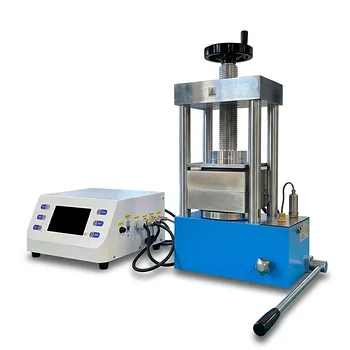
The primary purpose of a uniaxial hydraulic press in this context is to mechanically transform loose sulfide solid electrolyte powders into dense, coherent pellets. By applying substantial pressure—typically ranging from 300 to 400 MPa—the press eliminates inter-particle voids and ensures intimate contact between grains, allowing for the accurate measurement of the material's ionic conductivity.
Core Takeaway Reliable conductivity data depends entirely on the physical continuity of the sample. The hydraulic press acts as a critical preparation tool to minimize grain boundary resistance, ensuring that test results reflect the intrinsic properties of the material rather than the artifacts of a loosely packed powder.
The Mechanics of Densification
Eliminating Microscopic Voids
Loose electrolyte powders contain significant amounts of air and empty space between particles. These voids act as insulators, blocking the path of ions.
A uniaxial press applies high force to mechanically collapse these voids. This process forces the powder particles closer together, creating a solid geometric form suitable for testing.
Reducing Grain Boundary Resistance
The interface where two particles meet is known as a grain boundary. If this contact is poor, it creates high resistance to ionic flow.
By compressing the material, the press maximizes the contact area between particles. This tight physical contact is the basis for reducing inter-particle resistance, allowing ions to move freely through the bulk material.
Leveraging Material Ductility
Unlike ceramic oxides which often require high-heat sintering to bond, many sulfide electrolytes are amorphous and somewhat ductile.
The cold-pressing process leverages this ductility. Under high pressure (e.g., 360 MPa), the particles deform and fuse together, reducing pores without the need for thermal processing that might degrade the material.
Ensuring Data Integrity
Validating Intrinsic Properties
The ultimate goal of testing is to determine how well the chemical structure of the sulfide conducts ions.
If the sample is not sufficiently dense, the measuring equipment (typically using Electrochemical Impedance Spectroscopy, or EIS) will measure the resistance of the gaps, not the material. High-pressure densification ensures the data reflects the intrinsic transport properties of the sulfide.
Establishing Electrode Contact
Accurate testing requires a seamless interface between the electrolyte pellet and the blocking electrodes used in the test cell.
The pressing process creates a uniform, flat surface. This ensures intimate contact with the electrodes, preventing contact resistance from skewing the impedance data.
Understanding the Trade-offs
Uniaxial vs. Isostatic Pressure
While a uniaxial hydraulic press is the standard tool for laboratory sample preparation, it applies pressure from only one vertical direction.
This can lead to density gradients, where the pellet is denser at the surfaces than in the center. In contrast, a Cold Isostatic Press (CIP) applies uniform pressure from all directions, which is more effective at eliminating internal defects and further lowering transport resistance.
The Risk of Inconsistency
If the pressure applied is too low (e.g., significantly below 300 MPa), the pellet may retain too much porosity.
This results in "noisy" data and lower apparent conductivity. Conversely, excessive pressure beyond the material's tolerance could potentially damage the pressing mold or induce stress fractures in the pellet.
Making the Right Choice for Your Goal
To obtain valid conductivity data for sulfide electrolytes, you must match your pressing technique to your testing objectives:
- If your primary focus is routine material screening: Use a standard uniaxial hydraulic press at pressures around 300–400 MPa to quickly generate reproducible pellets for impedance testing.
- If your primary focus is maximizing cell performance: Consider following the uniaxial press with Cold Isostatic Pressing (CIP) to achieve uniform density and minimize internal resistance.
Ultimately, the hydraulic press transforms a non-conductive pile of powder into a functional solid electrolyte, making it the gatekeeper of accurate electrochemical analysis.
Summary Table:
| Feature | Impact on Conductivity Testing |
|---|---|
| Pressure Range | 300–400 MPa typically required for densification |
| Void Elimination | Removes insulating air gaps between powder particles |
| Resistance Reduction | Minimizes grain boundary resistance for better ion flow |
| Pellet Integrity | Creates flat, uniform surfaces for electrode contact |
| Material Ductility | Enables cold-pressing fusion without thermal degradation |
Elevate Your Battery Research Precision with KINTEK
Don't let sample preparation artifacts compromise your electrochemical data. KINTEK provides high-precision laboratory equipment designed to meet the rigorous demands of solid-state battery research.
Our extensive portfolio includes:
- Hydraulic Presses: Advanced uniaxial pellet, hot, and isostatic (CIP) systems for perfect densification.
- Battery Research Tools: Specialized tools and consumables tailored for sulfide and oxide electrolyte studies.
- High-Temperature Solutions: Muffle, vacuum, and atmosphere furnaces for advanced material synthesis.
Whether you are performing routine screening or maximizing cell performance, KINTEK’s solutions ensure your results reflect the intrinsic properties of your materials. Contact us today to find the perfect press for your lab!
Related Products
- Laboratory Hydraulic Press Split Electric Lab Pellet Press
- Automatic Laboratory Hydraulic Press for XRF & KBR Pellet Press
- Laboratory Hydraulic Pellet Press for XRF KBR FTIR Lab Applications
- 24T 30T 60T Heated Hydraulic Press Machine with Heated Plates for Laboratory Hot Press
- Laboratory Manual Hydraulic Pellet Press for Lab Use
People Also Ask
- What role does a laboratory hydraulic press play in platinum recovery research? Enhancing Sample Precision
- What are the specific applications of a lab hydraulic press in biochar evaluation? Optimize density and data accuracy.
- What are the roles of a laboratory hydraulic press and stainless steel molds in the preparation of graphite samples?
- What is the role of a laboratory hydraulic press in electrode prep? Maximize Energy Density & Sealing Precision
- Why must a laboratory hydraulic press equipped with cylindrical molds be used when preparing BZY green bodies? High Density