Knowledge What is the principle of PVD? A Guide to Atomic-Level Surface Engineering
Author avatar

Tech Team · Kintek Solution

Updated 6 days ago

What is the principle of PVD? A Guide to Atomic-Level Surface Engineering


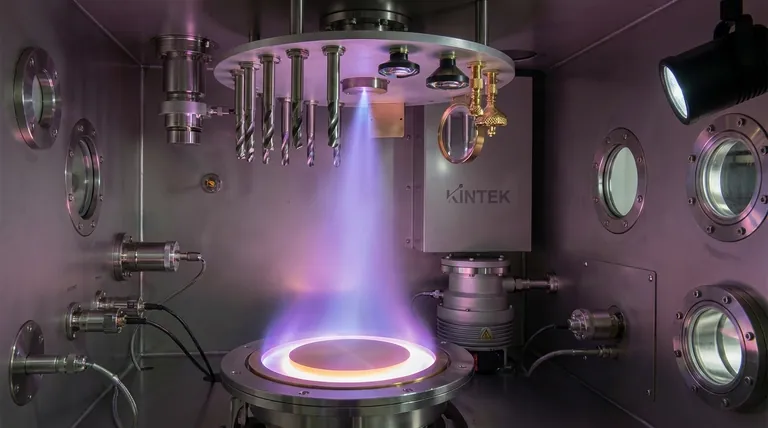
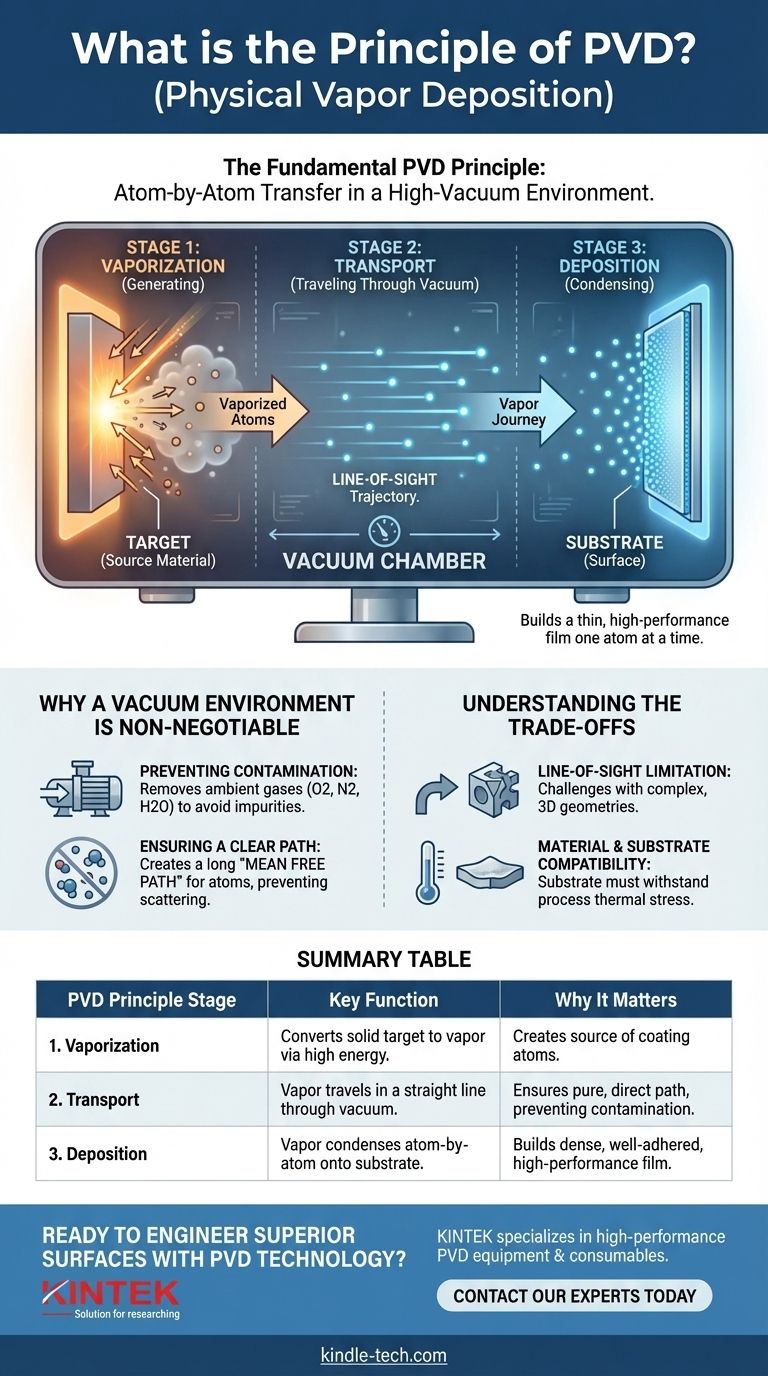
The fundamental principle of PVD is the physical transfer of material on an atom-by-atom basis. In a high-vacuum environment, a solid source material, known as the "target," is converted into a vapor. This vapor then travels through the vacuum and condenses onto a substrate, meticulously building a thin, high-performance film.

At its core, Physical Vapor Deposition (PVD) is a three-stage process—vaporization, transport, and deposition. It physically moves atoms from a source to a surface within a vacuum, completely avoiding chemical reactions to create exceptionally pure and dense coatings.
What is the principle of PVD? A Guide to Atomic-Level Surface Engineering

The Three Foundational Stages of PVD

To truly understand the principle, it's best to break the process down into its three distinct and sequential stages. Each stage is critical for the final quality of the coating.

Stage 1: Vaporization (Generating the Coating Material)

The process begins by converting a solid source material into a gaseous vapor. This is achieved by supplying a significant amount of energy to the target.

The specific method of vaporization is the primary way different PVD techniques are categorized. Common methods include simple heating, bombarding the target with high-energy ions (sputtering), or using a high-power electron beam or laser.

Stage 2: Transport (Traveling Through the Vacuum)

Once the atoms are vaporized, they travel through the vacuum chamber from the source to the substrate. This journey is a crucial, defining feature of the PVD process.

The high vacuum ensures there are virtually no air or gas molecules for the vaporized atoms to collide with. This allows them to travel in a straight, unimpeded path, often described as a "line-of-sight" trajectory.

Stage 3: Deposition (Condensing onto the Substrate)

When the vaporized atoms reach the cooler surface of the substrate, they condense back into a solid state. This condensation builds the coating one atom at a time.

The result is an extremely thin, well-adhered, and often very dense film. The properties of this film—such as hardness, friction, and oxidation resistance—can be precisely controlled.

Why a Vacuum Environment is Non-Negotiable

The entire PVD process is dependent on the carefully controlled, low-pressure vacuum chamber. This environment is not optional; it is fundamental to the principle.

Preventing Contamination

A primary function of the vacuum is to remove ambient gases like oxygen, nitrogen, and water vapor. If these particles were present, they would react with the vaporized material and become embedded in the film, creating impurities and compromising its performance.

Ensuring a Clear Path

The vacuum creates a long "mean free path" for the coating atoms. This means they can travel from the target to the substrate without colliding with other gas molecules, which would otherwise scatter them and prevent uniform, direct deposition.

Understanding the Trade-offs

While powerful, the principles of PVD introduce specific limitations that are important to understand.

The Line-of-Sight Limitation

Because the vapor travels in a straight line, PVD is best suited for coating flat or smoothly curved surfaces. Coating complex, three-dimensional geometries with sharp corners or deep recesses can be challenging and often requires sophisticated rotating fixtures to expose all surfaces to the vapor source.

Material and Substrate Compatibility

The energy required for vaporization and the conditions within the chamber can place thermal stress on the substrate. Therefore, the substrate material must be able to withstand the process temperatures without deforming or degrading.

Making the Right Choice for Your Goal

Understanding the core principle of PVD helps you determine where its unique capabilities can be best applied.

  • If your primary focus is creating highly pure, dense films: PVD is the standard for applications like semiconductors, optical lenses, and medical implants where material purity is paramount.
  • If your primary focus is enhancing surface properties: Use PVD for adding extreme hardness, wear resistance, and lubricity to cutting tools, engine components, and industrial molds.
  • If your primary focus is a durable, decorative finish: The process provides precise control over color and reflectivity, making it ideal for high-end watches, faucets, and architectural hardware.

Ultimately, the principle of PVD provides a mechanism for engineering surfaces at the atomic level, delivering performance unattainable by conventional methods.

Summary Table:

PVD Principle Stage Key Function Why It Matters
1. Vaporization Converts solid target material into a vapor using high energy. Creates the source of coating atoms.
2. Transport Vapor travels in a straight line through a high vacuum. Ensures a pure, direct path for the atoms, preventing contamination.
3. Deposition Vapor condenses atom-by-atom onto the substrate surface. Builds a dense, well-adhered, and high-performance thin film.

Ready to engineer superior surfaces with PVD technology?

KINTEK specializes in high-performance PVD equipment and consumables for laboratories and industrial applications. Whether you are developing semiconductors, enhancing tool durability, or creating precise decorative finishes, our solutions deliver the purity and control your projects demand.

Contact our experts today to discuss how our PVD systems can help you achieve unparalleled coating quality and performance.

Visual Guide
What is the principle of PVD? A Guide to Atomic-Level Surface Engineering Visual Guide

Related Products

People Also Ask

Related Products

Inclined Rotary Plasma Enhanced Chemical Vapor Deposition PECVD Equipment Tube Furnace Machine

Inclined Rotary Plasma Enhanced Chemical Vapor Deposition PECVD Equipment Tube Furnace Machine

Upgrade your coating process with PECVD coating equipment. Ideal for LED, power semiconductors, MEMS and more. Deposits high-quality solid films at low temps.

HFCVD Machine System Equipment for Drawing Die Nano-Diamond Coating

HFCVD Machine System Equipment for Drawing Die Nano-Diamond Coating

The nano-diamond composite coating drawing die uses cemented carbide (WC-Co) as the substrate, and uses the chemical vapor phase method ( CVD method for short ) to coat the conventional diamond and nano-diamond composite coating on the surface of the inner hole of the mold.

Vacuum Hot Press Furnace Machine for Lamination and Heating

Vacuum Hot Press Furnace Machine for Lamination and Heating

Experience clean and precise lamination with Vacuum Lamination Press. Perfect for wafer bonding, thin-film transformations, and LCP lamination. Order now!

915MHz MPCVD Diamond Machine Microwave Plasma Chemical Vapor Deposition System Reactor

915MHz MPCVD Diamond Machine Microwave Plasma Chemical Vapor Deposition System Reactor

915MHz MPCVD Diamond Machine and its multi-crystal effective growth, the maximum area can reach 8 inches, the maximum effective growth area of single crystal can reach 5 inches. This equipment is mainly used for the production of large-size polycrystalline diamond films, the growth of long single crystal diamonds, the low-temperature growth of high-quality graphene, and other materials that require energy provided by microwave plasma for growth.

Laboratory Sterilizer Lab Autoclave Pulse Vacuum Lifting Sterilizer

Laboratory Sterilizer Lab Autoclave Pulse Vacuum Lifting Sterilizer

The pulse vacuum lifting sterilizer is a state-of-the-art equipment for efficient and precise sterilization. It uses pulsating vacuum technology, customizable cycles, and a user-friendly design for easy operation and safety.

Laboratory Sterilizer Lab Autoclave Vertical Pressure Steam Sterilizer for Liquid Crystal Display Automatic Type

Laboratory Sterilizer Lab Autoclave Vertical Pressure Steam Sterilizer for Liquid Crystal Display Automatic Type

Liquid crystal display automatic vertical sterilizer is a safe, reliable and automatic control sterilization equipment, which is composed of heating system, microcomputer control system and overheating and overvoltage protection system.

Benchtop Laboratory Vacuum Freeze Dryer

Benchtop Laboratory Vacuum Freeze Dryer

Benchtop laboratory freeze dryer for efficient lyophilization of biological, pharmaceutical, and food samples. Features intuitive touchscreen, high-performance refrigeration, and durable design. Preserve sample integrity—consult now!

Anti-Cracking Press Mold for Lab Use

Anti-Cracking Press Mold for Lab Use

The anti-cracking press mold is a specialized equipment designed for molding various shapes and sizes of film using high pressure and electric heating.

Laboratory Test Sieves and Sieving Machines

Laboratory Test Sieves and Sieving Machines

Precision lab test sieves & sieving machines for accurate particle analysis. Stainless steel, ISO-compliant, 20μm-125mm range. Request specs now!

Benchtop Laboratory Freeze Dryer for Lab Use

Benchtop Laboratory Freeze Dryer for Lab Use

Premium benchtop laboratory freeze dryer for lyophilization, preserving samples with ≤ -60°C cooling. Ideal for pharmaceuticals & research.

Small Vacuum Heat Treat and Tungsten Wire Sintering Furnace

Small Vacuum Heat Treat and Tungsten Wire Sintering Furnace

The small vacuum tungsten wire sintering furnace is a compact experimental vacuum furnace specially designed for universities and scientific research institutes. The furnace features a CNC welded shell and vacuum piping to ensure leak-free operation. Quick-connect electrical connections facilitate relocation and debugging, and the standard electrical control cabinet is safe and convenient to operate.

Molybdenum Vacuum Heat Treat Furnace

Molybdenum Vacuum Heat Treat Furnace

Discover the benefits of a high-configuration molybdenum vacuum furnace with heat shield insulation. Ideal for high-purity, vacuum environments like sapphire crystal growth and heat treatment.

Vacuum Heat Treat Furnace with Ceramic Fiber Liner

Vacuum Heat Treat Furnace with Ceramic Fiber Liner

Vacuum furnace with polycrystalline ceramic fiber insulation liner for excellent heat insulation and uniform temperature field. Choose from 1200℃ or 1700℃ max. working temperature with high vacuum performance and precise temperature control.

Variable Speed Peristaltic Pump

Variable Speed Peristaltic Pump

KT-VSP Series Smart Variable Speed Peristaltic Pumps offer precise flow control for labs, medical, and industrial applications. Reliable, contamination-free liquid transfer.

Vacuum Dental Porcelain Sintering Furnace

Vacuum Dental Porcelain Sintering Furnace

Get precise and reliable results with KinTek's Vacuum Porcelain Furnace. Suitable for all porcelain powders, it features hyperbolic ceramic furnace function, voice prompt, and automatic temperature calibration.

Graphite Vacuum Continuous Graphitization Furnace

Graphite Vacuum Continuous Graphitization Furnace

High-temperature graphitization furnace is a professional equipment for graphitization treatment of carbon materials. It is a key equipment for the production of high-quality graphite products. It has high temperature, high efficiency and uniform heating. It is suitable for various high-temperature treatments and graphitization treatments. It is widely used in metallurgy, electronics, aerospace, etc. industry.

Ultra-High Temperature Graphite Vacuum Graphitization Furnace

Ultra-High Temperature Graphite Vacuum Graphitization Furnace

The ultra-high temperature graphitization furnace utilizes medium frequency induction heating in a vacuum or inert gas environment. The induction coil generates an alternating magnetic field, inducing eddy currents in the graphite crucible, which heats up and radiates heat to the workpiece, bringing it to the desired temperature. This furnace is primarily used for graphitization and sintering of carbon materials, carbon fiber materials, and other composite materials.

Graphite Vacuum Furnace IGBT Experimental Graphitization Furnace

Graphite Vacuum Furnace IGBT Experimental Graphitization Furnace

IGBT experimental graphitization furnace, a tailored solution for universities and research institutions, with high heating efficiency, user-friendliness, and precise temperature control.

Graphite Vacuum Furnace High Thermal Conductivity Film Graphitization Furnace

Graphite Vacuum Furnace High Thermal Conductivity Film Graphitization Furnace

The high thermal conductivity film graphitization furnace has uniform temperature, low energy consumption and can operate continuously.

Vacuum Heat Treat and Molybdenum Wire Sintering Furnace for Vacuum Sintering

Vacuum Heat Treat and Molybdenum Wire Sintering Furnace for Vacuum Sintering

A vacuum molybdenum wire sintering furnace is a vertical or bedroom structure, which is suitable for withdrawal, brazing, sintering and degassing of metal materials under high vacuum and high temperature conditions. It is also suitable for dehydroxylation treatment of quartz materials.


Leave Your Message