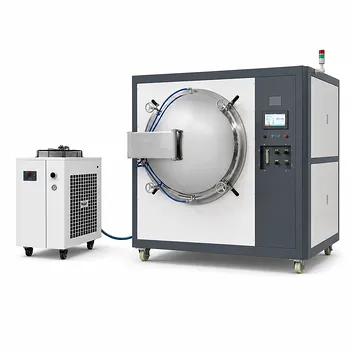
Precise atmosphere control is the defining factor in achieving high-density sintered materials. Introducing specific gases into the vacuum chamber transforms the environment from a passive void into an active processing tool. Hydrogen serves as a chemical reducing agent to clean metal surfaces, while argon acts as a thermal and protective buffer.
Core Takeaway While the vacuum environment provides the baseline for low-pressure processing, the addition of gas is proactive. Hydrogen is used to chemically strip oxide layers to ensure stronger particle bonding, whereas argon is used to maintain purity and accelerate heat dissipation during the cooling phase.
The Role of Controlled Atmospheres
To understand why these gases are introduced, you must look beyond the mechanics of the furnace and look at the chemistry of the metal powder.
Hydrogen: The Chemical Cleaning Agent
In a vacuum hot pressing furnace, the primary obstacle to achieving high mechanical strength is often the presence of oxide layers on the metal powder particles.
Hydrogen acts as a reducing agent. When introduced at high temperatures, it actively reacts with oxygen atoms found on the surface of the metal.
This reaction effectively "scrubs" the surface clean, removing the oxide layer. This is critical because oxide layers act as barriers that prevent metal particles from fusing together. By removing them, hydrogen significantly improves the interface bonding quality between particles, leading to a denser, stronger final product.
Argon: The Protective Shield
Argon plays a fundamentally different role. Being an inert gas, it does not react chemically with the workload.
Its primary function during the heating and sintering phases is protection. It creates a barrier that prevents contamination from impurities that might remain in the chamber or outgas from furnace components.
Managing Thermal Dynamics
The introduction of gas also changes the thermal properties of the furnace environment.
In a pure vacuum, heat transfer is limited to radiation and conduction. By introducing a gas like argon, you introduce convection into the equation.
This is particularly vital during the cooling phase. Argon assists in heat dissipation, allowing for a controlled and faster reduction in temperature compared to cooling in a static vacuum.
Operational Considerations and Trade-offs
While introducing gas offers clear benefits, it introduces variables that must be strictly controlled.
Pressure Sensitivity
The process requires precise pressure management, typically in the range of 0.05 to 0.06 MPa.
If the pressure is too low, the effectiveness of the reduction (hydrogen) or heat transfer (argon) may be negligible. If it is too high, it may alter the mechanical pressure dynamics required for densification.
Safety and Material Compatibility
Hydrogen presents a safety challenge due to its flammability. It requires robust safety interlocks and is generally only used when surface oxidation is a known issue.
Argon, while safer, is an additional cost. It is the preferred choice when the priority is maintaining extreme purity without altering the chemical composition of the metal.
Making the Right Choice for Your Process
The decision to introduce hydrogen, argon, or a mixture depends entirely on the specific hurdles preventing your material from reaching full density.
- If your primary focus is Interface Bonding: Use hydrogen to reduce surface oxides and allow metal particles to fuse directly, thereby increasing mechanical strength.
- If your primary focus is Purity and Speed: Use argon to shield reactive materials from contamination and to accelerate the cooling cycle for higher throughput.
Select the atmosphere that actively solves your material's specific limitations.
Summary Table:
| Gas Type | Primary Function | Key Benefit | Phase Used |
|---|---|---|---|
| Hydrogen (H2) | Reducing Agent | Removes surface oxides for stronger particle bonding | Sintering |
| Argon (Ar) | Inert Shield / Coolant | Prevents contamination and accelerates heat dissipation | Sintering & Cooling |
| Vacuum | Baseline Environment | Enables low-pressure processing and outgassing | All Phases |
Optimize Your Material Density with KINTEK Expertise
Achieving the perfect sintered structure requires more than just heat—it requires precise atmosphere control. KINTEK specializes in advanced laboratory equipment, including high-performance vacuum hot pressing furnaces, muffle furnaces, and high-temperature high-pressure reactors designed to handle complex gas environments like hydrogen and argon.
Whether you are working on battery research, advanced ceramics, or metallurgy, our comprehensive range of crushing systems, hydraulic presses, and cooling solutions ensures your lab achieves maximum efficiency and superior material properties.
Ready to elevate your research? Contact our technical specialists today to find the ideal furnace and consumables tailored to your specific application needs.
Related Products
- 600T Vacuum Induction Hot Press Furnace for Heat Treat and Sintering
- Vacuum Hot Press Furnace Heated Vacuum Press Machine Tube Furnace
- Vacuum Hot Press Furnace Machine for Lamination and Heating
- Vacuum Hot Press Furnace Machine Heated Vacuum Press
- Vacuum Heat Treat and Pressure Sintering Furnace for High Temperature Applications
People Also Ask
- What role does an induction vacuum hot pressing furnace play in sintering? Achieve 98% Density in Carbide Blocks
- What advantages does a vacuum hot press furnace provide for LSLBO ceramic electrolytes? Achieve 94% Relative Density
- What role does a Vacuum Hot Press (VHP) furnace play in the densification of austenitic stainless steel 316 composites?
- What are the advantages of a vacuum hot press furnace for W-50%Cu? Achieve 99.6% Density at Lower Temperatures
- What role does mechanical pressure play during the vacuum diffusion bonding of tungsten and copper? Keys to Solid Bonding