Knowledge engineering ceramics What is the purpose of firing or sintering? To Transform Weak Powder into Strong, Dense Ceramics
Author avatar

Tech Team · Kintek Solution

Updated 2 months ago

What is the purpose of firing or sintering? To Transform Weak Powder into Strong, Dense Ceramics


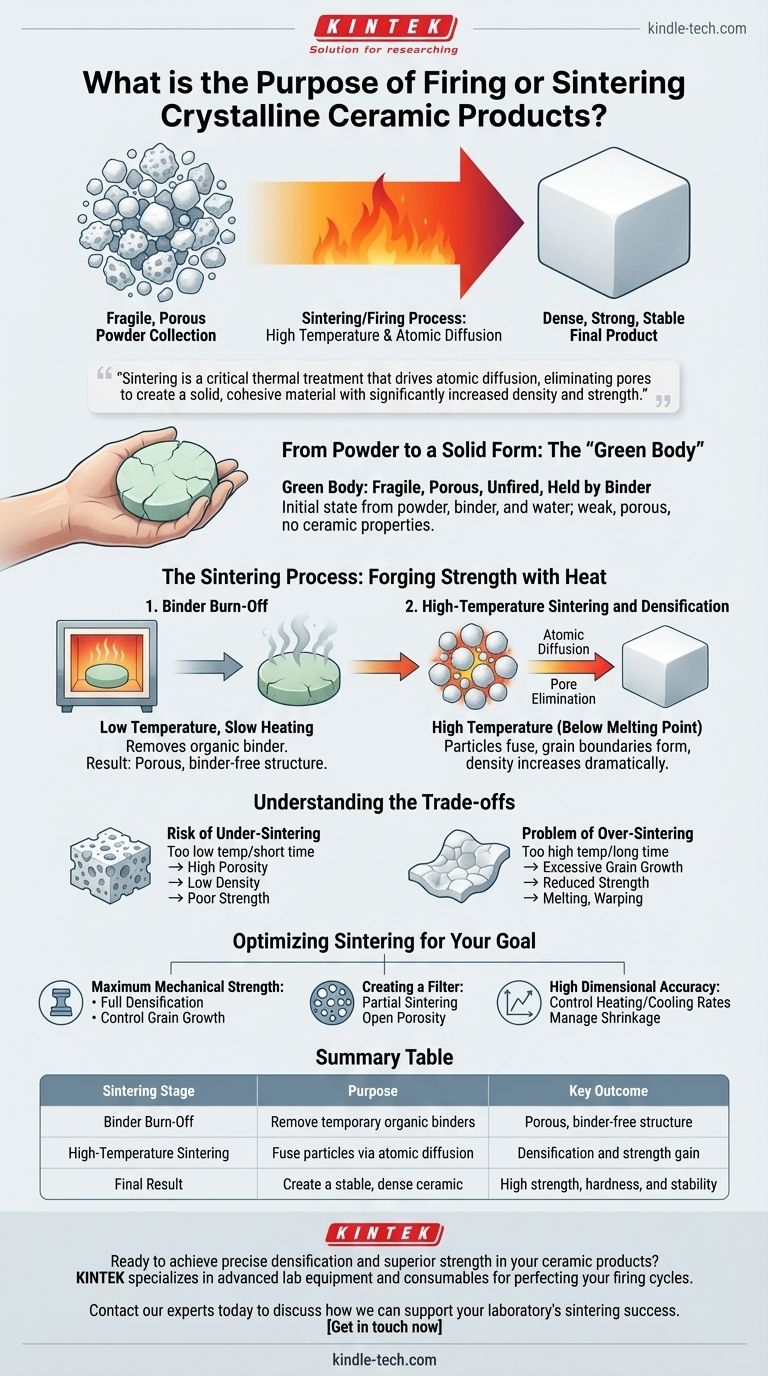
In short, the purpose of firing, or sintering, is to transform a fragile, porous collection of ceramic particles into a dense, strong, and stable final product. This high-temperature process fuses the individual particles together, fundamentally creating the desired mechanical and physical properties of the finished ceramic.

Sintering is not merely a drying or hardening step; it is a critical thermal treatment that drives atomic diffusion between particles. This process eliminates the empty spaces (pores) between them, creating a solid, cohesive material with significantly increased density and strength.
What is the purpose of firing or sintering? To Transform Weak Powder into Strong, Dense Ceramics

From Powder to a Solid Form: The "Green Body"

To understand why sintering is essential, you must first understand the state of the ceramic material right before it enters the kiln.

What is a "Green Body"?

A ceramic product begins as a carefully mixed powder. This powder is often combined with water and a temporary binder to form a slurry, which is then dried and pressed into the desired shape. This initial, unfired object is known as a "green body."

The Fragility of the Initial State

The green body is extremely fragile. Its particles are only held together mechanically and by the weak adhesive forces of the binder. It is highly porous and possesses none of the strength, hardness, or durability we associate with ceramics.

The Sintering Process: Forging Strength with Heat

The firing process occurs in distinct stages, each with a specific purpose in transforming the weak green body into a robust final part.

Step 1: Binder Burn-Off

The first phase of heating occurs at a relatively low temperature. The primary goal here is to carefully burn off the organic binder that was used to hold the green body together. This must be done slowly to avoid cracking the part as the binder gases escape. After this stage, the object consists of only ceramic particles, but it is still porous and weak.

Step 2: High-Temperature Sintering and Densification

This is the core of the sintering process. The temperature is raised to a point just below the ceramic's melting point. At this high temperature, the atoms at the contact points between individual ceramic particles become highly mobile.

This atomic diffusion causes the particles to fuse together, forming strong bonds and creating continuous "grain boundaries." As the particles merge, the pores between them shrink and are eventually eliminated, dramatically increasing the material's density.

The Result: A Strong, Dense Ceramic

The end result of successful sintering is a process called densification. The elimination of porosity and the formation of a tightly bonded crystalline structure are directly responsible for the final product's key properties: high mechanical strength, hardness, and chemical stability.

Understanding the Trade-offs

Optimizing the sintering process is critical, as deviations in time or temperature can compromise the final product.

The Risk of Under-Sintering

If the temperature is too low or the time is too short, atomic diffusion will be insufficient. The resulting ceramic will retain high levels of porosity, leading to low density, poor mechanical strength, and unacceptable performance.

The Problem of Over-Sintering

Conversely, if the temperature is too high or held for too long, a phenomenon called grain growth can occur. While the part may be dense, excessively large grains can sometimes reduce the material's strength and fracture toughness. In extreme cases, the part may begin to melt, warp, or lose its dimensional accuracy.

Optimizing Sintering for Your Goal

The ideal sintering parameters depend entirely on the intended application of the ceramic component.

  • If your primary focus is maximum mechanical strength: The goal is to achieve near-full densification while carefully controlling grain growth through precise temperature and time management.
  • If your primary focus is creating a filter: The goal is partial sintering, where you intentionally leave a network of open porosity while still creating strong bonds between particles for structural integrity.
  • If your primary focus is high dimensional accuracy: The key is to precisely control the heating and cooling rates to manage the predictable shrinkage that occurs during densification.

Mastering the sintering process is the key to engineering a ceramic's final properties to meet its specific operational demands.

Summary Table:

Sintering Stage Purpose Key Outcome
Binder Burn-Off Remove temporary organic binders Porous, binder-free structure
High-Temperature Sintering Fuse particles via atomic diffusion Densification and strength gain
Final Result Create a stable, dense ceramic High strength, hardness, and stability

Ready to achieve precise densification and superior strength in your ceramic products?

The sintering process is critical to your final product's performance. KINTEK specializes in the advanced lab equipment and consumables needed to perfect your firing cycles, ensuring optimal density, strength, and dimensional accuracy for your specific application—whether for maximum mechanical strength, filtration, or high precision.

Contact our experts today to discuss how we can support your laboratory's sintering success. Get in touch now

Visual Guide
What is the purpose of firing or sintering? To Transform Weak Powder into Strong, Dense Ceramics Visual Guide

Related Products

People Also Ask

Related Products

Dental Porcelain Zirconia Sintering Ceramic Furnace Chairside with Transformer

Dental Porcelain Zirconia Sintering Ceramic Furnace Chairside with Transformer

Experience top-notch sintering with Chairside Sintering Furnace with Transformer. Easy to operate, noise-free pallet, and automatic temperature calibration. Order now!

Dental Porcelain Zirconia Sintering Ceramic Vacuum Press Furnace

Dental Porcelain Zirconia Sintering Ceramic Vacuum Press Furnace

Get precise dental results with Dental Vacuum Press Furnace. Automatic temperature calibration, low noise tray, and touch screen operation. Order now!

Vacuum Dental Porcelain Sintering Furnace

Vacuum Dental Porcelain Sintering Furnace

Get precise and reliable results with KinTek's Vacuum Porcelain Furnace. Suitable for all porcelain powders, it features hyperbolic ceramic furnace function, voice prompt, and automatic temperature calibration.

Vacuum Heat Treat Furnace with Ceramic Fiber Liner

Vacuum Heat Treat Furnace with Ceramic Fiber Liner

Vacuum furnace with polycrystalline ceramic fiber insulation liner for excellent heat insulation and uniform temperature field. Choose from 1200℃ or 1700℃ max. working temperature with high vacuum performance and precise temperature control.

High Temperature Alumina (Al2O3) Furnace Tube for Engineering Advanced Fine Ceramics

High Temperature Alumina (Al2O3) Furnace Tube for Engineering Advanced Fine Ceramics

High temperature alumina furnace tube combines the advantages of high hardness of alumina, good chemical inertness and steel, and has excellent wear resistance, thermal shock resistance and mechanical shock resistance.

High Temperature Muffle Oven Furnace for Laboratory Debinding and Pre Sintering

High Temperature Muffle Oven Furnace for Laboratory Debinding and Pre Sintering

KT-MD High temperature debinding and pre-sintering furnace for ceramic materials with various molding processes. Ideal for electronic components such as MLCC and NFC.

Spark Plasma Sintering Furnace SPS Furnace

Spark Plasma Sintering Furnace SPS Furnace

Discover the benefits of Spark Plasma Sintering Furnaces for rapid, low-temperature material preparation. Uniform heating, low cost & eco-friendly.

Vacuum Heat Treat and Sintering Furnace with 9MPa Air Pressure

Vacuum Heat Treat and Sintering Furnace with 9MPa Air Pressure

The air pressure sintering furnace is a high-tech equipment commonly used for the sintering of advanced ceramic materials. It combines vacuum sintering and pressure sintering techniques to achieve high-density and high-strength ceramics.

Vacuum Heat Treat and Pressure Sintering Furnace for High Temperature Applications

Vacuum Heat Treat and Pressure Sintering Furnace for High Temperature Applications

Vacuum pressure sintering furnaces are designed for high temperature hot pressing applications in metal and ceramic sintering. Its advanced features ensure precise temperature control, reliable pressure maintenance, and a robust design for seamless operation.

600T Vacuum Induction Hot Press Furnace for Heat Treat and Sintering

600T Vacuum Induction Hot Press Furnace for Heat Treat and Sintering

Discover the 600T Vacuum Induction Hot Press Furnace, designed for high-temperature sintering experiments in vacuum or protected atmospheres. Its precise temperature and pressure control, adjustable working pressure, and advanced safety features make it ideal for nonmetal materials, carbon composites, ceramics, and metal powders.

Vacuum Heat Treat and Molybdenum Wire Sintering Furnace for Vacuum Sintering

Vacuum Heat Treat and Molybdenum Wire Sintering Furnace for Vacuum Sintering

A vacuum molybdenum wire sintering furnace is a vertical or bedroom structure, which is suitable for withdrawal, brazing, sintering and degassing of metal materials under high vacuum and high temperature conditions. It is also suitable for dehydroxylation treatment of quartz materials.

Small Vacuum Heat Treat and Tungsten Wire Sintering Furnace

Small Vacuum Heat Treat and Tungsten Wire Sintering Furnace

The small vacuum tungsten wire sintering furnace is a compact experimental vacuum furnace specially designed for universities and scientific research institutes. The furnace features a CNC welded shell and vacuum piping to ensure leak-free operation. Quick-connect electrical connections facilitate relocation and debugging, and the standard electrical control cabinet is safe and convenient to operate.

Mesh belt controlled atmosphere furnace

Mesh belt controlled atmosphere furnace

Discover our KT-MB mesh belt sintering furnace - perfect for high-temperature sintering of electronic components & glass insulators. Available for open air or controlled atmosphere environments.

Ultra-High Temperature Graphite Vacuum Graphitization Furnace

Ultra-High Temperature Graphite Vacuum Graphitization Furnace

The ultra-high temperature graphitization furnace utilizes medium frequency induction heating in a vacuum or inert gas environment. The induction coil generates an alternating magnetic field, inducing eddy currents in the graphite crucible, which heats up and radiates heat to the workpiece, bringing it to the desired temperature. This furnace is primarily used for graphitization and sintering of carbon materials, carbon fiber materials, and other composite materials.

2200 ℃ Graphite Vacuum Heat Treat Furnace

2200 ℃ Graphite Vacuum Heat Treat Furnace

Discover the power of the KT-VG Graphite Vacuum Furnace - with a maximum working temperature of 2200℃, it's perfect for vacuum sintering of various materials. Learn more now.

2200 ℃ Tungsten Vacuum Heat Treat and Sintering Furnace

2200 ℃ Tungsten Vacuum Heat Treat and Sintering Furnace

Experience the ultimate refractory metal furnace with our Tungsten vacuum furnace. Capable of reaching 2200℃, perfect for sintering advanced ceramics and refractory metals. Order now for high-quality results.

Controlled Nitrogen Inert Hydrogen Atmosphere Furnace

Controlled Nitrogen Inert Hydrogen Atmosphere Furnace

KT-AH Hydrogen atmosphere furnace - induction gas furnace for sintering/annealing with built-in safety features, dual housing design, and energy-saving efficiency. Ideal for lab and industrial use.

Graphite Vacuum Furnace Bottom Discharge Graphitization Furnace for Carbon Materials

Graphite Vacuum Furnace Bottom Discharge Graphitization Furnace for Carbon Materials

Bottom-out graphitization furnace for carbon materials, ultra-high temperature furnace up to 3100°C, suitable for graphitization and sintering of carbon rods and carbon blocks. Vertical design, bottom discharging, convenient feeding and discharging, high temperature uniformity, low energy consumption, good stability, hydraulic lifting system, convenient loading and unloading.

Large Vertical Graphite Vacuum Graphitization Furnace

Large Vertical Graphite Vacuum Graphitization Furnace

A large vertical high-temperature graphitization furnace is a type of industrial furnace used for the graphitization of carbon materials, such as carbon fiber and carbon black. It is a high-temperature furnace that can reach temperatures of up to 3100°C.

Vertical High Temperature Graphite Vacuum Graphitization Furnace

Vertical High Temperature Graphite Vacuum Graphitization Furnace

Vertical high temperature graphitization furnace for carbonization and graphitization of carbon materials up to 3100℃.Suitable for shaped graphitization of carbon fiber filaments and other materials sintered in a carbon environment.Applications in metallurgy, electronics, and aerospace for producing high-quality graphite products like electrodes and crucibles.


Leave Your Message