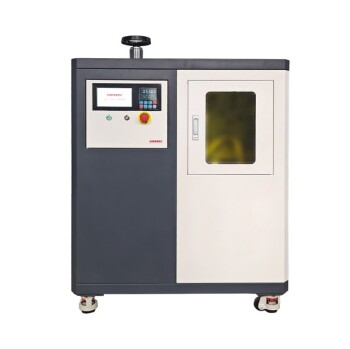
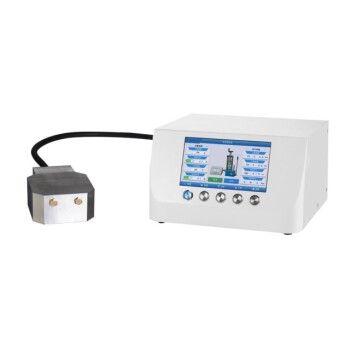
The primary purpose of using a hot press for sulfide solid-state electrolytes is to create a fully dense, transparent reference material that approaches theoretical density.
While cold pressing compresses the material, hot pressing simultaneously applies heat and pressure near the glass transition temperature (approximately 200°C). This process eliminates the porosity inherent in cold-pressed samples, producing a bulk material that serves as a precise benchmark for quality control.
Core Takeaway Hot pressing is essential for establishing a "perfect" control sample by removing internal voids and achieving maximum density. This creates a baseline standard that allows researchers to accurately calculate the relative density and evaluate the quality of standard cold-pressed sulfide electrolytes.
The Physics of Densification
Overcoming the Limits of Cold Pressing
Cold pressing relies solely on mechanical force to compact powder particles.
While effective for general shaping, this method inevitably leaves microscopic gaps or voids between particles. These voids result in lower overall density compared to the material's theoretical maximum.
The Role of the Glass Transition Temperature
Hot pressing introduces thermal energy alongside mechanical force.
By heating the sulfide electrolyte near its glass transition point (approx. 200°C), the material softens slightly. This allows the applied pressure to collapse internal pores more effectively than pressure alone.
achieving Transparency
The result of this simultaneous heat and pressure is a bulk material that is fully dense.
Because the internal porosity is minimized to near-zero, the sample often becomes transparent. This optical clarity is a visual indicator that the material has reached a density approaching its theoretical limit.
establishing a Quality Benchmark
The "Gold Standard" for Measurement
In solid-state battery research, knowing the absolute density of your electrolyte is critical.
However, theoretical calculations can be inexact due to variations in synthesis. A hot-pressed sample provides a physical, experimental standard of what 100% density looks like for that specific batch of material.
Calculating Relative Density
Once a hot-pressed reference is created, researchers can compare their cold-pressed samples against it.
This allows for the precise calculation of relative density. Without the hot-pressed benchmark, it is difficult to quantify exactly how porous or dense a standard production sample actually is.
Understanding the Trade-offs
Process Complexity vs. Throughput
Hot pressing is more time-consuming and energy-intensive than cold pressing.
It requires precise control of temperature and pressure to avoid degrading the material. Consequently, it is often used for creating reference standards or specialized membranes rather than high-volume production.
Material Integrity
While hot pressing maximizes density, it must be performed carefully.
As noted in broader applications, excessive heat or pressure can deform the matrix or alter the material properties. However, when done correctly, densification can significantly improve performance, potentially increasing ionic conductivity by eliminating the resistive voids found in porous samples.
Making the Right Choice for Your Goal
To determine whether you should employ hot pressing or stick to cold pressing, evaluate your immediate objective:
- If your primary focus is fundamental analysis: Use a hot press to create a fully dense, transparent reference sample to determine the theoretical maximum density of your material.
- If your primary focus is routine sample fabrication: Use cold pressing for speed, but validate the quality of these samples by comparing their density against your hot-pressed benchmark.
Ultimately, hot pressing is not just a forming technique; it is a validation tool that reveals the true potential of your sulfide electrolyte material.
Summary Table:
| Feature | Cold Pressing | Hot Pressing |
|---|---|---|
| Mechanism | Mechanical pressure only | Simultaneous heat (~200°C) and pressure |
| Material State | Opaque, porous powder compact | Transparent, fully dense bulk material |
| Primary Goal | Routine sample fabrication | Creating theoretical density benchmarks |
| Porosity | High (microscopic voids) | Near-zero (maximized densification) |
| Performance | Standard ionic conductivity | Enhanced conductivity via void elimination |
Elevate Your Solid-State Battery Research with KINTEK
Precise densification is the key to unlocking the true potential of sulfide electrolytes. KINTEK specializes in high-performance laboratory equipment, offering advanced hot presses, isostatic presses, and pellet presses designed to reach the exact glass transition temperatures required for your materials.
Whether you need robust crushing and milling systems for powder preparation or vacuum furnaces for material synthesis, our comprehensive portfolio supports every stage of your battery research workflow.
Ready to achieve theoretical density in your samples? Contact our technical experts today to find the perfect pressing solution for your lab's needs!
Related Products
- Automatic Heated Hydraulic Press Machine with Heated Plates for Laboratory Hot Press 25T 30T 50T
- Manual High Temperature Heated Hydraulic Press Machine with Heated Plates for Lab
- Touchscreen Automatic Vacuum Heat Press
- 30T 40T Split Automatic Heated Hydraulic Press Machine with Heated Plates for Laboratory Hot Press
- Vacuum Hot Press Furnace Machine Heated Vacuum Press
People Also Ask
- Why is the heating function of a laboratory hydraulic press essential for MEA assembly in DEFC? Optimize Cell Bonding
- What technical conditions does a heated hydraulic press provide for PEO batteries? Optimize Solid-State Interfaces
- How is a heated hydraulic press used for Li-LLZO batteries? Optimize Interfacial Bonding with Thermal-Pressure
- What role does a heated hydraulic press play in Cold Sintering (CSP)? Enhancing LATP-Halide Densification
- What are heated hydraulic presses used for? Molding Composites, Vulcanizing Rubber, and More