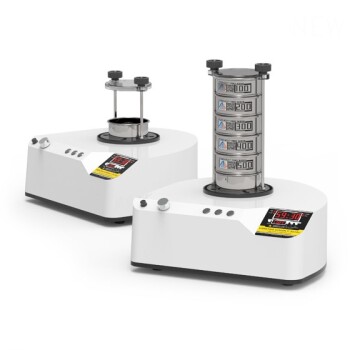
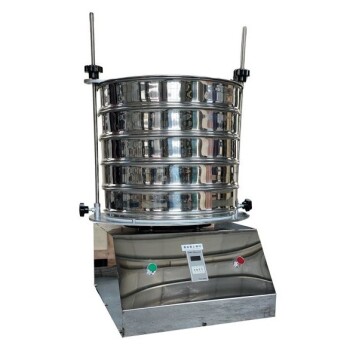
The fundamental purpose of using a nylon sieve during Magnesium Aluminum Spinel (MgAl2O4) preparation is to refine the powder's consistency immediately after the drying phase. This mechanical screening process removes unwanted coarse agglomerates and impurities, ensuring the material is uniform before it enters the molding stage.
Core Takeaway: Sieving is the critical bridge between raw powder preparation and final shaping. It guarantees a uniform particle size distribution, which is the absolute prerequisite for preventing large-scale structural defects in the finished ceramic product.
The Role of Sieving in Process Control
Managing Post-Drying Inconsistencies
Although ball milling reduces particle size, the subsequent drying process introduces new variables.
Drying often causes particles to bind together, forming coarse agglomerates or clumps.
The nylon sieve acts as a physical barrier, catching these drying-induced irregularities and any impurities that may have entered the batch.
Ensuring Particle Uniformity
The sieve, typically with a specific mesh size like 250 mesh, creates a standardized output.
By passing the powder through this screen, you ensure that every particle used for molding falls within a specific, narrow size range.
This step converts a potentially inconsistent mixture into a powder with a uniform particle size distribution.
Impact on Product Integrity
Preventing Structural Defects
The quality of the powder directly dictates the quality of the final ceramic.
If large agglomerates are allowed to remain in the powder, they create weak points during the molding and sintering phases.
Sieving effectively prevents these large-scale defects from forming inside the final product, ensuring structural reliability.
Common Pitfalls to Avoid
Underestimating the Drying Phase
A common mistake is assuming that because the powder was ball-milled, it is ready for molding.
You must recognize that the drying phase actively degrades uniformity by creating clumps.
Skipping the sieving step negates the benefits of the earlier milling process, leading to inconsistent densities in the molded part.
Making the Right Choice for Your Goal
To ensure the highest quality Magnesium Aluminum Spinel ceramic, apply the following principles:
- If your primary focus is Structural Integrity: Ensure strictly controlled sieving (e.g., 250 mesh) to eliminate agglomerates that cause internal defects.
- If your primary focus is Process Consistency: Treat the sieving stage as a mandatory quality gate after drying to standardize every batch before molding.
Summary: The nylon sieve is not merely a filter; it is the essential safeguard that translates raw powder into a defect-free, high-performance ceramic component.
Summary Table:
| Stage | Action | Primary Purpose | Impact on Final Product |
|---|---|---|---|
| Post-Drying | Mechanical Screening | Remove coarse agglomerates & clumps | Prevents internal weak points |
| Quality Control | 250 Mesh Sieving | Standardize particle size distribution | Ensures uniform material density |
| Pre-Molding | Impurity Removal | Filter out external contaminants | Enhances structural reliability |
Elevate Your Material Preparation with KINTEK Precision
Consistency is the key to high-performance ceramics. At KINTEK, we specialize in providing the professional-grade laboratory equipment needed to master every stage of powder processing. From crushing and milling systems that achieve the perfect initial particle size to high-precision sieving equipment and hydraulic presses for flawless molding, our solutions are designed for rigorous research and production standards.
Whether you are preparing Magnesium Aluminum Spinel or advanced battery materials, KINTEK offers a comprehensive range of high-temperature furnaces, PTFE consumables, and alumina ceramics to ensure your results are defect-free. Contact us today to discover how our expertise can optimize your lab's efficiency and product integrity!
Related Products
- Custom PTFE Teflon Parts Manufacturer for PTFE Mesh F4 Sieve
- Vibratory Sieve Shaker Machine Dry Three-Dimensional Vibrating Sieve
- Three-dimensional electromagnetic sieving instrument
- Laboratory Test Sieves and Sieving Machines
People Also Ask
- What are the primary reasons for selecting PTFE as a matrix? Enhance Composites with Carbon Nanotube Reinforcement
- How is PTFE utilized for insulation in Alloy 22 corrosion setups? Ensure Signal Purity & Accuracy
- Is PTFE corrosion resistant? Discover the Ultimate Chemical Resistance for Your Lab
- What are the specific applications of PTFE in micro-batch slug flow systems? Enhance Your Microfluidic Reaction Purity
- What is the mesh size of a sieve? A Guide to Particle Size and Sieve Selection