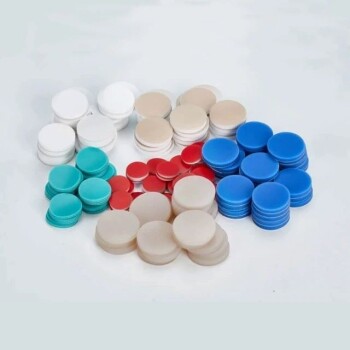
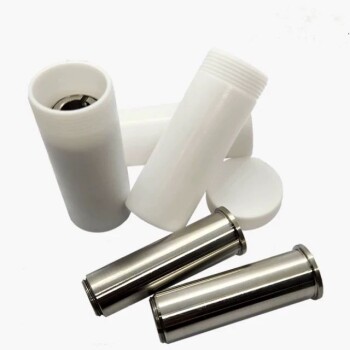
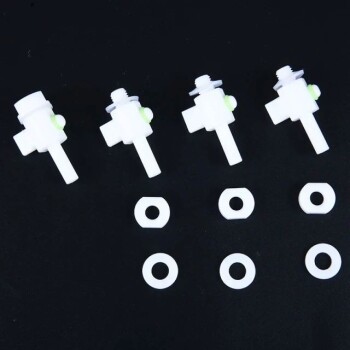
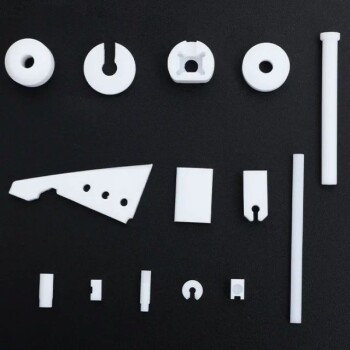
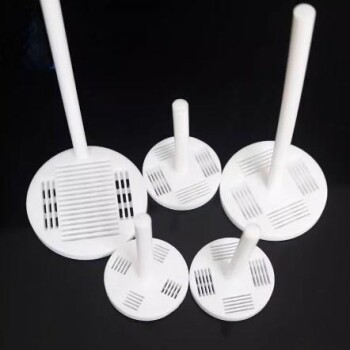
Polytetrafluoroethylene (PTFE) gaskets act as critical precision spacers and insulators within the electrochemical cells used to measure the ionic conductivity of liquid POEGMA electrolytes. They are physically placed between stainless steel electrodes to enforce a specific, consistent electrolyte layer thickness—commonly around 300 micrometers—while simultaneously preventing electrical shorts.
The primary function of the PTFE gasket is to define the cell geometry and isolate the electrodes. This ensures that the data derived from electrochemical impedance spectroscopy (EIS) represents the true conductive properties of the electrolyte, uncorrupted by geometric errors or electrical interference.
The Importance of Geometric Control
Defining the Electrolyte Layer
In conductivity measurements, the accuracy of your results depends heavily on the geometry of the sample.
PTFE gaskets are utilized to create a fixed distance between the electrodes. By using a gasket of a known thickness (e.g., 300 micrometers), you establish a precise path length for the ions to travel.
Preventing Electrode Contact
Direct contact between the two stainless steel electrodes would cause a short circuit, rendering the measurement useless.
The gasket acts as a physical barrier. It ensures the electrodes remain separated, maintaining the integrity of the electrochemical cell during the experiment.
Material Properties Ensuring Data Fidelity
Electrical Insulation
For electrochemical impedance spectroscopy (EIS) to be accurate, current must flow only through the electrolyte.
PTFE is an excellent electrical insulator. This property confines the electrical field to the liquid POEGMA electrolyte, preventing current leakage through the spacer itself which would skew the impedance results.
Chemical Stability
Liquid electrolytes can be chemically active, potentially degrading standard seal materials.
PTFE offers high chemical stability. It remains inert when in contact with POEGMA electrolytes, ensuring that no leached contaminants interfere with the ionic movement or the electrode surface.
Understanding the Trade-offs
Thickness under Compression
While PTFE is rigid enough to act as a spacer, it is not perfectly incompressible.
If the assembly is over-tightened, the gasket may compress, reducing the actual distance between electrodes below the nominal value (e.g., less than 300 micrometers). This discrepancy will lead to calculation errors when converting resistance to conductivity.
Sealing vs. Deformation
To prevent liquid leakage, the cell must be tight.
However, excessive force to ensure a seal can deform the gasket, changing the effective surface area of the electrolyte. Balancing the clamping force is essential to maintain both a hermetic seal and accurate geometric parameters.
Making the Right Choice for Your Experiment
To maximize the accuracy of your POEGMA conductivity measurements, consider your specific experimental needs:
- If your primary focus is absolute accuracy: Verify the post-assembly thickness of the cell, as compression may alter the nominal 300-micrometer path length.
- If your primary focus is long-term stability: Rely on PTFE’s chemical inertness, but ensure the gasket is inspected for physical deformation between repeated uses.
Using PTFE gaskets correctly transforms a simple setup into a precision instrument for material characterization.
Summary Table:
| Feature | Function in Conductivity Measurement | Benefit for POEGMA Electrolytes |
|---|---|---|
| Fixed Thickness | Defines path length (e.g., 300 μm) | Ensures accurate geometric calculations for EIS |
| Electrical Insulation | Prevents electrode short-circuiting | Confines current flow strictly to the electrolyte |
| Chemical Inertness | Resists degradation from electrolytes | Prevents sample contamination and data skewing |
| Physical Barrier | Maintains electrode separation | Protects the integrity of the electrochemical cell |
Elevate Your Material Research with KINTEK Precision Consumables
Achieving accurate ionic conductivity measurements requires more than just high-quality electrolytes; it demands precision-engineered components. KINTEK specializes in providing high-performance laboratory solutions, including high-quality PTFE products, ceramics, and crucibles designed to withstand rigorous electrochemical testing.
Whether you are working with liquid POEGMA electrolytes or advanced battery research, our comprehensive range of equipment—from high-temperature furnaces and reactors to electrolytic cells and electrodes—is tailored to meet the exacting standards of modern laboratories.
Ready to optimize your experimental setup? Contact our technical experts today to find the perfect fit for your lab's specific needs and ensure your data remains uncorrupted and precise.
Related Products
- Custom PTFE Teflon Parts Manufacturer for Gaskets and More
- Custom PTFE Teflon Parts Manufacturer for Hollow Cleaning Basket and Rack Carrier
- Custom PTFE Teflon Parts Manufacturer for PTFE Bottle Oil Fume Sampling Tube
- Custom PTFE Teflon Parts Manufacturer for Air Valve Applications
- Custom PTFE Teflon Parts Manufacturer for Non-Standard Insulator Customization
People Also Ask
- What technical advantages do PTFE seals provide in high-pressure CO2? Optimize Your Seal Integrity
- What are the critical functions of Polytetrafluoroethylene (PTFE) gaskets within a glow discharge unit? Enhance Precision
- What is the purpose of using PTFE gaskets in fuel cell test fixtures? Ensure Seal Purity and Data Integrity
- What protective roles do Sealing Gaskets and Support Grids play in oil-water separation? Ensure High-Pressure Integrity
- What is the function of Polytetrafluoroethylene (PTFE) sleeves and gaskets? Ensure Precise Corrosion Testing Accuracy