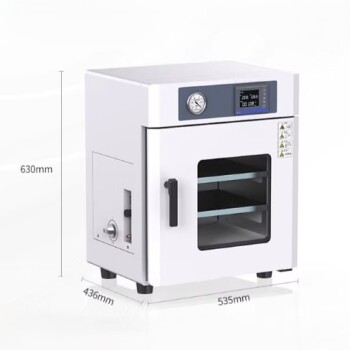
Knowledge What is the purpose of using a vacuum drying oven for TiS2 composite cathodes? Ensure Purity in Solid-State Batteries
Author avatar

Tech Team · Kintek Solution

Updated 4 days ago

What is the purpose of using a vacuum drying oven for TiS2 composite cathodes? Ensure Purity in Solid-State Batteries


The primary purpose of using a vacuum drying oven in this context is to rigorously eliminate organic solvents and trace moisture from the TiS2 composite cathode mixture. By utilizing low-pressure heating, this process ensures the material is chemically pure before it contacts the highly sensitive solid-state electrolyte.

Core Takeaway Sulfide-based solid-state batteries are chemically fragile; the presence of even microscopic amounts of water can cause catastrophic failure. Vacuum drying is not just about evaporation—it is a critical safety step to prevent the generation of toxic hydrogen sulfide (H2S) gas and preserve the structural integrity of the battery interface.

The Critical Role of Contaminant Removal

Eliminating Residual Solvents

During the cathode preparation phase, solvents (often NMP) are used to create a slurry. Complete removal is non-negotiable.

The vacuum environment lowers the boiling point of these solvents. This allows them to evaporate thoroughly from the composite mixture without requiring excessive temperatures that might degrade the active materials.

Extracting Trace Moisture

While removing bulk solvents is important, extracting trace moisture is the definitive reason for using a vacuum oven in this specific application.

Materials used in the cathode composite can adsorb water from the atmosphere. A standard drying oven may leave residual moisture trapped in micropores, but the pressure differential in a vacuum oven forces this trapped moisture out.

Protecting the Sulfide Electrolyte

Preventing Toxic Gas Generation

The primary reference highlights that sulfide electrolytes, such as Li10GeP2S12 (LGPS), are extremely sensitive to moisture.

If a TiS2 cathode containing residual water contacts the sulfide electrolyte, a hydrolysis reaction occurs immediately. This reaction produces hydrogen sulfide (H2S), a highly toxic and corrosive gas. Vacuum drying is the primary defense against this hazardous side reaction.

Ensuring Long-Term Stability

Beyond safety, the reaction between moisture and the electrolyte degrades the battery's performance.

When the electrolyte decomposes into gas, it creates physical gaps at the cathode-electrolyte interface. These gaps block ion transport. By ensuring the cathode is perfectly dry, you maintain a cohesive interface, which is essential for long-term cycling stability.

Understanding the Trade-offs

Vacuum vs. Standard Thermal Drying

You might consider using a standard thermal oven to cut costs or complexity, but in sulfide systems, this is a major pitfall.

Standard ovens require higher temperatures to achieve the same level of dryness, which increases the risk of oxidizing the TiS2 active material. Furthermore, without the vacuum to "pull" volatiles out of the microstructure, trapped pockets of solvent often remain, leading to internal pressure buildup and eventual battery swelling.

The Risk of Incomplete Drying

If the vacuum drying duration is insufficient or the pressure is not low enough, "surface dryness" may be achieved while deep-pore moisture remains.

In liquid electrolyte batteries, this might only reduce efficiency. In sulfide solid-state batteries, this results in immediate chemical degradation of the electrolyte layer, rendering the cell useless before it is even cycled.

Making the Right Choice for Your Goal

To optimize your preparation of TiS2 composite cathodes, consider your specific priorities:

  • If your primary focus is Safety: Ensure the vacuum drying process is extended significantly to guarantee zero moisture transfer to the LGPS electrolyte, preventing H2S formation.
  • If your primary focus is Performance Stability: Prioritize vacuum levels over temperature to remove deep-pore solvents without thermally stressing or oxidizing the TiS2 material.

The success of a sulfide-based solid-state battery is determined before assembly; it relies entirely on the purity and dryness achieved during the vacuum treatment of its components.

Summary Table:

Feature Vacuum Drying Oven Standard Thermal Oven
Moisture Removal Deep-pore extraction (High) Surface-level only (Low)
Solvent Evaporation Low-temperature/High-efficiency High-temperature/Risk of oxidation
Safety Impact Prevents H2S gas formation Risk of electrolyte hydrolysis
Interface Stability Preserves cohesive cathode-electrolyte contact Causes gaps due to gas byproduct
Material Integrity Protects sensitive TiS2 & LGPS High risk of degradation

Elevate Your Solid-State Battery Research with KINTEK

Precision drying is the foundation of high-performance battery technology. At KINTEK, we specialize in providing advanced laboratory solutions tailored for sensitive material synthesis. Whether you are developing TiS2 composite cathodes or working with moisture-sensitive sulfide-based electrolytes, our high-performance vacuum ovens and crushing and milling systems ensure the chemical purity your research demands.

From high-temperature furnaces and hydraulic pellet presses for solid-state cell assembly to ULT freezers and battery research consumables, KINTEK offers the comprehensive equipment portfolio needed to prevent degradation and maximize cycling stability.

Don't let trace moisture compromise your innovation. Contact our laboratory specialists today to find the perfect drying and processing solution for your energy storage projects!

Related Products

People Also Ask

Related Products

Vacuum Dental Porcelain Sintering Furnace

Vacuum Dental Porcelain Sintering Furnace

Get precise and reliable results with KinTek's Vacuum Porcelain Furnace. Suitable for all porcelain powders, it features hyperbolic ceramic furnace function, voice prompt, and automatic temperature calibration.

Graphite Vacuum Furnace High Thermal Conductivity Film Graphitization Furnace

Graphite Vacuum Furnace High Thermal Conductivity Film Graphitization Furnace

The high thermal conductivity film graphitization furnace has uniform temperature, low energy consumption and can operate continuously.

Vacuum Heat Treat Sintering Brazing Furnace

Vacuum Heat Treat Sintering Brazing Furnace

A vacuum brazing furnace is a type of industrial furnace used for brazing, a metalworking process that joins two pieces of metal using a filler metal that melts at a lower temperature than the base metals. Vacuum brazing furnaces are typically used for high-quality applications where a strong, clean joint is required.

Vacuum Heat Treat and Molybdenum Wire Sintering Furnace for Vacuum Sintering

Vacuum Heat Treat and Molybdenum Wire Sintering Furnace for Vacuum Sintering

A vacuum molybdenum wire sintering furnace is a vertical or bedroom structure, which is suitable for withdrawal, brazing, sintering and degassing of metal materials under high vacuum and high temperature conditions. It is also suitable for dehydroxylation treatment of quartz materials.

Horizontal High Temperature Graphite Vacuum Graphitization Furnace

Horizontal High Temperature Graphite Vacuum Graphitization Furnace

Horizontal Graphitization Furnace: This type of furnace is designed with the heating elements placed horizontally, allowing for uniform heating of the sample. It's well-suited for graphitizing large or bulky samples that require precise temperature control and uniformity.

1800℃ Muffle Oven Furnace for Laboratory

1800℃ Muffle Oven Furnace for Laboratory

KT-18 muffle furnace with Japan Al2O3 polycrystalline fibe and Silicon Molybdenum heating element, up to 1900℃, PID temperature control and 7" smart touch screen. Compact design, low heat loss, and high energy efficiency. Safety interlock system and versatile functions.

Vacuum Heat Treat and Sintering Furnace with 9MPa Air Pressure

Vacuum Heat Treat and Sintering Furnace with 9MPa Air Pressure

The air pressure sintering furnace is a high-tech equipment commonly used for the sintering of advanced ceramic materials. It combines vacuum sintering and pressure sintering techniques to achieve high-density and high-strength ceramics.

2200 ℃ Tungsten Vacuum Heat Treat and Sintering Furnace

2200 ℃ Tungsten Vacuum Heat Treat and Sintering Furnace

Experience the ultimate refractory metal furnace with our Tungsten vacuum furnace. Capable of reaching 2200℃, perfect for sintering advanced ceramics and refractory metals. Order now for high-quality results.

Vertical High Temperature Graphite Vacuum Graphitization Furnace

Vertical High Temperature Graphite Vacuum Graphitization Furnace

Vertical high temperature graphitization furnace for carbonization and graphitization of carbon materials up to 3100℃.Suitable for shaped graphitization of carbon fiber filaments and other materials sintered in a carbon environment.Applications in metallurgy, electronics, and aerospace for producing high-quality graphite products like electrodes and crucibles.

Non Consumable Vacuum Arc Induction Melting Furnace

Non Consumable Vacuum Arc Induction Melting Furnace

Explore the benefits of Non-Consumable Vacuum Arc Furnace with high melting point electrodes. Small, easy to operate & eco-friendly. Ideal for laboratory research on refractory metals & carbides.

1700℃ Muffle Oven Furnace for Laboratory

1700℃ Muffle Oven Furnace for Laboratory

Get superior heat control with our 1700℃ Muffle Furnace. Equipped with intelligent temperature microprocessor, TFT touch screen controller & advanced insulation materials for precise heating up to 1700C. Order now!

Ultra-High Temperature Graphite Vacuum Graphitization Furnace

Ultra-High Temperature Graphite Vacuum Graphitization Furnace

The ultra-high temperature graphitization furnace utilizes medium frequency induction heating in a vacuum or inert gas environment. The induction coil generates an alternating magnetic field, inducing eddy currents in the graphite crucible, which heats up and radiates heat to the workpiece, bringing it to the desired temperature. This furnace is primarily used for graphitization and sintering of carbon materials, carbon fiber materials, and other composite materials.

Vacuum Hot Press Furnace Heated Vacuum Press Machine Tube Furnace

Vacuum Hot Press Furnace Heated Vacuum Press Machine Tube Furnace

Reduce forming pressure & shorten sintering time with Vacuum Tube Hot Press Furnace for high-density, fine-grain materials. Ideal for refractory metals.

Dental Porcelain Zirconia Sintering Ceramic Vacuum Press Furnace

Dental Porcelain Zirconia Sintering Ceramic Vacuum Press Furnace

Get precise dental results with Dental Vacuum Press Furnace. Automatic temperature calibration, low noise tray, and touch screen operation. Order now!

1200℃ Controlled Atmosphere Furnace Nitrogen Inert Atmosphere Furnace

1200℃ Controlled Atmosphere Furnace Nitrogen Inert Atmosphere Furnace

Discover our KT-12A Pro Controlled atmosphere furnace - high precision, heavy duty vacuum chamber, versatile smart touch screen controller, and excellent temperature uniformity up to 1200C. Ideal for both laboratory and industrial application.

1400℃ Controlled Atmosphere Furnace with Nitrogen and Inert Atmosphere

1400℃ Controlled Atmosphere Furnace with Nitrogen and Inert Atmosphere

Achieve precise heat treatment with KT-14A controlled atmosphere furnace. Vacuum sealed with a smart controller, it's ideal for lab and industrial use up to 1400℃.

Vacuum Heat Treat Furnace and Levitation Induction Melting Furnace

Vacuum Heat Treat Furnace and Levitation Induction Melting Furnace

Experience precise melting with our Vacuum Levitation Melting Furnace. Ideal for high melting point metals or alloys, with advanced technology for effective smelting. Order now for high-quality results.

Vacuum Hot Press Furnace Machine Heated Vacuum Press

Vacuum Hot Press Furnace Machine Heated Vacuum Press

Discover the advantages of Vacuum Hot Press Furnace! Manufacture dense refractory metals & compounds, ceramics, and composites under high temp and pressure.

600T Vacuum Induction Hot Press Furnace for Heat Treat and Sintering

600T Vacuum Induction Hot Press Furnace for Heat Treat and Sintering

Discover the 600T Vacuum Induction Hot Press Furnace, designed for high-temperature sintering experiments in vacuum or protected atmospheres. Its precise temperature and pressure control, adjustable working pressure, and advanced safety features make it ideal for nonmetal materials, carbon composites, ceramics, and metal powders.

Mesh belt controlled atmosphere furnace

Mesh belt controlled atmosphere furnace

Discover our KT-MB mesh belt sintering furnace - perfect for high-temperature sintering of electronic components & glass insulators. Available for open air or controlled atmosphere environments.


Leave Your Message