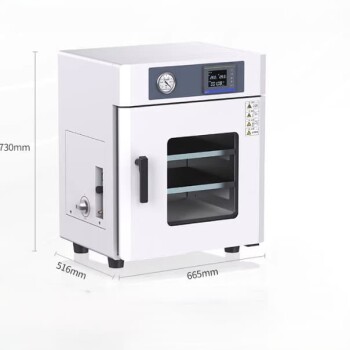
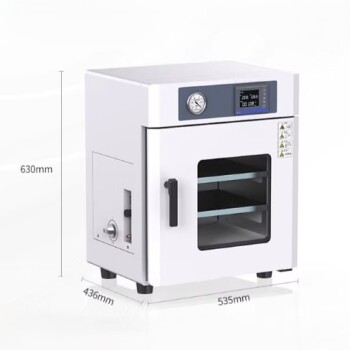
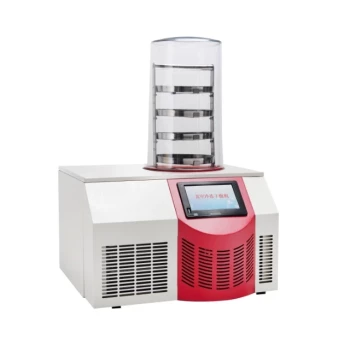
The primary purpose of using a vacuum drying oven for recycled graphite electrode sheets is to achieve deep, absolute dryness by removing residual organic solvents and trace moisture under negative pressure. Typically operating at temperatures around 100°C, this process eliminates contaminants that would otherwise compromise the battery's electrochemical performance.
Core Takeaway The vacuum drying oven acts as a critical safeguard against battery failure mechanisms. By lowering the boiling point of solvents, it removes N-methylpyrrolidone (NMP) and moisture without subjecting the graphite to oxidation, preventing electrolyte decomposition and ensuring long-term cycling stability.
The Critical Role of Deep Drying
Removing Organic Solvents (NMP)
After the coating process, the graphite slurry contains organic solvents, most notably N-methylpyrrolidone (NMP). The vacuum drying oven is essential for completely evacuating these solvents from the porous electrode structure. Failing to remove NMP can interfere with the battery's internal chemistry and reduce energy density.
Eliminating Trace Moisture
Water is a significant contaminant in battery production. The oven removes even trace amounts of moisture that may have been adsorbed from the atmosphere or introduced during slurry preparation. This "absolute dryness" is a non-negotiable requirement for high-performance lithium-ion batteries.
Ensuring Electrochemical Stability
The presence of moisture is directly linked to electrolyte decomposition. If water remains in the electrode sheet, it reacts with the electrolyte once the battery is assembled, creating hydrofluoric acid (HF) and other byproducts. This degradation leads to secondary reactions that severely impair the battery's capacity and long-term cycling stability.
Why Vacuum Conditions Are Essential
Lowering the Boiling Point
Operating in a vacuum environment significantly lowers the boiling point of the solvents and moisture trapped in the electrode sheets. This allows for rapid, efficient evaporation at lower temperatures (e.g., 100°C) compared to atmospheric drying. This efficiency is crucial for processing throughput without sacrificing quality.
Preventing Graphite Oxidation
Graphite and other carbon-based materials are susceptible to surface oxidation when exposed to high temperatures in the presence of oxygen. By removing air from the chamber, the vacuum oven creates an inert environment. This preserves the surface chemistry and structural integrity of the recycled graphite, ensuring high-quality interfacial bonding.
Preventing Re-adsorption
Vacuum drying is distinct from standard oven drying because it prevents the re-adsorption of atmospheric moisture. In a standard oven, as the material cools or sits, it can pull humidity back from the air. The vacuum environment ensures that once the contaminants are removed, they are permanently evacuated from the system.
Common Pitfalls to Avoid
The Risk of Incomplete Drying
Relying on standard thermal drying without a vacuum often results in residual moisture deep within the electrode pores. While the surface may appear dry, internal moisture will eventually migrate out during battery operation, causing gas generation (swelling) and eventual failure.
Thermal Stress vs. Vacuum Efficiency
Attempting to speed up drying by simply increasing the temperature in a non-vacuum oven is a mistake. High temperatures can induce phase changes or damage the binder material holding the graphite sheet together. The vacuum allows for thorough drying at moderate temperatures, protecting the physical structure of the electrode.
Making the Right Choice for Your Goal
To optimize the preparation of recycled graphite electrode sheets, align your process with your specific objectives:
- If your primary focus is Long-Term Cycling Stability: Prioritize the removal of NMP and moisture to prevent electrolyte decomposition and secondary reactions.
- If your primary focus is Material Integrity: Rely on the vacuum environment to lower process temperatures, preventing surface oxidation of the graphite and preserving the electrode's physical structure.
Ultimately, the vacuum drying oven is not just a drying tool; it is a chemical stabilization step that defines the lifespan and safety of the final battery cell.
Summary Table:
| Feature | Advantage in Vacuum Drying | Impact on Graphite Electrode |
|---|---|---|
| Pressure Control | Lower boiling points of solvents | Rapid removal of NMP & moisture at lower temperatures |
| Atmosphere | Oxygen-free environment | Prevents surface oxidation and maintains material integrity |
| Moisture Level | Achieves "Absolute Dryness" | Prevents HF formation and electrolyte decomposition |
| Thermal Stress | Uniform, moderate heating | Protects binder materials and prevents electrode structural damage |
Maximize Your Battery Research Precision with KINTEK
Don't let trace moisture or oxidation compromise your energy storage innovations. KINTEK specializes in advanced laboratory equipment designed for the rigorous demands of battery material processing.
Our high-performance vacuum drying ovens and crushing/milling systems provide the controlled environments necessary to ensure your recycled graphite electrode sheets achieve peak electrochemical stability and long-term cycling performance. From high-temperature furnaces and pellet presses to specialized electrolytic cells, KINTEK offers the comprehensive tools your lab needs to bridge the gap between material research and industrial excellence.
Ready to upgrade your battery preparation process? Contact us today to find the perfect solution for your lab!
Related Products
- 56L Vertical Laboratory Vacuum Drying Oven
- 23L Laboratory Vacuum Drying Oven
- Laboratory Scientific Electric Heating Blast Drying Oven
- Benchtop Laboratory Vacuum Freeze Dryer
- Dental Porcelain Zirconia Sintering Ceramic Vacuum Press Furnace
People Also Ask
- Why is a laboratory vacuum drying oven recommended for rice straw residues? Protect Your Biomass Integrity
- What role does a laboratory vacuum drying oven play in the preparation of modified multi-walled carbon nanotubes?
- What is the importance of using a laboratory vacuum drying oven? Preserving Slow-Release Microcapsule Integrity
- Why is a Laboratory Vacuum Drying Oven recommended for PBAT microspheres? Protect Sensitive Polymer Integrity
- What role does a laboratory vacuum drying oven play in processing nanoparticle powder samples? Protect Sample Integrity