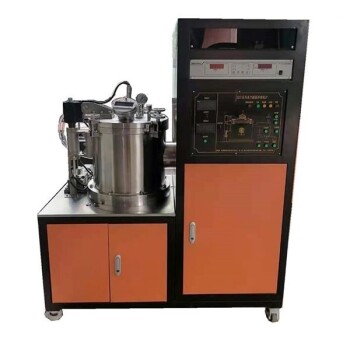
The purpose of using a vacuum furnace equipped with a titanium trap is to create a chemically inert, ultra-low oxygen environment that protects the substrate during thermal conditioning. This setup actively strips residual oxygen from the atmosphere to prevent the oxidation of the NiCoCrAlY metal support, while the thermal treatment itself stabilizes the material's microstructure to prevent future mechanical failure.
Core Takeaway This process creates a dual-layer of protection: the titanium trap acts as a sacrificial oxygen "getter" to ensure the metal surface remains oxide-free, while the pre-annealing heat cycle dissolves the unstable sigma phase to eliminate volume expansion, preventing the LSCF membrane from cracking under stress.
The Role of the Titanium Trap
The presence of oxygen, even in trace amounts, is the primary enemy of NiCoCrAlY supports during high-temperature processing.
Lowering Oxygen Partial Pressure
Standard vacuum furnaces backfilled with inert gas (like argon) often retain microscopic levels of residual oxygen.
A titanium trap functions as a "getter" material. Titanium is highly reactive with oxygen at elevated temperatures; it absorbs the oxygen from the gas stream before it can reach the substrate.
Preventing Substrate Oxidation
The porous substrate typically consists of NiCoCrAlY (Nickel-Cobalt-Chromium-Aluminum-Yttrium).
If exposed to oxygen during preheating, this alloy will form an oxide scale. This oxidation compromises the surface quality and can negatively affect the adhesion and performance of the subsequent LSCF (Lanthanum Strontium Cobalt Ferrite) coating.
The Mechanism of Pre-Annealing
Once the environment is secured by the titanium trap, the thermal annealing process (typically around 720°C) targets the structural stability of the metal.
Dissolving the Sigma Phase
The NiCoCrAlY alloy contains a microstructural component known as the sigma phase.
Pre-annealing facilitates the dissolution of this phase. By holding the material at the target temperature, you force the microstructure to transform into a more stable state prior to coating deposition.
Eliminating Volume Expansion
The dissolution of the sigma phase is critical because its presence is linked to volume expansion effects.
If this phase transformation were to occur during the actual operation of the device (rather than during pre-annealing), the substrate would physically expand underneath the coating.
Preventing Tensile Stresses and Cracking
Uncontrolled volume expansion generates significant tensile stresses at the interface between the metal support and the ceramic membrane.
Since LSCF membranes are brittle, these stresses inevitably lead to cracking. By pre-annealing, you effectively "pre-shrink" or stabilize the substrate, ensuring the LSCF membrane remains intact during operation.
Operational Risks and Considerations
While this process is effective, it relies on precise control of both chemistry and temperature.
The Risk of Incomplete Gettering
If the titanium trap is saturated or undersized, oxygen partial pressure will rise.
Even slight oxidation of the NiCoCrAlY support can act as a barrier, preventing the LSCF coating from bonding correctly, rendering the mechanical stabilization moot.
Thermal Precision is Non-Negotiable
The effectiveness of stress prevention is entirely dependent on the dissolution of the sigma phase.
If the pre-annealing temperature deviates significantly from the target (e.g., 720°C) or the duration is too short, the sigma phase will remain. This leaves the substrate a "ticking time bomb" that will expand and crack the membrane once the device is put into service.
Making the Right Choice for Your Project
To ensure the longevity of your LSCF membranes, you must view the furnace and the trap as a single, integrated system.
- If your primary focus is Adhesion: Rely on the titanium trap to minimize oxygen partial pressure, ensuring the NiCoCrAlY surface remains metallic and pristine for coating.
- If your primary focus is Structural Integrity: strictly control the pre-annealing temperature (720°C) to fully dissolve the sigma phase, eliminating the volume expansion that drives cracking.
By stabilizing the substrate's volume in a deoxygenated environment, you remove the physical and chemical drivers of membrane failure before the coating is even applied.
Summary Table:
| Component/Process | Function | Primary Benefit |
|---|---|---|
| Titanium Trap | Acts as a sacrificial 'getter' to absorb residual oxygen | Prevents NiCoCrAlY oxidation & ensures coating adhesion |
| Vacuum Environment | Provides an inert, low-pressure atmosphere | Eliminates chemical contaminants during thermal cycles |
| Pre-Annealing (720°C) | Facilitates the dissolution of the brittle sigma phase | Eliminates volume expansion & prevents membrane cracking |
| LSCF Coating Prep | Stabilizes the porous substrate microstructure | Ensures long-term mechanical integrity of the ceramic layer |
Optimize Your Materials Research with KINTEK Precision
Don't let substrate oxidation or mechanical failure compromise your LSCF membrane performance. KINTEK specializes in advanced laboratory solutions tailored for high-stakes research and industrial applications. Our comprehensive portfolio features high-performance vacuum and atmosphere furnaces specifically designed to maintain ultra-low oxygen environments, alongside high-precision crushing systems, hydraulic presses, and specialized ceramics.
Whether you are refining NiCoCrAlY substrates or developing next-generation battery technologies, our expert team provides the equipment and consumables—from titanium getters to high-temperature reactors—needed to achieve repeatable, failure-free results.
Ready to elevate your thermal processing? Contact KINTEK today to discuss your project requirements!
References
- Diana Marcano, José M. Serra. Controlling the stress state of La1−Sr Co Fe1−O3− oxygen transport membranes on porous metallic supports deposited by plasma spray–physical vapor process. DOI: 10.1016/j.memsci.2015.12.029
This article is also based on technical information from Kintek Solution Knowledge Base .
Related Products
- Small Vacuum Heat Treat and Tungsten Wire Sintering Furnace
- 2200 ℃ Tungsten Vacuum Heat Treat and Sintering Furnace
- Vacuum Heat Treat Furnace with Ceramic Fiber Liner
- Graphite Vacuum Furnace IGBT Experimental Graphitization Furnace
- Vacuum Arc Induction Melting Furnace
People Also Ask
- What is the melting point of tungsten in a vacuum? The Real Limit is Sublimation, Not Melting
- What are some alternative atmospheres to pure hydrogen for powder metallurgy sintering processes? Top Sintering Solutions
- Why must green bodies produced via binder jetting undergo treatment in a vacuum sintering furnace?
- How does the vacuum environment impact sintering of diamond-copper composites? Protect Against Thermal Damage
- What is a vacuum sintering furnace? Unlock Purity and Performance in Advanced Materials