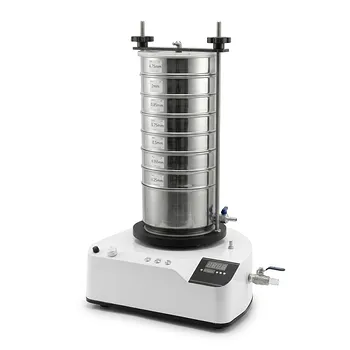
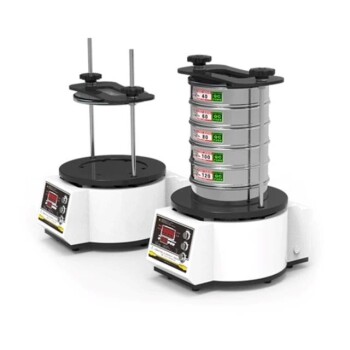
The primary purpose of using precision standard sieves during powder granulation is to strictly control particle size distribution, ensuring it remains narrow and uniform. By passing the powder through a specific mesh size—such as a 125 µm sieve—you optimize the granules' flowability, which is a prerequisite for achieving high-quality composite structures.
Core Takeaway Sieving is not merely a sorting mechanism; it is a critical processing step that enhances powder packing density and eliminates defects caused by the bridging effect. This directly dictates the final composite material's structural isotropy and high density after sintering.
Optimizing Physical Powder Characteristics
Achieving Narrow Particle Size Distribution
The fundamental goal of using a precision standard sieve is to eliminate outliers in granule size. Without this step, the powder mixture would contain a chaotic range of particle sizes.
By standardizing the size (e.g., to 125 µm), you ensure that every granule behaves predictably during subsequent processing steps.
Enhancing Flowability
Uniform granules flow significantly better than irregular, non-sieved powders. Good flowability is essential when transferring powder into molds, ensuring the material fills the space evenly without mechanical assistance or excessive agitation.
Improving Sintering Mechanics
Maximizing Packing Density
The most critical downstream effect of sieving is improved packing density within the mold.
In processes like Spark Plasma Sintering (SPS), the powder must be packed as tightly as possible before heat and pressure are applied. Precision sieving allows granules to settle closer together, reducing the volume of air gaps.
Reducing the Bridging Effect
Non-uniform powders often suffer from the "bridging effect," where particles interlock and create stable arches over voids.
These bridges prevent the powder from settling fully, leaving large internal gaps. Precision sieving removes the irregular particles that cause this interlocking, ensuring the powder bed collapses into a dense, solid mass.
Understanding the Trade-offs
Process Complexity vs. Material Quality
Incorporating precision sieving adds a step to the manufacturing line, requiring time and specific equipment maintenance. However, skipping this step introduces variables that make the final material properties unpredictable.
The Role of Consistency
While the primary goal is density, sieving also ensures experimental repeatability.
Just as precise sizing helps maintain stable conditions in other chemical engineering contexts (such as catalytic reactions), in composite manufacturing, it ensures that every batch reacts to thermal treatment in the exact same way.
The Impact on Final Material Properties
Structural Isotropy
When powder packs unevenly, the final material often has "weak spots" or directional properties (anisotropy).
By ensuring a uniform pack via sieving, the final sintered composite achieves structural isotropy, meaning its mechanical properties are consistent regardless of the direction of force applied.
High Sintered Density
Ultimately, the density of the green body (the packed powder) determines the density of the final sintered product.
A sieved, well-packed powder results in a composite with minimal porosity and maximum structural integrity.
Making the Right Choice for Your Goal
To apply this to your specific project, evaluate your priorities:
- If your primary focus is Structural Integrity: Use precision sieves to minimize voids and the bridging effect, ensuring the highest possible sintered density.
- If your primary focus is Process Repeatability: Implement strict sieving protocols to guarantee that every batch has identical flowability and packing behavior, reducing data variance.
Precision sieving is the bridge between a raw powder mixture and a high-performance, defect-free composite material.
Summary Table:
| Feature | Impact of Precision Sieving | Benefit to Final Composite |
|---|---|---|
| Particle Size Distribution | Ensures narrow and uniform granule range (e.g., 125 µm) | Predictable material behavior and repeatability |
| Powder Flowability | Reduces friction and irregular interlocking | Even mold filling without mechanical agitation |
| Packing Density | Minimizes air gaps and voids between granules | Higher green body density before sintering |
| Bridging Effect | Eliminates stable arches that create internal gaps | Reduced porosity and enhanced structural integrity |
| Material Isotropy | Provides uniform internal structure | Consistent mechanical properties in all directions |
Elevate your material science research with KINTEK’s precision sieving and crushing systems. Whether you are optimizing powder granulation for high-performance composites or prepping samples for Spark Plasma Sintering (SPS), our high-quality laboratory equipment ensures the particle consistency you need for defect-free results. Beyond sieves, explore our comprehensive range of high-temperature furnaces, hydraulic presses, and specialized consumables like PTFE and ceramics designed for rigorous lab environments. Don't let unpredictable particle sizes compromise your structural integrity—contact our experts at KINTEK today to find the perfect solution for your lab!
References
- Paweł Rutkowski, Paweł Nieroda. Thermal properties of spark plasma sintered Inconel 625 modified by titanium zirconium mixed carbide. DOI: 10.1007/s10973-023-12259-1
This article is also based on technical information from Kintek Solution Knowledge Base .
Related Products
- Precision Wire Saw Laboratory Cutting Machine with 800mm x 800mm Workbench for Diamond Single Wire Circular Small Cutting
- Custom PTFE Teflon Parts Manufacturer for PTFE Mesh F4 Sieve
- Three-dimensional electromagnetic sieving instrument
- Laboratory Micro Horizontal Jar Mill for Precision Sample Preparation in Research and Analysis
- Laboratory Test Sieves and Sieving Machines
People Also Ask
- Are diamonds used in machines? Unlock Superior Performance with Diamond Tools
- What machine is used for cutting diamond? Discover the Laser Technology That Shapes Gems
- What machines make lab diamonds? Discover the HPHT and CVD Technologies Behind Lab-Grown Gems
- What is metallographic sandpaper and how should it be used? A Guide to Flawless Sample Preparation
- What is a stainless steel micro spatula used for in polishing? Achieve Contamination-Free, High-Precision Finishes