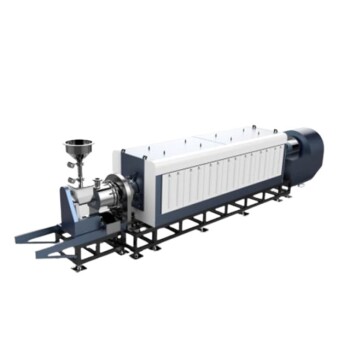
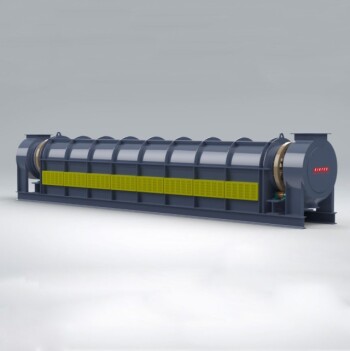
Knowledge Resources What is the pyrolysis method of waste management? Converting Waste into Energy and Resources
Author avatar

Tech Team · Kintek Solution

Updated 2 months ago

What is the pyrolysis method of waste management? Converting Waste into Energy and Resources


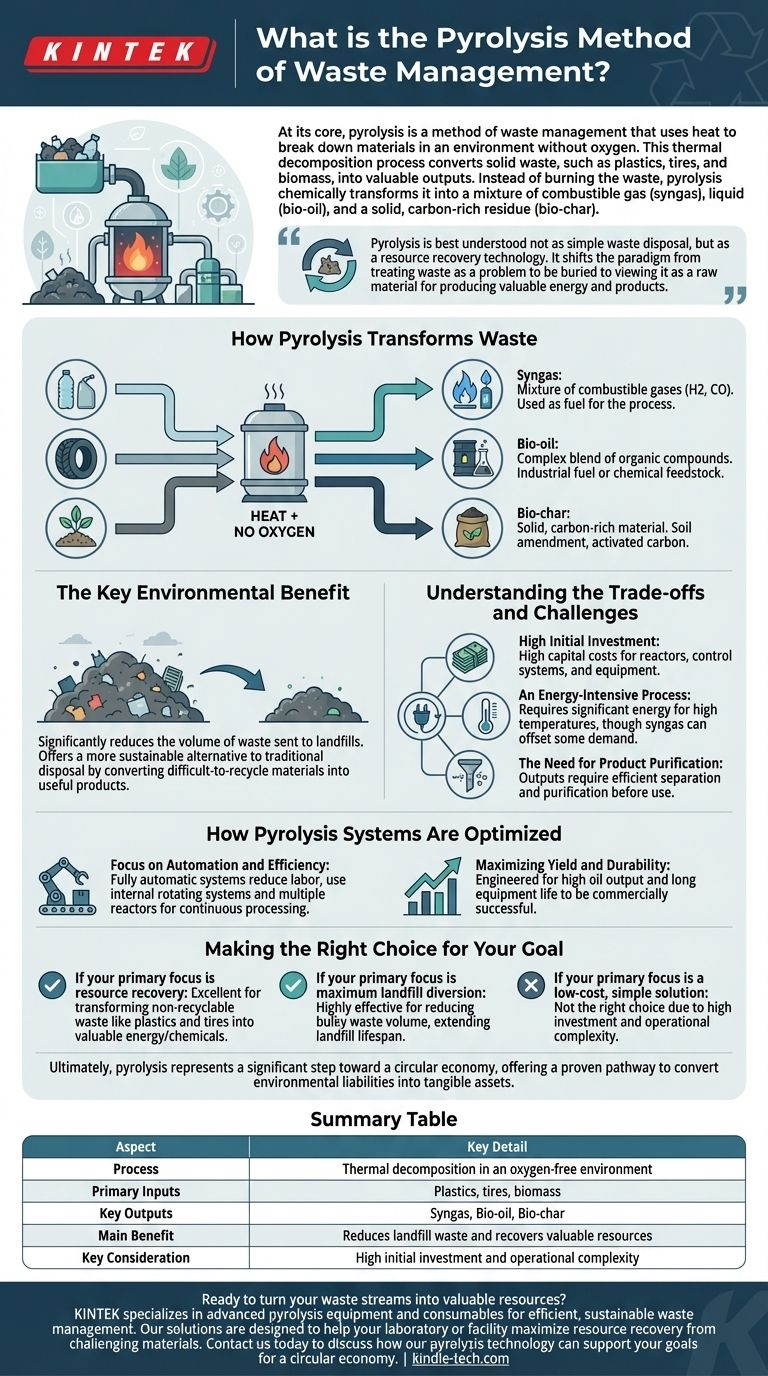
At its core, pyrolysis is a method of waste management that uses heat to break down materials in an environment without oxygen. This thermal decomposition process converts solid waste, such as plastics, tires, and biomass, into valuable outputs. Instead of burning the waste, pyrolysis chemically transforms it into a mixture of combustible gas (syngas), liquid (bio-oil), and a solid, carbon-rich residue (bio-char).

Pyrolysis is best understood not as simple waste disposal, but as a resource recovery technology. It shifts the paradigm from treating waste as a problem to be buried to viewing it as a raw material for producing valuable energy and products.
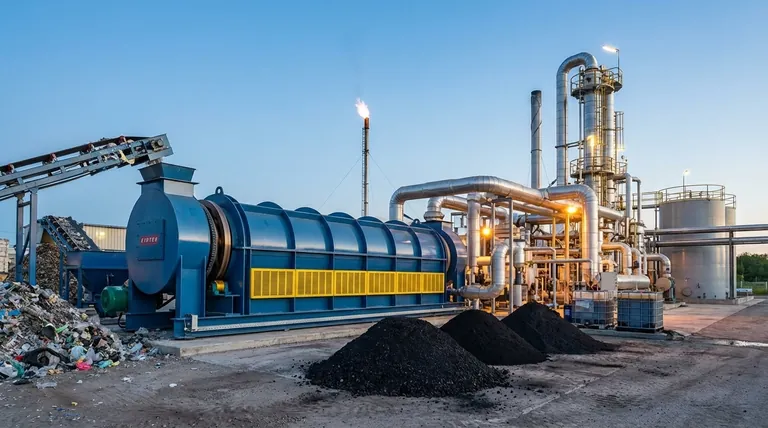
What is the pyrolysis method of waste management? Converting Waste into Energy and Resources

How Pyrolysis Transforms Waste

The fundamental principle of pyrolysis is to heat organic-based materials to high temperatures in an inert atmosphere. The absence of oxygen is critical; it prevents combustion and instead causes the long polymer chains within the waste to break down into smaller, simpler molecules.

The Three Primary Outputs

The process consistently yields three distinct products, each with potential applications.

Syngas: This is a mixture of combustible gases, primarily hydrogen and carbon monoxide. It can be used directly as a fuel source to power the pyrolysis process itself, making the system more energy-efficient.

Bio-oil: Also known as pyrolysis oil, this liquid is a complex blend of different organic compounds. It can be utilized as an industrial fuel or further refined into higher-grade fuels and chemicals.

Bio-char: This solid, carbon-rich material is similar to charcoal. It has significant value as a soil amendment to improve fertility and can also be used as a feedstock for producing activated carbon, which is used in filtration systems.

The Key Environmental Benefit

The primary advantage of pyrolysis is its ability to significantly reduce the volume of waste sent to landfills. By converting materials that are difficult to recycle into useful products, it offers a more sustainable alternative to traditional disposal methods.

Understanding the Trade-offs and Challenges

While promising, pyrolysis is a sophisticated industrial process with significant operational considerations. It is not a universally simple solution for all waste management scenarios.

High Initial Investment

Pyrolysis plants involve high capital costs. The reactors, control systems, and equipment needed for processing and refining the outputs require a substantial upfront investment.

An Energy-Intensive Process

Reaching and maintaining the high temperatures necessary for decomposition requires a significant amount of energy. While the syngas produced can offset some of this demand, the initial energy input remains a critical factor in its economic viability.

The Need for Product Purification

The outputs of pyrolysis are not immediately ready for use. The gas and oil streams are mixtures that require efficient separation and purification before they can be sold or used as fuel, adding another layer of complexity and cost to the operation.

How Pyrolysis Systems Are Optimized

Modern pyrolysis systems are designed to maximize efficiency and output. The goal is to create a continuous and automated process that improves the economic case for the technology.

Focus on Automation and Efficiency

Many systems are fully automatic, which reduces labor costs and ensures consistent operating conditions. Designs often feature internal rotating systems and multiple reactors to allow for continuous processing and higher throughput.

Maximizing Yield and Durability

The engineering focus is on achieving a high oil output from the waste feedstock. This, combined with designs that save time and energy and ensure a long working life for the equipment, is crucial for making a pyrolysis facility commercially successful.

Making the Right Choice for Your Goal

Pyrolysis is a powerful tool when applied to the right problem. Its suitability depends entirely on the primary objective of the waste management strategy.

  • If your primary focus is resource recovery: Pyrolysis is an excellent technology for transforming specific, non-recyclable waste streams like plastics and tires into valuable energy and chemical feedstocks.
  • If your primary focus is maximum landfill diversion: This method is highly effective for reducing the volume of bulky waste materials, directly contributing to longer landfill lifespans and reduced environmental impact.
  • If your primary focus is a low-cost, simple solution: Pyrolysis is likely not the right choice due to its high capital investment and operational complexity compared to more traditional waste management options.

Ultimately, pyrolysis represents a significant step toward a circular economy, offering a proven pathway to convert environmental liabilities into tangible assets.

Summary Table:

Aspect Key Detail
Process Thermal decomposition in an oxygen-free environment
Primary Inputs Plastics, tires, biomass
Key Outputs Syngas, Bio-oil, Bio-char
Main Benefit Reduces landfill waste and recovers valuable resources
Key Consideration High initial investment and operational complexity

Ready to turn your waste streams into valuable resources? KINTEK specializes in advanced pyrolysis equipment and consumables for efficient, sustainable waste management. Our solutions are designed to help your laboratory or facility maximize resource recovery from challenging materials. Contact us today to discuss how our pyrolysis technology can support your goals for a circular economy.

Visual Guide
What is the pyrolysis method of waste management? Converting Waste into Energy and Resources Visual Guide

Related Products

People Also Ask

Related Products

Electric Rotary Kiln Small Rotary Furnace Biomass Pyrolysis Plant

Electric Rotary Kiln Small Rotary Furnace Biomass Pyrolysis Plant

Learn about Rotary Biomass Pyrolysis Furnaces & how they decompose organic material at high temps without oxygen. Use for biofuels, waste processing, chemicals & more.

Electric Rotary Kiln Pyrolysis Furnace Plant Machine Calciner Small Rotary Kiln Rotating Furnace

Electric Rotary Kiln Pyrolysis Furnace Plant Machine Calciner Small Rotary Kiln Rotating Furnace

Electric rotary kiln - precisely controlled, it's ideal for calcination and drying of materials like lithium cobalate, rare earths, and non-ferrous metals.

Electric Rotary Kiln Continuous Working Small Rotary Furnace Heating Pyrolysis Plant

Electric Rotary Kiln Continuous Working Small Rotary Furnace Heating Pyrolysis Plant

Efficiently calcine and dry bulk powder and lump fluid materials with an electric heating rotary furnace. Ideal for processing lithium ion battery materials and more.

Ultra-High Temperature Graphite Vacuum Graphitization Furnace

Ultra-High Temperature Graphite Vacuum Graphitization Furnace

The ultra-high temperature graphitization furnace utilizes medium frequency induction heating in a vacuum or inert gas environment. The induction coil generates an alternating magnetic field, inducing eddy currents in the graphite crucible, which heats up and radiates heat to the workpiece, bringing it to the desired temperature. This furnace is primarily used for graphitization and sintering of carbon materials, carbon fiber materials, and other composite materials.

Vertical High Temperature Graphite Vacuum Graphitization Furnace

Vertical High Temperature Graphite Vacuum Graphitization Furnace

Vertical high temperature graphitization furnace for carbonization and graphitization of carbon materials up to 3100℃.Suitable for shaped graphitization of carbon fiber filaments and other materials sintered in a carbon environment.Applications in metallurgy, electronics, and aerospace for producing high-quality graphite products like electrodes and crucibles.

Horizontal High Temperature Graphite Vacuum Graphitization Furnace

Horizontal High Temperature Graphite Vacuum Graphitization Furnace

Horizontal Graphitization Furnace: This type of furnace is designed with the heating elements placed horizontally, allowing for uniform heating of the sample. It's well-suited for graphitizing large or bulky samples that require precise temperature control and uniformity.

Large Vertical Graphite Vacuum Graphitization Furnace

Large Vertical Graphite Vacuum Graphitization Furnace

A large vertical high-temperature graphitization furnace is a type of industrial furnace used for the graphitization of carbon materials, such as carbon fiber and carbon black. It is a high-temperature furnace that can reach temperatures of up to 3100°C.

Graphite Vacuum Furnace Bottom Discharge Graphitization Furnace for Carbon Materials

Graphite Vacuum Furnace Bottom Discharge Graphitization Furnace for Carbon Materials

Bottom-out graphitization furnace for carbon materials, ultra-high temperature furnace up to 3100°C, suitable for graphitization and sintering of carbon rods and carbon blocks. Vertical design, bottom discharging, convenient feeding and discharging, high temperature uniformity, low energy consumption, good stability, hydraulic lifting system, convenient loading and unloading.

Graphite Vacuum Continuous Graphitization Furnace

Graphite Vacuum Continuous Graphitization Furnace

High-temperature graphitization furnace is a professional equipment for graphitization treatment of carbon materials. It is a key equipment for the production of high-quality graphite products. It has high temperature, high efficiency and uniform heating. It is suitable for various high-temperature treatments and graphitization treatments. It is widely used in metallurgy, electronics, aerospace, etc. industry.

Controlled Nitrogen Inert Hydrogen Atmosphere Furnace

Controlled Nitrogen Inert Hydrogen Atmosphere Furnace

KT-AH Hydrogen atmosphere furnace - induction gas furnace for sintering/annealing with built-in safety features, dual housing design, and energy-saving efficiency. Ideal for lab and industrial use.

1700℃ Controlled Atmosphere Furnace Nitrogen Inert Atmosphere Furnace

1700℃ Controlled Atmosphere Furnace Nitrogen Inert Atmosphere Furnace

KT-17A Controlled atmosphere furnace: 1700℃ heating, vacuum sealing technology, PID temperature control, and versatile TFT smart touch screen controller for laboratory and industrial use.

Vacuum Arc Induction Melting Furnace

Vacuum Arc Induction Melting Furnace

Discover the power of Vacuum Arc Furnace for melting active & refractory metals. High-speed, remarkable degassing effect, and free of contamination. Learn more now!

High Temperature Muffle Oven Furnace for Laboratory Debinding and Pre Sintering

High Temperature Muffle Oven Furnace for Laboratory Debinding and Pre Sintering

KT-MD High temperature debinding and pre-sintering furnace for ceramic materials with various molding processes. Ideal for electronic components such as MLCC and NFC.

Spark Plasma Sintering Furnace SPS Furnace

Spark Plasma Sintering Furnace SPS Furnace

Discover the benefits of Spark Plasma Sintering Furnaces for rapid, low-temperature material preparation. Uniform heating, low cost & eco-friendly.

Vacuum Heat Treat and Pressure Sintering Furnace for High Temperature Applications

Vacuum Heat Treat and Pressure Sintering Furnace for High Temperature Applications

Vacuum pressure sintering furnaces are designed for high temperature hot pressing applications in metal and ceramic sintering. Its advanced features ensure precise temperature control, reliable pressure maintenance, and a robust design for seamless operation.

Non Consumable Vacuum Arc Induction Melting Furnace

Non Consumable Vacuum Arc Induction Melting Furnace

Explore the benefits of Non-Consumable Vacuum Arc Furnace with high melting point electrodes. Small, easy to operate & eco-friendly. Ideal for laboratory research on refractory metals & carbides.

Graphite Vacuum Furnace High Thermal Conductivity Film Graphitization Furnace

Graphite Vacuum Furnace High Thermal Conductivity Film Graphitization Furnace

The high thermal conductivity film graphitization furnace has uniform temperature, low energy consumption and can operate continuously.

Graphite Vacuum Furnace IGBT Experimental Graphitization Furnace

Graphite Vacuum Furnace IGBT Experimental Graphitization Furnace

IGBT experimental graphitization furnace, a tailored solution for universities and research institutions, with high heating efficiency, user-friendliness, and precise temperature control.

600T Vacuum Induction Hot Press Furnace for Heat Treat and Sintering

600T Vacuum Induction Hot Press Furnace for Heat Treat and Sintering

Discover the 600T Vacuum Induction Hot Press Furnace, designed for high-temperature sintering experiments in vacuum or protected atmospheres. Its precise temperature and pressure control, adjustable working pressure, and advanced safety features make it ideal for nonmetal materials, carbon composites, ceramics, and metal powders.

Vacuum Heat Treat Furnace with Ceramic Fiber Liner

Vacuum Heat Treat Furnace with Ceramic Fiber Liner

Vacuum furnace with polycrystalline ceramic fiber insulation liner for excellent heat insulation and uniform temperature field. Choose from 1200℃ or 1700℃ max. working temperature with high vacuum performance and precise temperature control.


Leave Your Message