Knowledge What is the refractory material used in muffle furnace? Choose the Right Lining for Your Lab's Needs
Author avatar

Tech Team · Kintek Solution

Updated 5 days ago

What is the refractory material used in muffle furnace? Choose the Right Lining for Your Lab's Needs


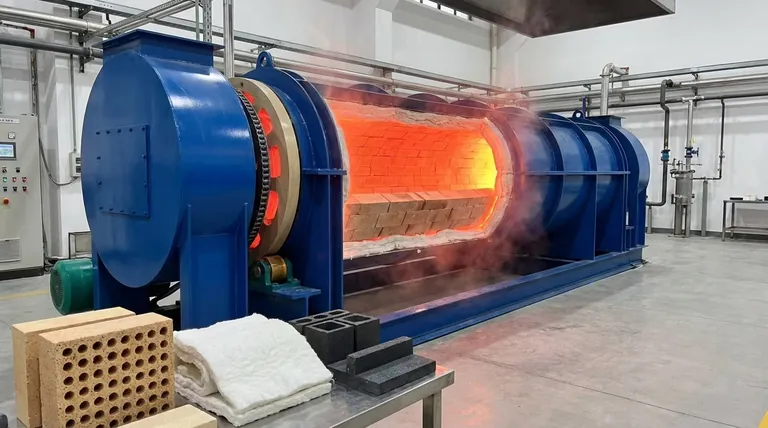
At its core, a muffle furnace's performance is defined by its refractory materials. The most common choices for the insulating lining are high-strength alumina (Al₂O₃), silicon carbide (SiC), and lightweight ceramic fibers, often formed into durable bricks. These materials are selected for their ability to withstand extreme temperatures while ensuring uniform and stable process conditions.

The specific refractory material used in a muffle furnace is not just a detail—it is the critical factor that dictates the furnace's heating speed, energy efficiency, chemical compatibility, and suitability for high-purity applications.
What is the refractory material used in muffle furnace? Choose the Right Lining for Your Lab's Needs

The Role of Refractory Insulation

Why Special Materials Are Necessary

At temperatures above 200°C, standard materials begin to degrade, deform, or fail. Muffle furnaces operate at much higher temperatures, often exceeding 1000°C, which demands the use of specialized refractory materials.

Defining "Refractory" Properties

The term refractory describes a class of materials that are exceptionally resistant to heat, pressure, and chemical attack. Key properties include an extremely high melting point, thermal stability, and resistance to wear and deformation under heat.

The Two Primary Types of Furnace Linings

Muffle furnaces are generally classified into two categories based on their primary insulation material. This choice fundamentally alters the furnace's performance characteristics.

Traditional Refractory Bricks

Furnaces lined with dense, hard bricks made from materials like high-strength alumina or silicon carbide are the traditional standard. These materials offer excellent durability and create highly stable and uniform temperature conditions inside the chamber.

Modern Ceramic Fibers

A more modern approach uses lightweight ceramic fiber insulation. This material has lower thermal mass, allowing the furnace to heat up and cool down much faster. This often results in better energy efficiency for processes that require frequent cycles.

Understanding the Trade-offs and Limitations

The choice of refractory material involves a balance of performance, durability, and compatibility. Understanding these trade-offs is crucial for safe and effective operation.

Chemical Incompatibility

Certain substances can chemically attack and degrade the refractory lining. Alkaline materials, for example, should never be used to melt or process samples inside a muffle furnace, as they can damage the chamber.

Risk of Thermal Shock

While excellent at handling sustained high temperatures, some refractory ceramics can be susceptible to thermal shock—cracking caused by rapid temperature changes. Materials like quartz, sometimes used for high-purity applications, are particularly vulnerable.

Contamination and Purity

For high-purity work, such as in the semiconductor industry, the refractory material itself can be a source of contamination. In these cases, specialized materials like high-purity quartz or ceramic are used for internal components to ensure the process remains clean.

Prohibited Materials

For safety and to protect the furnace lining, you should never place flammable, explosive, or strongly corrosive materials inside. Additionally, materials that can easily melt or deform at low temperatures may damage the furnace floor.

How to Apply This to Your Process

Your specific application will determine which type of furnace and refractory material is most suitable for your work.

  • If your primary focus is durability and temperature stability: A furnace lined with traditional alumina or silicon carbide firebricks is a robust and reliable choice.
  • If your primary focus is rapid cycling and energy efficiency: A furnace with a modern ceramic fiber lining will provide faster heat-up and cool-down times.
  • If your primary focus is high-purity applications: You need to ensure the furnace uses materials like quartz or high-purity ceramics that will not contaminate your samples.

By understanding the properties of its refractory lining, you can maximize the performance and lifespan of your muffle furnace.

Summary Table:

Refractory Material Key Characteristics Ideal For
Alumina / Silicon Carbide Bricks High durability, excellent temperature stability Processes requiring uniform, stable heat
Ceramic Fiber Low thermal mass, fast heat-up/cool-down, energy-efficient Rapid cycling applications
High-Purity Quartz/Ceramics Maximum chemical inertness, minimal contamination High-purity applications (e.g., semiconductors)

Maximize your lab's efficiency and safety with the right muffle furnace. The refractory lining is critical for your application's success, impacting temperature stability, heating speed, and sample purity. At KINTEK, we specialize in lab equipment and consumables, providing expert guidance to help you select the perfect furnace for your specific processes—whether you need durability, rapid cycling, or high-purity performance.

Contact our experts today to discuss your requirements and ensure you get the most reliable and efficient solution for your laboratory needs.

Visual Guide
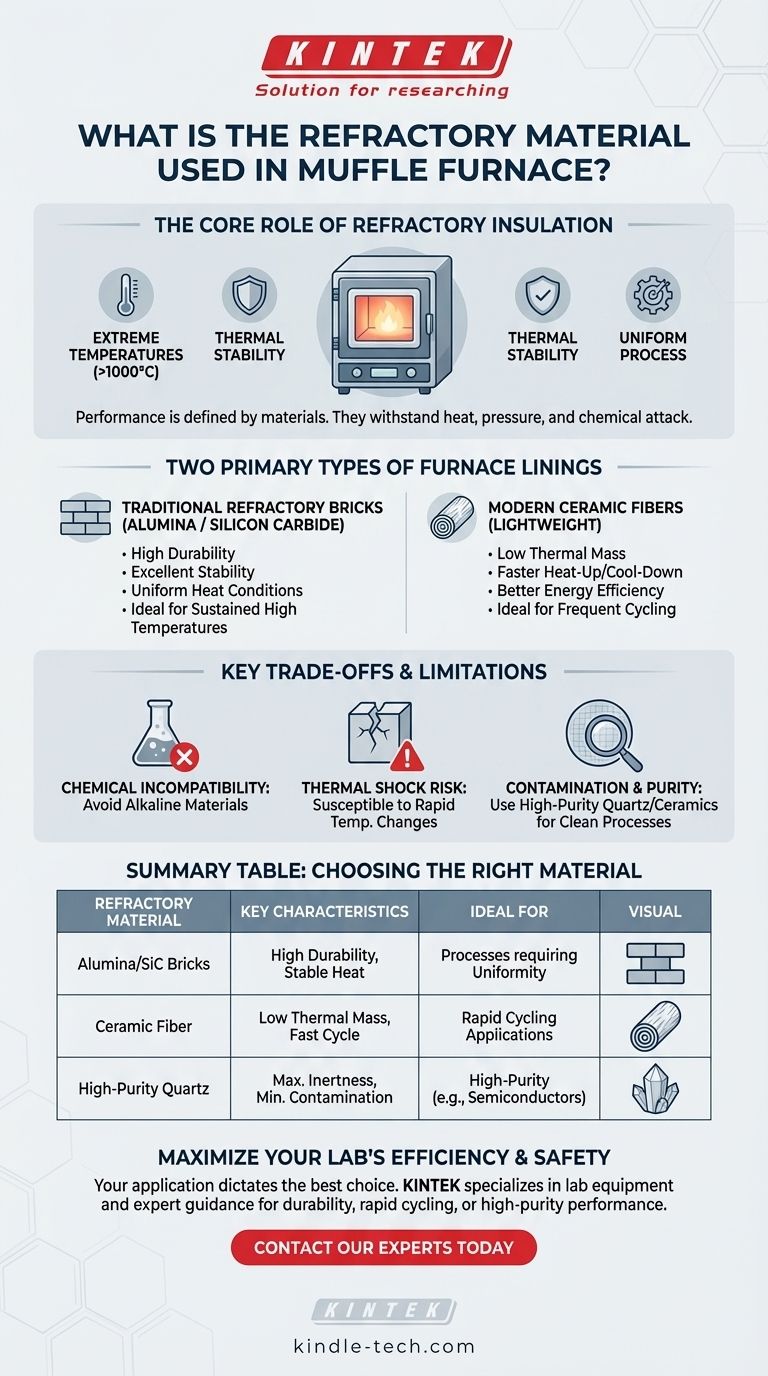
What is the refractory material used in muffle furnace? Choose the Right Lining for Your Lab's Needs Visual Guide

Related Products

People Also Ask

Related Products

Electric Rotary Kiln Pyrolysis Furnace Plant Machine Calciner Small Rotary Kiln Rotating Furnace

Electric Rotary Kiln Pyrolysis Furnace Plant Machine Calciner Small Rotary Kiln Rotating Furnace

Electric rotary kiln - precisely controlled, it's ideal for calcination and drying of materials like lithium cobalate, rare earths, and non-ferrous metals.

Graphite Vacuum Continuous Graphitization Furnace

Graphite Vacuum Continuous Graphitization Furnace

High-temperature graphitization furnace is a professional equipment for graphitization treatment of carbon materials. It is a key equipment for the production of high-quality graphite products. It has high temperature, high efficiency and uniform heating. It is suitable for various high-temperature treatments and graphitization treatments. It is widely used in metallurgy, electronics, aerospace, etc. industry.

Vacuum Sealed Continuous Working Rotary Tube Furnace Rotating Tube Furnace

Vacuum Sealed Continuous Working Rotary Tube Furnace Rotating Tube Furnace

Experience efficient material processing with our vacuum-sealed rotary tube furnace. Perfect for experiments or industrial production, equipped with optional features for controlled feeding and optimized results. Order now.

Ultra-High Temperature Graphite Vacuum Graphitization Furnace

Ultra-High Temperature Graphite Vacuum Graphitization Furnace

The ultra-high temperature graphitization furnace utilizes medium frequency induction heating in a vacuum or inert gas environment. The induction coil generates an alternating magnetic field, inducing eddy currents in the graphite crucible, which heats up and radiates heat to the workpiece, bringing it to the desired temperature. This furnace is primarily used for graphitization and sintering of carbon materials, carbon fiber materials, and other composite materials.

Vacuum Hot Press Furnace Machine Heated Vacuum Press

Vacuum Hot Press Furnace Machine Heated Vacuum Press

Discover the advantages of Vacuum Hot Press Furnace! Manufacture dense refractory metals & compounds, ceramics, and composites under high temp and pressure.

Vacuum Hot Press Furnace Machine for Lamination and Heating

Vacuum Hot Press Furnace Machine for Lamination and Heating

Experience clean and precise lamination with Vacuum Lamination Press. Perfect for wafer bonding, thin-film transformations, and LCP lamination. Order now!

Conductive Carbon Cloth Carbon Paper Carbon Felt for Electrodes and Batteries

Conductive Carbon Cloth Carbon Paper Carbon Felt for Electrodes and Batteries

Conductive carbon cloth, paper, and felt for electrochemical experiments. High-quality materials for reliable and accurate results. Order now for customization options.

Conductive Boron Nitride BN Ceramics Composite for Advanced Applications

Conductive Boron Nitride BN Ceramics Composite for Advanced Applications

Due to the characteristics of boron nitride itself, the dielectric constant and dielectric loss are very small, so it is an ideal electrical insulating material.

Electrode Polishing Material for Electrochemical Experiments

Electrode Polishing Material for Electrochemical Experiments

Looking for a way to polish your electrodes for electrochemical experiments? Our polishing materials are here to help! Follow our easy instructions for best results.

High Temperature Constant Temperature Heating Circulator Water Bath Chiller Circulator for Reaction Bath

High Temperature Constant Temperature Heating Circulator Water Bath Chiller Circulator for Reaction Bath

Efficient and reliable, KinTek KHB Heating Circulator is perfect for your lab needs. With a max. heating temperature of up to 300℃, it features accurate temperature control and fast heating.

80L Heating Chilling Circulator Cooling Water Bath Circulator for High and Low Temperature Constant Temperature Reaction

80L Heating Chilling Circulator Cooling Water Bath Circulator for High and Low Temperature Constant Temperature Reaction

Get all-in-one heating, chilling, and circulating capabilities with our KinTek KCBH 80L Heating Chilling Circulator. High efficiency, reliable performance for labs and industrial applications.

80L Chilling Circulator Cooling Water Circulator for Water Bath Cooling and Low Temperature Constant Temperature Reaction Bath

80L Chilling Circulator Cooling Water Circulator for Water Bath Cooling and Low Temperature Constant Temperature Reaction Bath

Efficient and Reliable 80L Chilling Circulator with a max temp of -120℃. Ideal for labs and industrial use, also works as a one chilling bath.

50L Heating Chilling Circulator Cooling Water Bath Circulator for High and Low Temperature Constant Temperature Reaction

50L Heating Chilling Circulator Cooling Water Bath Circulator for High and Low Temperature Constant Temperature Reaction

Experience versatile heating, chilling, and circulating capabilities with our KinTek KCBH 50L Heating Chilling Circulator. Ideal for labs and industrial settings, with efficient and reliable performance.

20L Heating Chilling Circulator Cooling Water Bath Circulator for High and Low Temperature Constant Temperature Reaction

20L Heating Chilling Circulator Cooling Water Bath Circulator for High and Low Temperature Constant Temperature Reaction

Maximize lab productivity with KinTek KCBH 20L Heating Chilling Circulator. Its all-in-one design offers reliable heating, chilling, and circulating functions for industrial and lab use.

10L Heating Chilling Circulator Cooling Water Bath Circulator for High and Low Temperature Constant Temperature Reaction

10L Heating Chilling Circulator Cooling Water Bath Circulator for High and Low Temperature Constant Temperature Reaction

Experience efficient lab performance with KinTek KCBH 10L Heating Chilling Circulator. Its all-in-one design offers reliable heating, chilling, and circulating functions for industrial and lab use.

Laboratory Vibratory Sieve Shaker Machine Slap Vibrating Sieve

Laboratory Vibratory Sieve Shaker Machine Slap Vibrating Sieve

KT-T200TAP is a slapping and oscillating sieving instrument for laboratory desktop use, with 300 rpm horizontal circular motion and 300 vertical slapping motions to simulate manual sieving to help sample particles pass through better.

Platinum Auxiliary Electrode for Laboratory Use

Platinum Auxiliary Electrode for Laboratory Use

Optimize your electrochemical experiments with our Platinum Auxiliary Electrode. Our high-quality, customizable models are safe and durable. Upgrade today!

Precision Machined Zirconia Ceramic Ball for Engineering Advanced Fine Ceramics

Precision Machined Zirconia Ceramic Ball for Engineering Advanced Fine Ceramics

zirconia ceramic ball have the characteristics of high strength, high hardness, PPM wear level, high fracture toughness, good wear resistance, and high specific gravity.

Automatic Laboratory Heat Press Machine

Automatic Laboratory Heat Press Machine

Precision automatic heat press machines for labs—ideal for material testing, composites, and R&D. Customizable, safe, and efficient. Contact KINTEK today!

Laboratory Hydraulic Press Lab Pellet Press for Button Battery

Laboratory Hydraulic Press Lab Pellet Press for Button Battery

Efficiently prepare samples with our 2T Button Battery Press. Ideal for material research labs and small-scale production. Small footprint, lightweight, and vacuum-compatible.


Leave Your Message