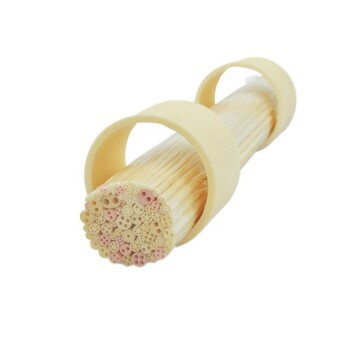
The quartz tube acts as a sealed, high-temperature reaction vessel specifically designed for the vacuum encapsulation of the raw material mixture. It serves as the primary barrier during synthesis, protecting the Molybdenum Carbide (Mo2C) and Gallium (Ga) from environmental contamination while physically containing the reactants.
By maintaining a vacuum environment during the 650°C heat treatment, the quartz tube ensures the chemical integrity of the precursor. It simultaneously locks out oxygen to prevent degradation and locks in liquid gallium to maintain the precise stoichiometry required for the reaction.
The Mechanics of Vacuum Encapsulation
Prevention of Material Oxidation
The most immediate risk to Mo2Ga2C synthesis is exposure to atmospheric oxygen at elevated temperatures. The quartz tube addresses this by facilitating vacuum encapsulation.
By sealing the Mo2C powder and Ga chunks under a vacuum, the tube eliminates the presence of oxygen. This prevents the oxidation of the raw materials, which would otherwise degrade the purity of the final powder and introduce unwanted impurities.
Thermal Resilience at 650°C
The synthesis process involves a heat treatment at 650°C, a temperature at which many standard containment materials might degrade or react.
Quartz is utilized because of its high thermal stability and resistance to thermal shock. It maintains its structural integrity and chemical inertness throughout the heating cycle, ensuring the container itself does not interfere with the precursor formation.
Controlling Reaction Stoichiometry
Confinement of Liquid Gallium
Gallium has a low melting point and becomes liquid well before the reaction temperature reaches 650°C. Without proper containment, the liquid metal could flow away from the reaction site or evaporate.
The sealed quartz tube confines the melted liquid gallium strictly within the reaction zone. This ensures that the gallium remains in contact with the Mo2C powder, facilitating a complete reaction.
Maintaining Chemical Ratios
The success of the synthesis depends on maintaining accurate stoichiometry (the precise ratio of elements).
If the gallium were allowed to escape or volatilize, the chemical ratio would shift, leading to an incomplete reaction or the formation of incorrect phases. The quartz tube’s closed system guarantees that the exact amount of reactants introduced at the start remains available for the synthesis.
Understanding the Trade-offs
The Risk of Seal Integrity
While the quartz tube is excellent for containment, the system relies entirely on the integrity of the vacuum seal.
If the encapsulation is imperfect, even a microscopic leak can introduce oxygen. This compromises the entire batch by oxidizing the sensitive reactants before the desired phase transformation can occur.
Thermal Expansion Constraints
Quartz is rigid, but the materials inside—specifically Gallium—undergo phase changes (solid to liquid) and thermal expansion.
The tube must be sized correctly to accommodate internal pressure changes. If the tube is too small for the expansion of the heated gases or liquid metals, the stress could potentially fracture the quartz, breaking the vacuum and ruining the synthesis.
Making the Right Choice for Your Goal
To ensure the successful preparation of Mo2Ga2C precursors, focus on the following operational priorities:
- If your primary focus is Purity: Ensure the vacuum encapsulation process is rigorous and leak-tested, as the quartz tube is your only defense against oxidation.
- If your primary focus is Stoichiometry: Verify that the reactants are centrally located within the tube before sealing, ensuring the liquid gallium cannot migrate away from the Mo2C powder during heating.
The quartz tube is not just a container; it is an active component of the process control, defining the chemical boundaries of your synthesis.
Summary Table:
| Feature | Role in Mo2Ga2C Synthesis | Key Benefit |
|---|---|---|
| Material Integrity | High thermal resilience at 650°C | Prevents container degradation & contamination |
| Vacuum Seal | Eliminates atmospheric oxygen | Prevents oxidation of Mo2C and Gallium |
| Physical Containment | Confines liquid Gallium in the reaction zone | Maintains precise chemical stoichiometry |
| Chemical Inertness | Non-reactive with precursors | Ensures high purity of final powder |
Elevate Your Material Synthesis with KINTEK Precision
High-purity powder preparation requires more than just high temperatures; it demands rigorous environmental control. KINTEK specializes in providing the high-quality laboratory equipment and consumables necessary for advanced materials research. From specialized quartz tubes and high-temperature furnaces (tube, vacuum, and atmosphere) to essential ceramics and crucibles, our solutions are designed to maintain the chemical integrity of your most sensitive precursors.
Whether you are focusing on Mo2Ga2C synthesis or battery research, KINTEK offers the thermal stability and vacuum reliability your lab needs. Contact us today to optimize your synthesis workflow!
Related Products
- Laboratory Rapid Thermal Processing (RTP) Quartz Tube Furnace
- 1200℃ Split Tube Furnace with Quartz Tube Laboratory Tubular Furnace
- Optical Window Glass Substrate Wafer Quartz Plate JGS1 JGS2 JGS3
- High Temperature Resistant Optical Quartz Glass Sheet
- Rotary Tube Furnace Split Multi Heating Zone Rotating Tube Furnace
People Also Ask
- What technical advantages does an RTP tube furnace offer for photoelectrodes? Achieve Precision & High Phase Purity
- What is the temperature of a quartz tube furnace? Master the Limits for Safe, High-Temp Operation
- How does a quartz tube furnace facilitate the synthesis of rGO? Optimize Your Cathode Matrix with Precise Pyrolysis
- What are the advantages of using an electric heating furnace with a quartz tube for liquid bismuth corrosion control?
- What is the maximum temperature for a quartz tube furnace? Key Limits for Safe & Efficient Operation