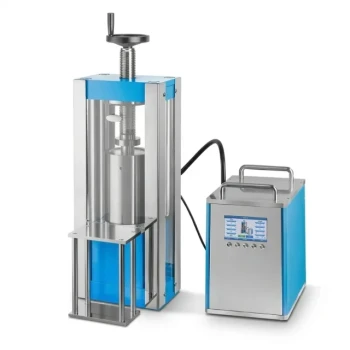
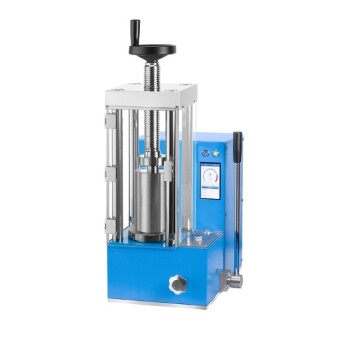
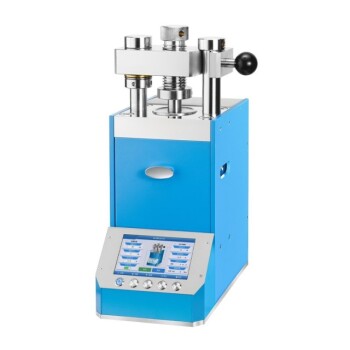
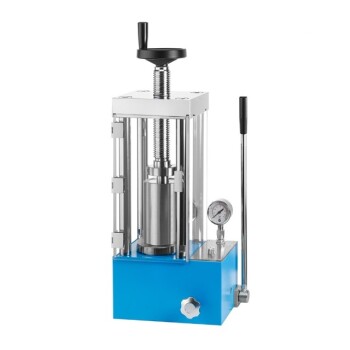
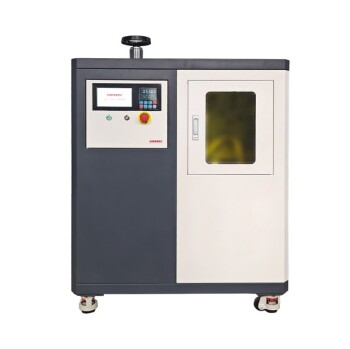
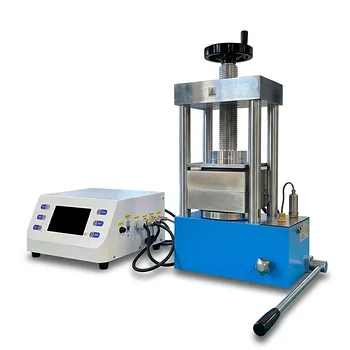
Laboratory hydraulic presses and Cold Isostatic Presses (CIP) function as essential densification tools in the assembly of Lithium Iron Phosphate (LFP) solid-state batteries. Their primary role is to apply high-intensity mechanical pressure to force the solid electrolyte and LFP cathode materials into intimate physical contact. This mechanical intervention is required to overcome the inherent lack of wettability in solid materials, ensuring the battery can conduct ions effectively.
The Core Insight: The fundamental challenge in solid-state batteries is high interface impedance caused by "point contacts" between particles. These presses solve this by mechanically crushing components together to eliminate voids, transforming weak points of contact into robust, continuous pathways for ion transport.
The Challenge of Solid-Solid Interfaces
Overcoming High Interface Impedance
Unlike liquid electrolytes, which naturally flow into pores and wet electrode surfaces, solid electrolytes are rigid.
When an LFP cathode and a sulfide electrolyte are placed together, they naturally form high interface impedance. This is resistance caused by poor physical contact, where particles only touch at microscopic points rather than across their entire surface.
The Problem of Microscopic Voids
Without external intervention, the assembly contains numerous microscopic voids or air gaps.
These voids act as insulators. They block the flow of lithium ions between the cathode and the electrolyte, severing the conductive pathway and rendering the battery inefficient or non-functional.
How Pressure Optimizes Battery Performance
Eliminating Voids Through Densification
The hydraulic press or CIP applies significant mechanical pressure to the assembly.
This pressure forces the sulfide electrolyte particles and LFP cathode particles to deform and pack tightly together. The process effectively eliminates interface voids, maximizing the active surface area available for chemical reactions.
Densifying the Electrolyte Layer
Beyond the interface, the integrity of the electrolyte layer itself is critical.
Using pressures that can reach up to 500 MPa, these presses significantly reduce the porosity of sulfide solid electrolytes (such as Li6PS5Cl). A denser electrolyte layer translates to higher ionic conductivity and structural stability.
Establishing Current Collector Contact
The role of the press extends to the outer layers of the cell assembly.
High-pressure densification ensures tight physical contact between the electrolyte layer and the current collector. This connection is vital for the external transfer of electrons, complementing the internal transport of ions.
Critical Operational Considerations
The Necessity of High Pressure
Standard assembly pressures used in liquid-ion manufacturing are insufficient for solid-state batteries.
To achieve the necessary "tight physical contact," the equipment must be capable of delivering high-tonnage force. If the pressure is too low, the porosity remains high, and the impedance will not drop sufficiently to allow high-performance operation.
Component Uniformity
While hydraulic presses apply uniaxial pressure (from top and bottom), Cold Isostatic Presses (CIP) apply pressure from all directions.
Regardless of the method, the goal is uniformity. Uneven pressure application can lead to localized voids, creating "hot spots" of high resistance that degrade battery performance prematurely.
Making the Right Choice for Your Goal
To maximize the effectiveness of your assembly process, focus on the specific physical outcome you need to achieve.
- If your primary focus is maximizing ion conductivity: Prioritize pressures (up to 500 MPa) that fully densify the sulfide electrolyte, as reducing porosity is directly linked to ion transport speed.
- If your primary focus is reducing internal resistance: Use the press to ensure maximum surface contact between the LFP cathode particles and the electrolyte, thereby minimizing interface impedance.
- If your primary focus is structural integrity: Ensure the pressure is sufficient to bond the electrolyte to the current collector, preventing delamination during handling or testing.
Ultimately, the hydraulic press is not just an assembly tool; it is the primary instrument for engineering the microscopic architecture required for solid-state energy storage.
Summary Table:
| Feature | Role in LFP Solid-State Assembly | Impact on Battery Performance |
|---|---|---|
| Densification | Eliminates microscopic voids in sulfide electrolytes | Increases ionic conductivity and structural stability |
| Interface Contact | Forces LFP cathode and electrolyte into intimate contact | Reduces high interface impedance for faster ion flow |
| High Pressure | Applies up to 500 MPa of mechanical force | Ensures tight physical bonding across all cell layers |
| Current Collector | Presses electrolyte layer to current collector | Facilitates efficient external electron transfer |
Elevate Your Solid-State Battery Research with KINTEK
Precision and pressure are the cornerstones of high-performance solid-state battery assembly. KINTEK specializes in providing advanced laboratory equipment tailored for the energy sector, including high-tonnage hydraulic presses (pellet, hot, and isostatic) and Cold Isostatic Presses (CIP) designed to achieve the extreme densification required for LFP and sulfide electrolyte systems.
Beyond assembly tools, we offer a comprehensive portfolio ranging from high-temperature furnaces (muffle, vacuum, CVD) for material synthesis to crushing and milling systems for precursor preparation. Whether you are optimizing ion transport or reducing interface impedance, our expert solutions ensure your research meets the highest standards of uniformity and reliability.
Ready to optimize your battery architecture? Contact KINTEK today to discover how our high-pressure systems can transform your lab's efficiency!
Related Products
- Electric Split Lab Cold Isostatic Press CIP Machine for Cold Isostatic Pressing
- Electric Lab Cold Isostatic Press CIP Machine for Cold Isostatic Pressing
- Automatic Lab Cold Isostatic Press CIP Machine Cold Isostatic Pressing
- Manual Cold Isostatic Pressing Machine CIP Pellet Press
- Warm Isostatic Press for Solid State Battery Research
People Also Ask
- How is isostatic pressing equipment utilized to integrate lithium metal anodes during solid-state battery assembly?
- How does isostatic pressing equipment enhance lithium metal anode contact? Optimize Your Solid-State Battery Assembly
- What is the meaning of isostatic pressing? Achieve Uniform Density in Complex Parts
- What is isostatic pressing method for ceramics? Achieve Uniform Density for Complex Parts
- What role does cold isostatic pressing play in the formation of feed rods for single crystal growth? Ensure Stability.