The primary role of a Cold Isostatic Press (CIP) is to transform loose powder mixtures into a high-density "green body" capable of withstanding handling and machining. By utilizing isotropic fluid pressures of up to 280 MPa, CIP compresses the aluminum matrix composite materials into a preformed state with a green density of approximately 90%.
By eliminating the majority of internal pores early in the process, CIP establishes a structural foundation that significantly reduces the time required for subsequent vacuum hot pressing while ensuring the component has sufficient strength to be machined to fit specific molds.
The Mechanics of Preform Preparation
Achieving High Initial Density
The core function of CIP is to apply uniform pressure from all directions using a fluid medium. This results in a high green density—around 90% of the theoretical maximum—before thermal processing even begins.
Unlike uniaxial pressing, which can create density gradients, the isotropic nature of CIP ensures uniform density throughout the part. This uniformity is crucial for minimizing distortion and preventing cracking during the later firing stages.
Eliminating Internal Porosity
Loose metal powders naturally contain significant voids and air gaps. CIP mechanically forces these particles together, effectively eliminating the majority of internal pores.
Removing these voids at the cold stage is more efficient than relying solely on the hot press to do the heavy lifting. It creates a solid baseline that allows the subsequent vacuum hot pressing to focus on final bonding rather than gross compaction.
Operational Advantages for Manufacturing
Enabling Mechanical Machining
One of the most practical benefits of CIP is the green strength it imparts to the material. A raw powder mixture cannot be easily shaped to fit a complex vacuum hot press mold.
The CIP process solidifies the powder enough to allow for mechanical machining. This allows operators to precisely shape the preform to fit the hot pressing molds, ensuring a perfect interface and optimal thermal transfer during sintering.
Reducing Hot Press Cycle Time
Vacuum hot pressing is an energy-intensive and time-consuming process. By entering this phase with a preform that is already 90% dense, the required time for hot pressing is significantly reduced.
The vacuum hot press no longer needs to achieve the full range of compaction; it simply completes the densification and facilitates the diffusion bonding of the aluminum matrix.
Understanding the Trade-offs
Tooling and Geometry Constraints
While CIP is excellent for complex shapes, it requires careful tooling management. Support structures are often necessary to prevent bulging, sagging, or unwanted deformation during the tool-filling and pressurization stages.
Not a Standalone Solution
It is critical to remember that the CIP product is a "green" body. While it has high density, it lacks the chemical bonding and final mechanical properties that only high-temperature sintering or hot pressing can provide. It is a preparation step, not a finishing step.
Making the Right Choice for Your Goal
To maximize the efficiency of your aluminum matrix composite production, consider your specific manufacturing priorities:
- If your primary focus is process efficiency: Utilize CIP to maximize pre-process density (90%), which will directly shorten the expensive and time-consuming vacuum hot press cycles.
- If your primary focus is geometric precision: Rely on the green strength provided by CIP to machine your preforms into near-net shapes that perfectly fit your hot press molds.
CIP transforms a difficult-to-handle powder into a robust, dense preform, streamlining the path to a high-integrity final composite.
Summary Table:
| Feature | Benefit of CIP in Composite Preparation |
|---|---|
| Isotropic Pressure | Up to 280 MPa for uniform density and zero distortion. |
| Green Density | Reaches ~90% theoretical density before thermal processing. |
| Porosity Reduction | Eliminates internal voids to shorten subsequent hot pressing. |
| Green Strength | Enables mechanical machining to fit specific molds precisely. |
| Cycle Efficiency | Minimizes time and energy required in the vacuum hot press. |
Streamline Your Composite Manufacturing with KINTEK
Maximize the efficiency and precision of your aluminum matrix composite production with KINTEK’s industry-leading Cold Isostatic Presses (CIP) and isostatic systems. By achieving 90% green density, our solutions significantly reduce your vacuum hot press cycle times and energy costs.
At KINTEK, we specialize in providing high-performance laboratory equipment, including high-temperature furnaces, vacuum hot presses, and hydraulic pellet presses, alongside essential consumables like PTFE products and crucibles. Our team is dedicated to helping researchers and manufacturers optimize their material properties and throughput.
Ready to enhance your material prep workflow? Contact our experts today to find the perfect CIP solution for your lab!
Related Products
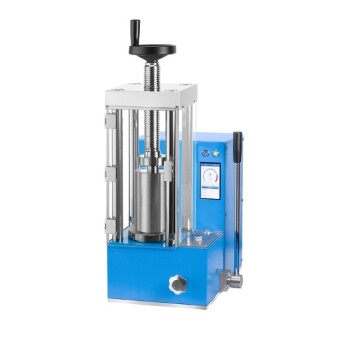
- Electric Lab Cold Isostatic Press CIP Machine for Cold Isostatic Pressing
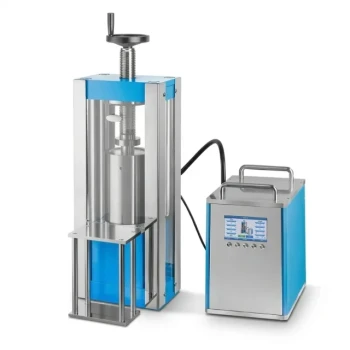
- Electric Split Lab Cold Isostatic Press CIP Machine for Cold Isostatic Pressing
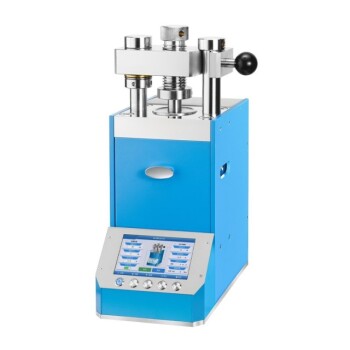
- Automatic Lab Cold Isostatic Press CIP Machine Cold Isostatic Pressing
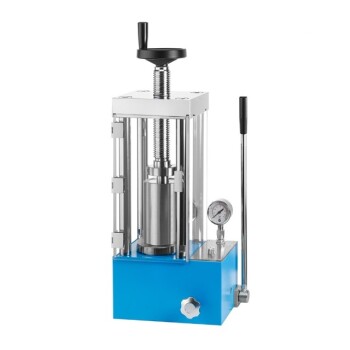
- Manual Cold Isostatic Pressing Machine CIP Pellet Press
- Isostatic Molding Pressing Molds for Lab
People Also Ask
- What role does cold isostatic pressing play in the formation of feed rods for single crystal growth? Ensure Stability.
- What is isostatic pressing method for ceramics? Achieve Uniform Density for Complex Parts
- In what ways does Cold Isostatic Pressing (CIP) enhance LiFePO4 battery performance? Boost Density and Conductivity
- How does Cold Isostatic Pressing (CIP) benefit SiC ceramic reactors? Achieve Flawless Material Integrity
- Why is a cold isostatic press advantageous for Argyrodite sulfide solid-state batteries? Achieve Optimal Densification