Knowledge Resources What is the sequence of the heat treatment process? Master the 3 Stages for Perfect Material Properties
Author avatar

Tech Team · Kintek Solution

Updated 2 months ago

What is the sequence of the heat treatment process? Master the 3 Stages for Perfect Material Properties


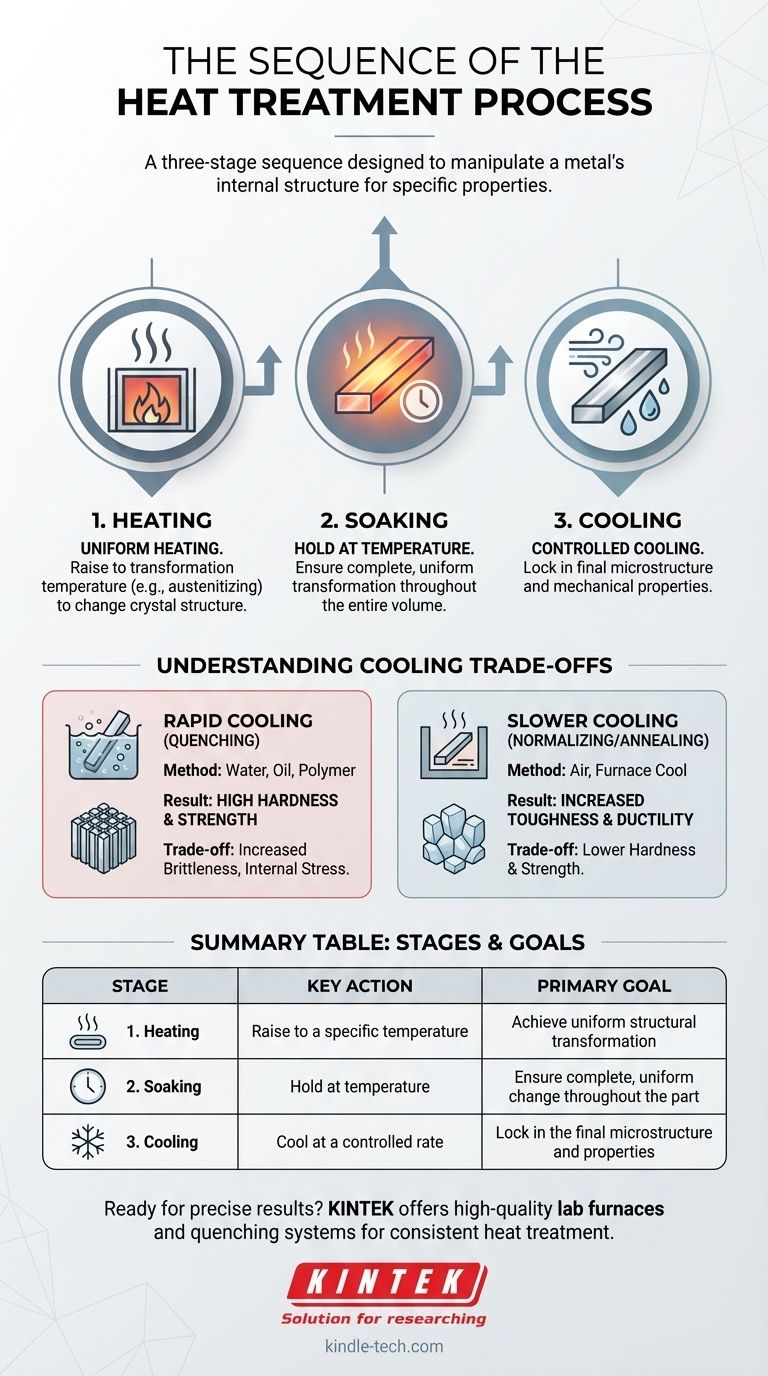
At its core, the heat treatment process consists of three distinct, sequential stages designed to manipulate a metal's internal structure. The universally recognized sequence is heating the material to a specific temperature, soaking it at that temperature for a set duration, and finally, cooling it back to room temperature at a controlled rate.

The entire purpose of this three-stage sequence—heating, soaking, and cooling—is to deliberately alter the microscopic crystal structure of a metal to achieve specific, predictable mechanical properties like hardness, toughness, or ductility.
What is the sequence of the heat treatment process? Master the 3 Stages for Perfect Material Properties

The Three Foundational Stages of Heat Treatment

Each stage in the heat treatment process serves a unique and critical function. The success of the final outcome depends on precise control over the variables in each of the three phases.

Stage 1: Heating - Setting the Stage for Change

The process begins by uniformly heating the metal or alloy. The primary goal is to bring the material's internal structure to a specific transformation temperature.

For many common steels, this is known as the austenitizing temperature, where the crystal structure changes into a phase called austenite, which is capable of dissolving carbon. The rate of heating is also a critical factor, as heating too quickly can cause thermal stress and cracking, especially in complex shapes.

Stage 2: Soaking - Ensuring Complete Transformation

Once the target temperature is reached, the material is held there for a predetermined period. This stage is known as soaking.

The purpose of soaking is to ensure that the desired structural transformation occurs uniformly throughout the entire volume of the part, from the surface to the core. Soaking time depends heavily on the alloy type, the cross-sectional thickness of the component, and the initial condition of the material.

Stage 3: Cooling - Locking in the Final Properties

The final and often most critical stage is cooling. The rate at which the material is cooled from the soaking temperature directly determines the final microstructure and, consequently, its mechanical properties.

This controlled cooling "locks in" a specific crystal structure. The method and speed of cooling are chosen deliberately to produce the desired balance of hardness, strength, and ductility.

Understanding the Trade-offs in Cooling

The cooling stage is not a one-size-fits-all process. The choice of cooling method involves significant trade-offs that dictate the metal's final performance characteristics.

Rapid Cooling (Quenching)

Quenching involves cooling the material very rapidly by immersing it in a medium like water, oil, or a polymer solution.

This rapid cooling traps the transformed structure (e.g., creating martensite in steel), resulting in extremely high hardness and strength. However, the major trade-off is a significant increase in brittleness and high internal stresses, which can make the part susceptible to cracking.

Slower Cooling (Normalizing or Annealing)

Slower cooling methods, such as allowing the part to cool in still air (normalizing) or cooling it very slowly inside a furnace (annealing), produce different results.

These methods result in softer, more ductile microstructures. The benefit is significantly reduced internal stress and increased toughness, but the trade-off is lower hardness and tensile strength compared to a quenched part.

How to Apply This to Your Goal

Your desired outcome determines how you manage the variables within this three-stage process, particularly the cooling rate.

  • If your primary focus is achieving maximum hardness and wear resistance: You will need a very rapid cooling rate, achieved through quenching.
  • If your primary focus is a balance of good strength and toughness: A more moderate cooling rate, such as cooling in air (normalizing), is the appropriate choice.
  • If your primary focus is maximizing ductility and machinability: You will require a very slow, controlled cooling rate, typically achieved through furnace cooling (annealing).

Ultimately, mastering heat treatment is about understanding how to manipulate this fundamental sequence to produce a material perfectly suited for its intended application.

Summary Table:

Stage Key Action Primary Goal
1. Heating Raise to a specific temperature Achieve uniform structural transformation
2. Soaking Hold at temperature Ensure complete, uniform change throughout the part
3. Cooling Cool at a controlled rate Lock in the final microstructure and properties

Ready to achieve precise material properties in your lab? The right equipment is crucial for controlling each stage of the heat treatment sequence. KINTEK specializes in high-quality lab furnaces and quenching systems that deliver the exact heating, soaking, and cooling rates you need for consistent, repeatable results. Whether your goal is maximum hardness, improved toughness, or enhanced ductility, our solutions are designed for your success. Contact our experts today to discuss your specific heat treatment requirements!

Visual Guide
What is the sequence of the heat treatment process? Master the 3 Stages for Perfect Material Properties Visual Guide

Related Products

People Also Ask

Related Products

Vacuum Heat Treat Furnace with Ceramic Fiber Liner

Vacuum Heat Treat Furnace with Ceramic Fiber Liner

Vacuum furnace with polycrystalline ceramic fiber insulation liner for excellent heat insulation and uniform temperature field. Choose from 1200℃ or 1700℃ max. working temperature with high vacuum performance and precise temperature control.

Molybdenum Vacuum Heat Treat Furnace

Molybdenum Vacuum Heat Treat Furnace

Discover the benefits of a high-configuration molybdenum vacuum furnace with heat shield insulation. Ideal for high-purity, vacuum environments like sapphire crystal growth and heat treatment.

2200 ℃ Graphite Vacuum Heat Treat Furnace

2200 ℃ Graphite Vacuum Heat Treat Furnace

Discover the power of the KT-VG Graphite Vacuum Furnace - with a maximum working temperature of 2200℃, it's perfect for vacuum sintering of various materials. Learn more now.

1400℃ Controlled Atmosphere Furnace with Nitrogen and Inert Atmosphere

1400℃ Controlled Atmosphere Furnace with Nitrogen and Inert Atmosphere

Achieve precise heat treatment with KT-14A controlled atmosphere furnace. Vacuum sealed with a smart controller, it's ideal for lab and industrial use up to 1400℃.

600T Vacuum Induction Hot Press Furnace for Heat Treat and Sintering

600T Vacuum Induction Hot Press Furnace for Heat Treat and Sintering

Discover the 600T Vacuum Induction Hot Press Furnace, designed for high-temperature sintering experiments in vacuum or protected atmospheres. Its precise temperature and pressure control, adjustable working pressure, and advanced safety features make it ideal for nonmetal materials, carbon composites, ceramics, and metal powders.

1200℃ Controlled Atmosphere Furnace Nitrogen Inert Atmosphere Furnace

1200℃ Controlled Atmosphere Furnace Nitrogen Inert Atmosphere Furnace

Discover our KT-12A Pro Controlled atmosphere furnace - high precision, heavy duty vacuum chamber, versatile smart touch screen controller, and excellent temperature uniformity up to 1200C. Ideal for both laboratory and industrial application.

Vacuum Heat Treat and Pressure Sintering Furnace for High Temperature Applications

Vacuum Heat Treat and Pressure Sintering Furnace for High Temperature Applications

Vacuum pressure sintering furnaces are designed for high temperature hot pressing applications in metal and ceramic sintering. Its advanced features ensure precise temperature control, reliable pressure maintenance, and a robust design for seamless operation.

1700℃ Controlled Atmosphere Furnace Nitrogen Inert Atmosphere Furnace

1700℃ Controlled Atmosphere Furnace Nitrogen Inert Atmosphere Furnace

KT-17A Controlled atmosphere furnace: 1700℃ heating, vacuum sealing technology, PID temperature control, and versatile TFT smart touch screen controller for laboratory and industrial use.

2200 ℃ Tungsten Vacuum Heat Treat and Sintering Furnace

2200 ℃ Tungsten Vacuum Heat Treat and Sintering Furnace

Experience the ultimate refractory metal furnace with our Tungsten vacuum furnace. Capable of reaching 2200℃, perfect for sintering advanced ceramics and refractory metals. Order now for high-quality results.

Laboratory Rapid Thermal Processing (RTP) Quartz Tube Furnace

Laboratory Rapid Thermal Processing (RTP) Quartz Tube Furnace

Get lightning-fast heating with our RTP Rapid Heating Tube Furnace. Designed for precise, high-speed heating and cooling with convenient sliding rail and TFT touch screen controller. Order now for ideal thermal processing!

Vacuum Hot Press Furnace Machine Heated Vacuum Press

Vacuum Hot Press Furnace Machine Heated Vacuum Press

Discover the advantages of Vacuum Hot Press Furnace! Manufacture dense refractory metals & compounds, ceramics, and composites under high temp and pressure.

Rotary Tube Furnace Split Multi Heating Zone Rotating Tube Furnace

Rotary Tube Furnace Split Multi Heating Zone Rotating Tube Furnace

Multi zone rotary furnace for high-precision temperature control with 2-8 independent heating zones. Ideal for lithium ion battery electrode materials and high-temperature reactions. Can work under vacuum and controlled atmosphere.

Multi-zone Laboratory Tube Furnace

Multi-zone Laboratory Tube Furnace

Experience precise, efficient thermal testing with our Multi Zone Tube Furnace. Independent heating zones and temperature sensors allow for controlled high-temperature gradient heating fields. Order now for advanced thermal analysis!

Electric Rotary Kiln Continuous Working Small Rotary Furnace Heating Pyrolysis Plant

Electric Rotary Kiln Continuous Working Small Rotary Furnace Heating Pyrolysis Plant

Efficiently calcine and dry bulk powder and lump fluid materials with an electric heating rotary furnace. Ideal for processing lithium ion battery materials and more.

Ultra-High Temperature Graphite Vacuum Graphitization Furnace

Ultra-High Temperature Graphite Vacuum Graphitization Furnace

The ultra-high temperature graphitization furnace utilizes medium frequency induction heating in a vacuum or inert gas environment. The induction coil generates an alternating magnetic field, inducing eddy currents in the graphite crucible, which heats up and radiates heat to the workpiece, bringing it to the desired temperature. This furnace is primarily used for graphitization and sintering of carbon materials, carbon fiber materials, and other composite materials.

1700℃ Laboratory High Temperature Tube Furnace with Alumina Tube

1700℃ Laboratory High Temperature Tube Furnace with Alumina Tube

Looking for a high-temperature tube furnace? Check out our 1700℃ Tube Furnace with Alumina Tube. Perfect for research and industrial applications up to 1700C.

Horizontal High Temperature Graphite Vacuum Graphitization Furnace

Horizontal High Temperature Graphite Vacuum Graphitization Furnace

Horizontal Graphitization Furnace: This type of furnace is designed with the heating elements placed horizontally, allowing for uniform heating of the sample. It's well-suited for graphitizing large or bulky samples that require precise temperature control and uniformity.

Laboratory Muffle Oven Furnace Bottom Lifting Muffle Furnace

Laboratory Muffle Oven Furnace Bottom Lifting Muffle Furnace

Efficiently produce batches with excellent temperature uniformity using our Bottom Lifting Furnace. Features two electric lifting stages and advanced temperature control up to 1600℃.

High Temperature Muffle Oven Furnace for Laboratory Debinding and Pre Sintering

High Temperature Muffle Oven Furnace for Laboratory Debinding and Pre Sintering

KT-MD High temperature debinding and pre-sintering furnace for ceramic materials with various molding processes. Ideal for electronic components such as MLCC and NFC.

1200℃ Split Tube Furnace with Quartz Tube Laboratory Tubular Furnace

1200℃ Split Tube Furnace with Quartz Tube Laboratory Tubular Furnace

KT-TF12 split tube furnace: high-purity insulation, embedded heating wire coils, and max. 1200C. Widely used for new materials and chemical vapour deposition.


Leave Your Message