Knowledge What is the source of electron beam welding? The High-Voltage Power Supply Explained
Author avatar

Tech Team · Kintek Solution

Updated 1 week ago

What is the source of electron beam welding? The High-Voltage Power Supply Explained


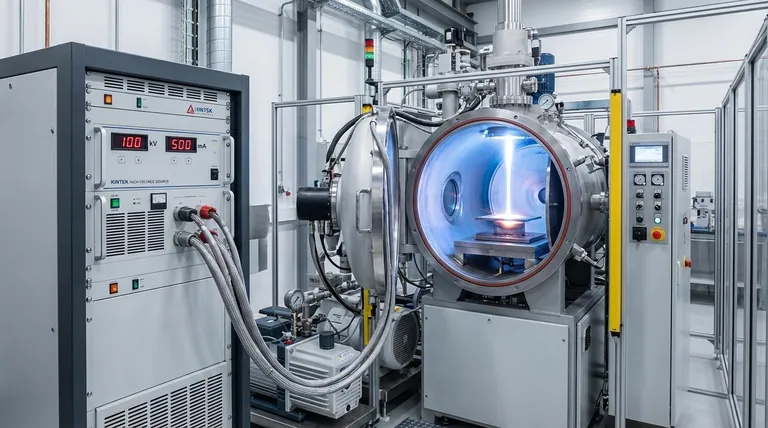
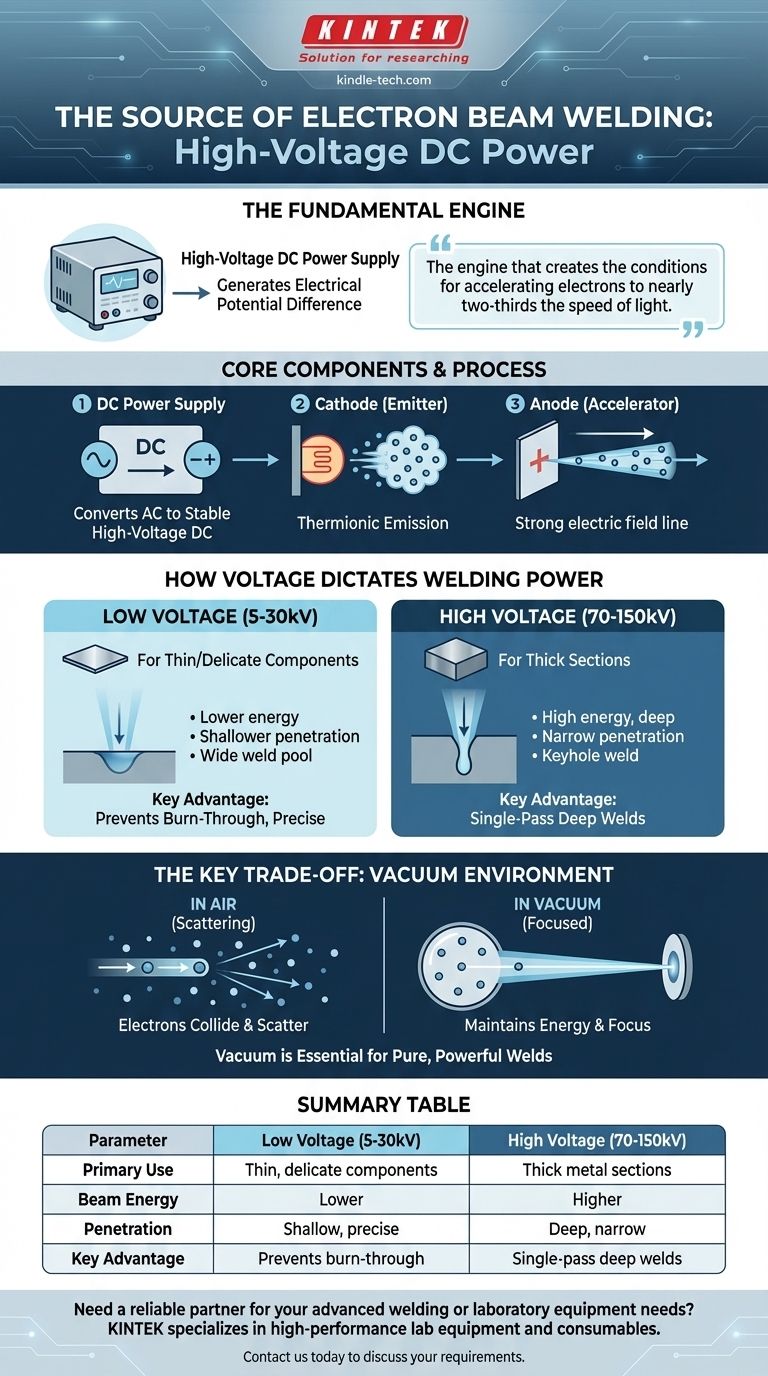
The source of an electron beam weld is a high-voltage direct current (DC) power supply. This specialized power source is responsible for generating a significant electrical potential difference between a cathode (the electron emitter) and an anode (the accelerator), which is the fundamental first step in creating a high-energy beam of electrons for welding.

The power supply is not merely a source of electricity; it is the engine that creates the conditions for accelerating electrons to nearly two-thirds the speed of light, transforming them into a powerful tool for joining materials.
What is the source of electron beam welding? The High-Voltage Power Supply Explained

The Core Components of the Power System

To understand the source, you must understand the system it drives. The DC power supply is the heart of a system designed to generate, accelerate, and focus a beam of electrons.

The High-Voltage DC Power Supply

This unit converts standard alternating current (AC) from the grid into the stable, high-voltage direct current (DC) required for the process. Its primary function is to create a powerful and stable electric field.

The Cathode (The Emitter)

The negative terminal of the power supply is connected to a filament, typically made of tungsten, which acts as the cathode. The power supply heats this filament, causing it to release a cloud of free electrons in a process called thermionic emission.

The Anode (The Accelerator)

The positive terminal of the power supply creates a strong positive charge on the anode. This establishes a massive voltage difference between the negative cathode and the positive anode, which violently accelerates the cloud of free electrons toward the anode, forming a coherent beam.

How Voltage Dictates Welding Power

The voltage level generated by the power supply directly controls the kinetic energy of the electrons in the beam. This energy determines the beam's penetration depth and welding capability.

Low Voltage for Thin Materials

For welding thin or delicate components, power sources typically operate in the 5kV to 30kV range. The lower voltage imparts less velocity to the electrons, resulting in a lower-energy beam with shallower penetration, which prevents burning through the material.

High Voltage for Thick Materials

To weld thick sections of metal, power sources must generate much higher voltages, typically between 70kV and 150kV. This extreme voltage accelerates electrons to very high speeds, creating a high-energy beam capable of producing deep, narrow, and high-quality welds.

Understanding the Key Trade-off: Power vs. Environment

The use of a high-voltage electron beam introduces a fundamental operational requirement that defines the entire process.

The Necessity of a Vacuum

An electron beam can only maintain its energy and focus in a vacuum. If fired in open air, the electrons would immediately collide with air molecules, scattering their energy and making welding impossible.

Therefore, the entire process must be conducted inside a vacuum chamber. While this allows for exceptionally pure and powerful welds, it adds significant complexity, cost, and cycle time to the operation compared to other welding methods.

Matching the Source to the Application

The choice of power source voltage is dictated entirely by the material and the joint design.

  • If your primary focus is welding thin, delicate components: A lower-voltage system (5-30kV) provides the necessary precision and controlled penetration.
  • If your primary focus is joining thick metal sections for structural applications: A high-voltage system (70-150kV) is required to generate the high-energy beam needed for deep, single-pass welds.

Understanding the power source is the key to mastering the unique capabilities of the electron beam welding process.

Summary Table:

Parameter Low Voltage (5-30kV) High Voltage (70-150kV)
Primary Use Thin, delicate components Thick metal sections
Beam Energy Lower Higher
Penetration Shallow, precise Deep, narrow
Key Advantage Prevents burn-through Single-pass deep welds

Need a reliable partner for your advanced welding or laboratory equipment needs? KINTEK specializes in high-performance lab equipment and consumables, serving industries that require precision and reliability. Whether you're working with advanced materials or need robust solutions for your R&D or production, our expertise can help you achieve superior results. Contact us today to discuss how we can support your specific requirements!

Visual Guide
What is the source of electron beam welding? The High-Voltage Power Supply Explained Visual Guide

Related Products

People Also Ask

Related Products

Electric Heated Hydraulic Vacuum Heat Press for Lab

Electric Heated Hydraulic Vacuum Heat Press for Lab

The Electric Vacuum Heat Press is a specialized heat press equipment that operates in a vacuum environment, utilizing advanced infrared heating and precise temperature control for high quality, rugged and reliable performance.

Cold Isostatic Pressing Machine CIP for Small Workpiece Production 400Mpa

Cold Isostatic Pressing Machine CIP for Small Workpiece Production 400Mpa

Produce uniformly high-density materials with our Cold Isostatic Press. Ideal for compacting small workpieces in production settings. Widely used in powder metallurgy, ceramics, and biopharmaceutical fields for high-pressure sterilization and protein activation.

Vacuum Cold Mounting Machine for Sample Preparation

Vacuum Cold Mounting Machine for Sample Preparation

Vacuum Cold Mounting Machine for precise sample prep. Handles porous, fragile materials with -0.08MPa vacuum. Ideal for electronics, metallurgy, and failure analysis.

Engineering Advanced Fine Ceramics Head Tweezers with Pointed Elbow Zirconia Ceramic Tip

Engineering Advanced Fine Ceramics Head Tweezers with Pointed Elbow Zirconia Ceramic Tip

Zirconia ceramic tweezers are a high-precision tool made of advanced ceramic materials, especially suitable for operating environments that require high precision and corrosion resistance. This type of tweezers not only has excellent physical properties, but is also popular in the medical and laboratory fields because of its biocompatibility.

30T 40T Split Automatic Heated Hydraulic Press Machine with Heated Plates for Laboratory Hot Press

30T 40T Split Automatic Heated Hydraulic Press Machine with Heated Plates for Laboratory Hot Press

Discover our split automatic heated lab press 30T/40T for precise sample preparation in material research, pharmacy, ceramics, and electronics industries. With a small footprint and heating up to 300°C, it's perfect for processing under vacuum environment.

Laboratory Disc Rotary Mixer for Efficient Sample Mixing and Homogenization

Laboratory Disc Rotary Mixer for Efficient Sample Mixing and Homogenization

Efficient Laboratory Disc Rotary Mixer for Precise Sample Mixing, Versatile for Various Applications, DC Motor and Microcomputer Control, Adjustable Speed and Angle.

Laboratory Oscillating Orbital Shaker

Laboratory Oscillating Orbital Shaker

Mixer-OT orbital shaker uses brushless motor, which can run for a long time. It is suitable for vibration tasks of culture dishes, flasks and beakers.

Vacuum Hot Press Furnace Machine for Lamination and Heating

Vacuum Hot Press Furnace Machine for Lamination and Heating

Experience clean and precise lamination with Vacuum Lamination Press. Perfect for wafer bonding, thin-film transformations, and LCP lamination. Order now!

Dental Porcelain Zirconia Sintering Ceramic Vacuum Press Furnace

Dental Porcelain Zirconia Sintering Ceramic Vacuum Press Furnace

Get precise dental results with Dental Vacuum Press Furnace. Automatic temperature calibration, low noise tray, and touch screen operation. Order now!

Large Vertical Graphite Vacuum Graphitization Furnace

Large Vertical Graphite Vacuum Graphitization Furnace

A large vertical high-temperature graphitization furnace is a type of industrial furnace used for the graphitization of carbon materials, such as carbon fiber and carbon black. It is a high-temperature furnace that can reach temperatures of up to 3100°C.

Custom PTFE Teflon Parts Manufacturer for PTFE Tweezers

Custom PTFE Teflon Parts Manufacturer for PTFE Tweezers

PTFE tweezers inherit the excellent physical and chemical properties of PTFE, such as high temperature resistance, cold resistance, acid and alkali resistance, and corrosion resistance to most organic solvents.

Vacuum Hot Press Furnace Machine Heated Vacuum Press

Vacuum Hot Press Furnace Machine Heated Vacuum Press

Discover the advantages of Vacuum Hot Press Furnace! Manufacture dense refractory metals & compounds, ceramics, and composites under high temp and pressure.

Ultra-High Temperature Graphite Vacuum Graphitization Furnace

Ultra-High Temperature Graphite Vacuum Graphitization Furnace

The ultra-high temperature graphitization furnace utilizes medium frequency induction heating in a vacuum or inert gas environment. The induction coil generates an alternating magnetic field, inducing eddy currents in the graphite crucible, which heats up and radiates heat to the workpiece, bringing it to the desired temperature. This furnace is primarily used for graphitization and sintering of carbon materials, carbon fiber materials, and other composite materials.

Molybdenum Vacuum Heat Treat Furnace

Molybdenum Vacuum Heat Treat Furnace

Discover the benefits of a high-configuration molybdenum vacuum furnace with heat shield insulation. Ideal for high-purity, vacuum environments like sapphire crystal growth and heat treatment.

Multifunctional Electrolytic Electrochemical Cell Water Bath Single Layer Double Layer

Multifunctional Electrolytic Electrochemical Cell Water Bath Single Layer Double Layer

Discover our high-quality Multifunctional Electrolytic Cell Water Baths. Choose from single or double-layer options with superior corrosion resistance. Available in 30ml to 1000ml sizes.

50L Heating Chilling Circulator Cooling Water Bath Circulator for High and Low Temperature Constant Temperature Reaction

50L Heating Chilling Circulator Cooling Water Bath Circulator for High and Low Temperature Constant Temperature Reaction

Experience versatile heating, chilling, and circulating capabilities with our KinTek KCBH 50L Heating Chilling Circulator. Ideal for labs and industrial settings, with efficient and reliable performance.

2200 ℃ Graphite Vacuum Heat Treat Furnace

2200 ℃ Graphite Vacuum Heat Treat Furnace

Discover the power of the KT-VG Graphite Vacuum Furnace - with a maximum working temperature of 2200℃, it's perfect for vacuum sintering of various materials. Learn more now.

600T Vacuum Induction Hot Press Furnace for Heat Treat and Sintering

600T Vacuum Induction Hot Press Furnace for Heat Treat and Sintering

Discover the 600T Vacuum Induction Hot Press Furnace, designed for high-temperature sintering experiments in vacuum or protected atmospheres. Its precise temperature and pressure control, adjustable working pressure, and advanced safety features make it ideal for nonmetal materials, carbon composites, ceramics, and metal powders.

Vacuum Heat Treat and Molybdenum Wire Sintering Furnace for Vacuum Sintering

Vacuum Heat Treat and Molybdenum Wire Sintering Furnace for Vacuum Sintering

A vacuum molybdenum wire sintering furnace is a vertical or bedroom structure, which is suitable for withdrawal, brazing, sintering and degassing of metal materials under high vacuum and high temperature conditions. It is also suitable for dehydroxylation treatment of quartz materials.

Vacuum Heat Treat Furnace with Ceramic Fiber Liner

Vacuum Heat Treat Furnace with Ceramic Fiber Liner

Vacuum furnace with polycrystalline ceramic fiber insulation liner for excellent heat insulation and uniform temperature field. Choose from 1200℃ or 1700℃ max. working temperature with high vacuum performance and precise temperature control.


Leave Your Message