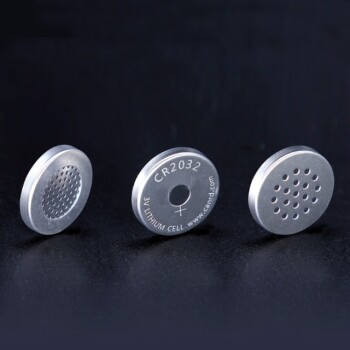
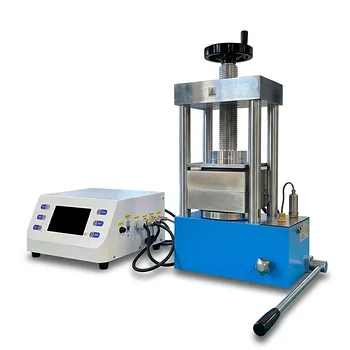
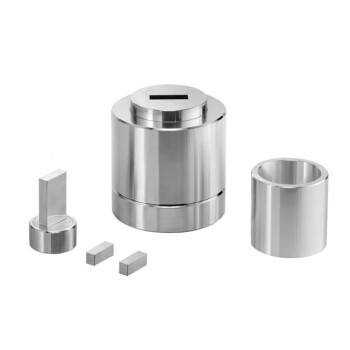
In the specific context of lithium-air battery fabrication, a laboratory hydraulic press is the primary tool used to bond the active catalyst material to the current collector. Specifically, it applies precise mechanical force to compress a prepared catalyst slurry mixture onto a nickel mesh, forming uniform electrode discs (typically 1cm in diameter). This step is not merely about shaping; it is the critical process that integrates loose chemical components into a mechanically stable, conductive electrode.
The hydraulic press acts as the bridge between chemical potential and electrical performance. By applying uniform pressure, it ensures intimate contact between the catalyst layer and current collector, which is non-negotiable for efficient electron transport and structural durability.
The Mechanics of Electrode Formation
Integrating the Catalyst and Collector
The process begins with a prepared catalyst slurry. To function as an air electrode, this slurry must be physically mated to a conductive backbone, typically a nickel mesh.
Creating the Physical Structure
The hydraulic press forces the slurry into the voids of the mesh. This transforms a viscous mixture and a metal grid into a single, unified solid disc.
Ensuring Dimensional Precision
Research consistency requires identical samples. The press allows for the creation of electrode discs with exact dimensions, such as the standard 1cm diameter cited in laboratory protocols.
The Critical Role of Densification
Establishing Electrical Continuity
Physical proximity between materials is not enough for high-performance batteries. The press applies sufficient tonnage to ensure "tight contact" between the catalyst and the nickel mesh.
Optimizing Electron Transport
This tight contact reduces interfacial resistance. By optimizing electron transport paths, the press ensures that the energy generated at the chemical level can move efficiently through the external circuit.
Structural Integrity and Longevity
Mechanical Bonding
Without the high pressure provided by a hydraulic press, the catalyst layer would likely delaminate or crumble. The pressure locks the particles together and adheres them to the mesh.
Withstanding Operation
The electrode must maintain its shape during the battery's operation. The hydraulic press creates a robust structure capable of maintaining stability despite the chemical and physical stresses of cycling.
Understanding the Trade-offs
Balancing Density with Porosity
While the hydraulic press ensures contact, "air" electrodes require porosity to allow oxygen ingress. The Risk: Applying too much pressure can crush the pores, suffocating the electrode and preventing the necessary oxidation reactions.
Protecting the Substrate
The nickel mesh serves as the skeleton of the electrode. The Risk: Excessive force can deform or shear the mesh, compromising the mechanical backbone of the component.
Making the Right Choice for Your Goal
- If your primary focus is electrical efficiency: Prioritize higher pressure ranges to maximize the contact area between the catalyst and the nickel mesh, reducing internal resistance.
- If your primary focus is gas diffusion rates: Use moderate pressure to secure the catalyst without collapsing the microscopic pores required for oxygen transport.
Precision in pressure application is the variable that transforms a simple slurry into a high-performance energy storage interface.
Summary Table:
| Process Phase | Role of Hydraulic Press | Key Outcome |
|---|---|---|
| Material Integration | Compresses catalyst slurry into nickel mesh | Unified, conductive solid disc |
| Electrical Continuity | Applies precise tonnage for "tight contact" | Minimized interfacial resistance |
| Structural Formation | Mechanical bonding of particles and mesh | Prevention of delamination/crumbling |
| Dimensional Control | Uniform force application across dies | Consistent 1cm diameter electrodes |
| Performance Tuning | Balancing pressure vs. porosity | Optimized oxygen ingress & electron flow |
Elevate Your Battery Research with KINTEK Precision
Transitioning from catalyst slurry to a high-performance electrode requires more than just pressure—it requires precision and repeatability. KINTEK specializes in advanced laboratory equipment, offering a robust range of pellet, hot, and isostatic hydraulic presses designed specifically for sensitive battery research and material densification.
Whether you are developing lithium-air interfaces, solid-state electrolytes, or advanced fuel cells, our solutions ensure your electrodes maintain perfect structural integrity and electrical continuity. Beyond presses, explore our comprehensive portfolio of high-temperature furnaces, crushing systems, and specialized consumables to streamline your entire R&D workflow.
Ready to achieve superior electrode performance? Contact our technical experts today to find the perfect hydraulic solution for your laboratory.
Related Products
- Laboratory Hydraulic Press Lab Pellet Press for Button Battery
- Li-Air Battery Case for Battery Lab Applications
- Automatic Laboratory Hydraulic Press for XRF & KBR Pellet Press
- Laboratory Hydraulic Press Split Electric Lab Pellet Press
- Laboratory Hydraulic Pellet Press for XRF KBR FTIR Lab Applications
People Also Ask
- Why use a lab hydraulic press for 380 MPa Ti-Al alloy compaction? Unlock superior density and structural integrity.
- Why is a high-precision laboratory hydraulic press necessary for radiation-shielding? Ensure Data Accuracy & Density
- What is the function of a laboratory hydraulic press in preparing La2FeCrO6? Ensure High-Density Ceramic Pellets
- Why is a laboratory hydraulic press required during the preparation of Ti3AlC2 precursor pellets?
- How does the laboratory hydraulic press contribute to the preparation of solid targets for laser ablation?