Knowledge CVD materials What is the structure of single-wall carbon nanotubes? Understanding Chirality for Metallic or Semiconducting Properties
Author avatar

Tech Team · Kintek Solution

Updated 2 months ago

What is the structure of single-wall carbon nanotubes? Understanding Chirality for Metallic or Semiconducting Properties


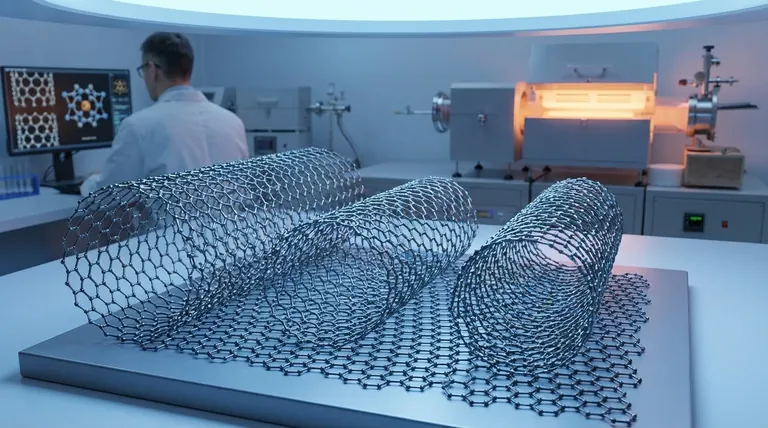
In essence, a single-wall carbon nanotube (SWCNT) is a seamless, hollow cylinder formed by rolling a single-atom-thick sheet of graphene. The structure is composed entirely of carbon atoms arranged in a hexagonal honeycomb lattice. This fundamental architecture, inherited from graphene, is responsible for the nanotube's extraordinary properties.

The most critical structural detail is not just that it's a rolled-up sheet, but how it is rolled. This "twist," known as chirality, dictates the nanotube's diameter, atomic arrangement, and most importantly, its fundamental electronic properties.
What is the structure of single-wall carbon nanotubes? Understanding Chirality for Metallic or Semiconducting Properties

The Foundation: From Graphene to Nanotube

To truly understand an SWCNT's structure, we must start with its building block: a sheet of graphene.

The Graphene Lattice

Graphene is a one-atom-thick layer of carbon atoms bonded together in a honeycomb pattern. These bonds are known as sp2-hybridized bonds, the same type found in graphite, and are exceptionally strong.

The Concept of the Roll-up Vector

Imagine taking that flat sheet of graphene and rolling it into a tube. The angle at which you roll it determines the pattern of the hexagons along the seam of the tube.

This "roll-up" is defined by a mathematical concept called the chiral vector, denoted by a pair of integers (n, m). These indices specify which two points on the graphene lattice are joined together to form the cylinder's circumference.

How (n, m) Defines the Structure

The (n, m) indices are the unique blueprint for every SWCNT. They precisely define two key physical attributes:

  1. Diameter: The values of n and m directly determine the diameter of the nanotube.
  2. Chirality (Twist): The relationship between n and m defines the chiral angle, or the degree of twist in the hexagonal lattice as it wraps around the tube.

The Three Classes of SWCNT Structures

Based on their (n, m) indices, all single-wall carbon nanotubes fall into one of three distinct structural families.

Armchair Nanotubes (n, n)

When the indices are identical (e.g., (5, 5) or (10, 10)), the resulting structure is called armchair. The hexagonal rings are aligned perfectly parallel to the tube's axis, creating a pattern that resembles an armrest along the circumference.

Zigzag Nanotubes (n, 0)

When the second index is zero (e.g., (9, 0) or (12, 0)), the nanotube has a zigzag structure. The pattern of carbon bonds forms a distinct zigzag shape along the circumference of the tube.

Chiral Nanotubes (n, m)

This is the most general case, where n ≠ m and m ≠ 0 (e.g., (10, 5)). These chiral nanotubes have a visible twist, with the hexagons spiraling down the length of the tube at a specific angle. They are the most common type found in real-world synthesis.

Understanding the Inherent Challenges

The direct link between atomic structure and properties creates a significant hurdle in nanotube applications.

The Synthesis Problem

Current large-scale synthesis methods, like chemical vapor deposition (CVD), inevitably produce a mixture of all three types of SWCNTs. The output is a blend of armchair, zigzag, and chiral tubes with a wide distribution of diameters.

The Separation Challenge

This structural diversity means that any raw sample contains both metallic and semiconducting nanotubes. For high-performance electronics, these must be separated, a complex and costly process that remains a major focus of materials research.

Matching Structure to Your Application

The specific (n, m) structure you need is entirely dependent on your end goal.

  • If your primary focus is transparent conductive films or high-strength composites: A mixture of SWCNT types is often sufficient, as you are leveraging the average bulk properties of the material.
  • If your primary focus is semiconductor electronics like transistors: You must use highly purified, semiconducting SWCNTs, making the isolation of specific chiral or zigzag types absolutely critical.
  • If your primary focus is creating nanoscale electrical interconnects: The ideal structure would be purely metallic (armchair) nanotubes to achieve the lowest possible electrical resistance.

Ultimately, understanding the atomic structure of a carbon nanotube is the key to harnessing its unparalleled technological potential.

Summary Table:

Structural Class Chiral Vector (n, m) Key Characteristic Electronic Property
Armchair (n, n) Hexagons aligned parallel to tube axis Metallic (always)
Zigzag (n, 0) Carbon bonds form a zigzag pattern Can be metallic or semiconducting
Chiral (n, m) n≠m Hexagons spiral along the tube length Can be metallic or semiconducting

Ready to leverage the precise properties of carbon nanotubes in your research or product development? The specific (n, m) structure of an SWCNT directly determines its electronic behavior, making material selection critical for applications in electronics, composites, and more. KINTEK specializes in providing high-quality lab equipment and consumables for advanced materials research. Our experts can help you identify the right tools for your nanotube synthesis, characterization, and application challenges.

Contact our team today to discuss how we can support your laboratory's specific needs.

Visual Guide
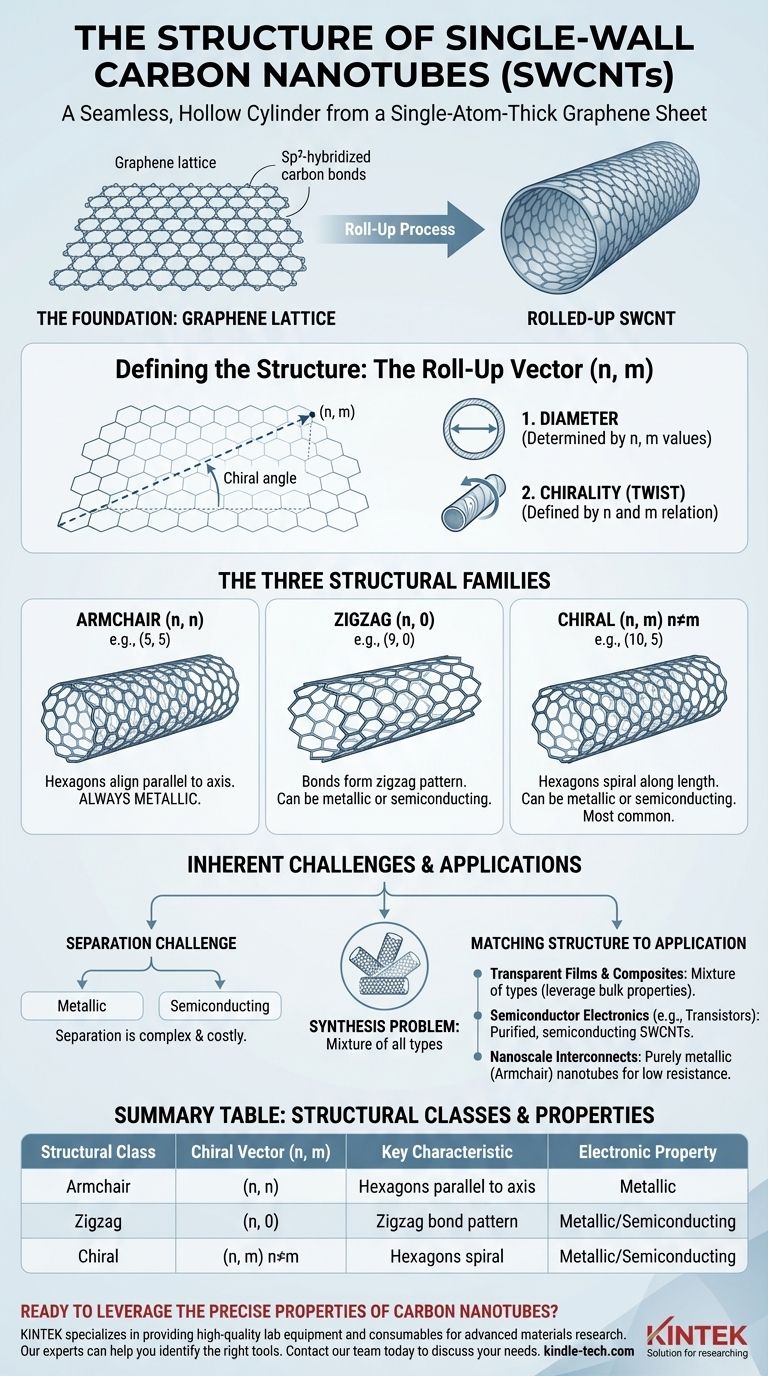
What is the structure of single-wall carbon nanotubes? Understanding Chirality for Metallic or Semiconducting Properties Visual Guide

Related Products

People Also Ask

Related Products

Laboratory CVD Boron Doped Diamond Materials

Laboratory CVD Boron Doped Diamond Materials

CVD boron-doped diamond: A versatile material enabling tailored electrical conductivity, optical transparency, and exceptional thermal properties for applications in electronics, optics, sensing, and quantum technologies.

Hydrophilic Carbon Paper TGPH060 for Battery Lab Applications

Hydrophilic Carbon Paper TGPH060 for Battery Lab Applications

Toray carbon paper is a porous C/C composite material product (composite material of carbon fiber and carbon) that has undergone high-temperature heat treatment.

Conductive Carbon Cloth Carbon Paper Carbon Felt for Electrodes and Batteries

Conductive Carbon Cloth Carbon Paper Carbon Felt for Electrodes and Batteries

Conductive carbon cloth, paper, and felt for electrochemical experiments. High-quality materials for reliable and accurate results. Order now for customization options.

Professional Cutting Tools for Carbon Paper Cloth Diaphragm Copper Aluminum Foil and More

Professional Cutting Tools for Carbon Paper Cloth Diaphragm Copper Aluminum Foil and More

Professional tools for cutting lithium sheets, carbon paper, carbon cloth, separators, copper foil, aluminum foil, etc., with round and square shapes and different sizes of blades.

Silicon Carbide (SIC) Ceramic Sheet Wear-Resistant Engineering Advanced Fine Ceramics

Silicon Carbide (SIC) Ceramic Sheet Wear-Resistant Engineering Advanced Fine Ceramics

Silicon carbide (sic) ceramic sheet is composed of high-purity silicon carbide and ultra-fine powder, which is formed by vibration molding and high-temperature sintering.

Precision Wire Saw Laboratory Cutting Machine with 800mm x 800mm Workbench for Diamond Single Wire Circular Small Cutting

Precision Wire Saw Laboratory Cutting Machine with 800mm x 800mm Workbench for Diamond Single Wire Circular Small Cutting

Diamond wire cutting machines are mainly used for precision cutting of ceramics, crystals, glass, metals, rocks, thermoelectric materials, infrared optical materials, composite materials, biomedical materials and other material analysis samples. Especially suitable for precision cutting of ultra-thin plates with thickness up to 0.2mm.

Boron Nitride (BN) Ceramic Plate

Boron Nitride (BN) Ceramic Plate

Boron nitride (BN) ceramic plates do not use aluminum water to wet, and can provide comprehensive protection for the surface of materials that directly contact molten aluminum, magnesium, zinc alloys and their slag.

Multifunctional Electrolytic Electrochemical Cell Water Bath Single Layer Double Layer

Multifunctional Electrolytic Electrochemical Cell Water Bath Single Layer Double Layer

Discover our high-quality Multifunctional Electrolytic Cell Water Baths. Choose from single or double-layer options with superior corrosion resistance. Available in 30ml to 1000ml sizes.

Vertical High Temperature Graphite Vacuum Graphitization Furnace

Vertical High Temperature Graphite Vacuum Graphitization Furnace

Vertical high temperature graphitization furnace for carbonization and graphitization of carbon materials up to 3100℃.Suitable for shaped graphitization of carbon fiber filaments and other materials sintered in a carbon environment.Applications in metallurgy, electronics, and aerospace for producing high-quality graphite products like electrodes and crucibles.

CVD Diamond for Thermal Management Applications

CVD Diamond for Thermal Management Applications

CVD diamond for thermal management: High-quality diamond with thermal conductivity up to 2000 W/mK, ideal for heat spreaders, laser diodes, and GaN on Diamond (GOD) applications.

Graphite Vacuum Furnace Bottom Discharge Graphitization Furnace for Carbon Materials

Graphite Vacuum Furnace Bottom Discharge Graphitization Furnace for Carbon Materials

Bottom-out graphitization furnace for carbon materials, ultra-high temperature furnace up to 3100°C, suitable for graphitization and sintering of carbon rods and carbon blocks. Vertical design, bottom discharging, convenient feeding and discharging, high temperature uniformity, low energy consumption, good stability, hydraulic lifting system, convenient loading and unloading.

Reference Electrode Calomel Silver Chloride Mercury Sulfate for Laboratory Use

Reference Electrode Calomel Silver Chloride Mercury Sulfate for Laboratory Use

Find high-quality reference electrodes for electrochemical experiments with complete specifications. Our models offer resistance to acid and alkali, durability, and safety, with customization options available to meet your specific needs.

Cylindrical Press Mold with Scale for Lab

Cylindrical Press Mold with Scale for Lab

Discover precision with our Cylindrical Press Mold. Ideal for high-pressure applications, it molds various shapes and sizes, ensuring stability and uniformity. Perfect for lab use.

Boron Nitride (BN) Ceramic Tube

Boron Nitride (BN) Ceramic Tube

Boron nitride (BN) is known for its high thermal stability, excellent electrical insulating properties and lubricating properties.

Multi Heating Zones CVD Tube Furnace Machine Chemical Vapor Deposition Chamber System Equipment

Multi Heating Zones CVD Tube Furnace Machine Chemical Vapor Deposition Chamber System Equipment

KT-CTF14 Multi Heating Zones CVD Furnace - Precise Temperature Control and Gas Flow for Advanced Applications. Max temp up to 1200℃, 4 channels MFC mass flow meter, and 7" TFT touch screen controller.

Glassy Carbon Sheet RVC for Electrochemical Experiments

Glassy Carbon Sheet RVC for Electrochemical Experiments

Discover our Glassy Carbon Sheet - RVC. Perfect for your experiments, this high-quality material will elevate your research to the next level.

High Purity Pure Graphite Crucible for Electron Beam Evaporation

High Purity Pure Graphite Crucible for Electron Beam Evaporation

A technology mainly used in the field of power electronics. It is a graphite film made of carbon source material by material deposition using electron beam technology.

Vertical Laboratory Tube Furnace

Vertical Laboratory Tube Furnace

Elevate your experiments with our Vertical Tube Furnace. Versatile design allows for operation under various environments and heat treatment applications. Order now for precise results!

Battery Lab Equipment 304 Stainless Steel Strip Foil 20um Thick for Battery Test

Battery Lab Equipment 304 Stainless Steel Strip Foil 20um Thick for Battery Test

304 is a versatile stainless steel, which is widely used in the production of equipment and parts that require good overall performance (corrosion resistance and formability).

Customizable CO2 Reduction Flow Cell for NRR ORR and CO2RR Research

Customizable CO2 Reduction Flow Cell for NRR ORR and CO2RR Research

The cell is meticulously crafted from high-quality materials to ensure chemical stability and experimental accuracy.


Leave Your Message