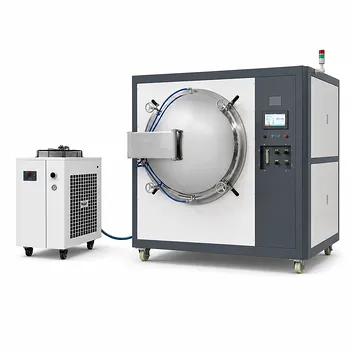
The 5°C/min heating rate is a critical threshold for ensuring structural integrity and chemical homogeneity during magnetite modification. By maintaining this specific ramp speed, you minimize the thermal gradients that cause physical fracturing and enable the precise, orderly formation of point defects within the lattice. This deliberate pace transforms the heat treatment from a simple temperature change into a controlled structural evolution.
Maintaining a slow heating rate of 5°C/min prioritizes crystal stability over processing speed, ensuring that point defects develop uniformly across the material lattice to prevent structural failure and inconsistent material properties.
Thermal Gradient Management
Eliminating Internal Stress
Rapid heating creates a significant temperature delta between the surface and the core of magnetite particles.
This gradient leads to differential thermal expansion, where the outer layers expand faster than the interior, resulting in micro-cracking or "stress-induced damage."
A 5°C/min rate allows heat to permeate the material evenly, keeping internal stresses below the threshold of crystal lattice rupture.
Ensuring Volumetric Uniformity
Magnetite powder in a furnace environment requires time to reach thermal equilibrium.
Uniform heating ensures that every portion of the sample experiences the same thermal history simultaneously.
This consistency is vital for achieving a final product that exhibits the same physical and chemical characteristics throughout the entire batch.
Crystal Lattice Engineering
Controlled Point Defect Generation
The modification of magnetite often relies on the creation of point defects, such as vacancies or interstitials, within the crystal structure.
A gentle heating process facilitates the orderly generation of these defects, allowing them to distribute themselves naturally without clustering.
When defects are generated too rapidly, they can lead to lattice distortions that compromise the stability of the modified material.
Maintaining Structural Consistency
The primary goal of heat treatment is often to reach a specific phase or state of "modified" magnetite.
By ramping at 5°C/min, you provide the energy necessary for atomic rearrangement without overshooting the energy required for structural stability.
This results in a consistent material structure that behaves predictably in subsequent applications.
Understanding the Trade-offs
Throughput vs. Material Quality
The most immediate trade-off of a 5°C/min rate is the reduction in processing throughput.
Faster ramp rates (e.g., 20°C/min) decrease furnace cycle times but significantly increase the risk of batch failure due to structural inconsistencies.
In high-precision applications, the cost of material degradation usually far outweighs the time saved by faster heating.
Energy Consumption and Precision
Operating a furnace at a slow, precise ramp rate requires high-precision temperature control systems.
Maintaining this specific rate can lead to higher cumulative energy consumption per batch because the furnace remains active for a longer duration.
However, this energy investment is necessary to prevent the "thermal shock" that occurs in less controlled environments.
Optimizing Your Heating Profile
Effective heat treatment requires balancing the physical limits of the magnetite crystal with the operational requirements of your project.
- If your primary focus is material durability: Stick strictly to the 5°C/min rate to ensure point defects are generated slowly and the crystal lattice remains free of stress-induced micro-fractures.
- If your primary focus is structural consistency across batches: Use high-precision controllers to automate the 5°C/min ramp, ensuring that the thermal history of every sample is identical and reproducible.
- If your primary focus is maximizing throughput for low-grade applications: You may experiment with slightly higher rates, but be prepared for a higher variance in the material's mechanical and chemical properties.
By respecting the thermal equilibrium of the magnetite lattice, you ensure the long-term stability and performance of the modified material.
Summary Table:
| Parameter | 5°C/min Heating Rate | Rapid Heating (>20°C/min) | Impact on Magnetite |
|---|---|---|---|
| Thermal Gradient | Low/Uniform | High/Extreme | Prevents micro-cracking and stress damage |
| Defect Generation | Orderly & Distributed | Clustered & Distorted | Ensures consistent chemical properties |
| Structural Integrity | High Stability | Risk of Lattice Rupture | Maximizes material durability |
| Throughput | Lower | Higher | Balances processing time with batch quality |
| Energy/Control | Requires Precision | High-Speed Output | Ensures reproducibility across batches |
Precision Heat Treatment Starts with KINTEK
Achieving the perfect 5°C/min ramp rate requires more than just a furnace; it requires high-precision thermal control. At KINTEK, we specialize in providing laboratory equipment that ensures your material research is reproducible and structurally sound.
Our extensive portfolio includes:
- High-Temperature Furnaces: Muffle, tube, vacuum, CVD, and atmosphere furnaces designed for exact heating profiles.
- Material Processing: Advanced crushing, milling systems, and hydraulic presses for sample preparation.
- Specialized Reactors: High-temperature high-pressure reactors and autoclaves for complex chemical modifications.
- Essential Consumables: High-purity ceramics, crucibles, and PTFE products to withstand rigorous thermal cycles.
Whether you are modifying magnetite or developing next-generation battery materials, KINTEK provides the reliability and precision your lab demands. Contact us today to optimize your heating profiles and enhance your material quality!
References
- Yuxin Li, Libing Liao. Improvement of magnetite adsorption performance for Pb (II) by introducing defects. DOI: 10.3389/fchem.2023.1137246
This article is also based on technical information from Kintek Solution Knowledge Base .
Related Products
- 2200 ℃ Graphite Vacuum Heat Treat Furnace
- Molybdenum Vacuum Heat Treat Furnace
- Vacuum Heat Treat Furnace with Ceramic Fiber Liner
- 1400℃ Controlled Atmosphere Furnace with Nitrogen and Inert Atmosphere
- 600T Vacuum Induction Hot Press Furnace for Heat Treat and Sintering
People Also Ask
- How does heat transmit in a vacuum? Mastering Thermal Radiation for Purity & Precision
- Why do you heat treat in a vacuum? Achieve Perfect Surface Finish and Material Integrity
- What is the process of vacuum heat treating? Achieve Superior Hardening with a Clean, Bright Finish
- How does a vacuum heat treat furnace work? Achieve Pristine, Oxide-Free Metal Parts
- What is graphite heating? A Guide to Durable, High-Temp Industrial Furnace Solutions