Knowledge Vacuum Furnace What is the temperature limit for brazing? Find Your Brazing Temperature Window
Author avatar

Tech Team · Kintek Solution

Updated 2 months ago

What is the temperature limit for brazing? Find Your Brazing Temperature Window


Technically, there is no single upper temperature limit for brazing. Instead, brazing is defined by its lower temperature boundary of 450°C (840°F). The actual temperature used is determined by the specific filler metal, while the practical upper limit is always set by the melting point of the base materials you are joining.

The critical temperature in brazing isn't a single number, but a carefully controlled window. You must operate above the melting point of your filler metal but safely below the melting point of your base materials. This fundamental principle is what defines the process and separates it from both soldering and welding.
What is the temperature limit for brazing? Find Your Brazing Temperature Window

The Defining Line: Brazing vs. Soldering vs. Welding

To understand the temperature limits of brazing, you must first understand its place among other joining processes. The temperature is the primary distinction.

The 450°C (840°F) Threshold

The American Welding Society officially defines brazing as any process that joins materials using a filler metal that melts and flows above 450°C (840°F).

Any similar process that occurs below this temperature is defined as soldering. This single temperature is the globally accepted dividing line between the two.

Brazing's Core Principle: Capillary Action

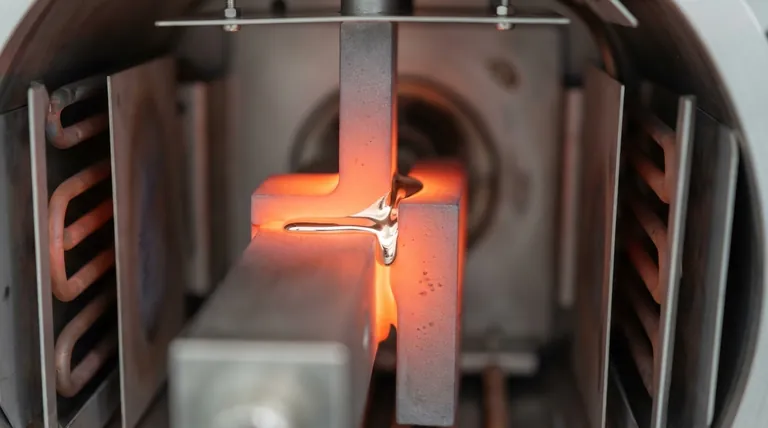
In a proper brazing operation, only the filler metal melts. The base materials being joined are heated, but they never reach their melting point.

The molten filler is drawn into the tight-fitting gap between the parts through a phenomenon called capillary action. This creates a strong, metallurgically bonded joint without fusing the base materials.

Why Welding Is Different

Welding, by contrast, works by melting the base materials themselves, often along with a filler metal, to fuse them into a single, continuous piece.

Because it involves melting the base materials, welding always occurs at significantly higher temperatures than brazing for any given metal.

Finding Your Brazing Temperature Window

The "correct" brazing temperature is not one number, but a specific range dictated by your materials.

The Role of the Filler Metal

Every brazing filler metal has a melting range defined by two points: its solidus (the temperature at which it begins to melt) and its liquidus (the temperature at which it is fully liquid).

To ensure proper flow and capillary action, the base materials must be heated to a temperature above the filler metal's liquidus point. For most fillers, this is typically 30-60°C (50-100°F) above the liquidus temperature.

The Constraint of the Base Material

The absolute upper limit for your brazing temperature is the solidus of the weakest base material in the assembly.

If you exceed this temperature, you will begin to melt the part itself. The process ceases to be brazing and becomes welding or, more accurately, a failure. This can cause irreversible damage, distortion, and a weak joint.

The "Brazing Range" in Practice

Your working temperature window is therefore the range between the filler metal's liquidus and the base material's solidus.

For example, joining steel (melts ~1370°C) with a silver-based filler (liquidus ~650°C) gives you a massive working window. Joining aluminum parts (melts ~600°C) with an aluminum-silicon filler (liquidus ~585°C) requires extremely precise temperature control.

Understanding the Trade-offs: Heat and Its Consequences

The high temperatures of brazing, even when below the base metal's melting point, have significant effects you must manage.

The Heat-Affected Zone (HAZ)

The area of the base material near the joint is heated and then cooled. This thermal cycle creates a heat-affected zone (HAZ).

Within the HAZ, the metal's microstructure and mechanical properties (like hardness and strength) can be altered. This is a critical consideration for heat-treated or work-hardened alloys.

Risk of Distortion and Warping

Heating metal causes it to expand, and cooling causes it to contract. Uneven or excessive heating can cause parts to warp or distort, especially on thin or complex assemblies. Lower brazing temperatures reduce this risk.

Oxidation and the Need for Flux

At brazing temperatures, most metals react rapidly with oxygen in the air, forming oxides on the surface. These oxide layers prevent the filler metal from wetting the surface and flowing into the joint.

This is why a brazing flux or a controlled, oxygen-free atmosphere (like nitrogen or a vacuum) is non-negotiable. They protect the joint area from oxidation during the heating cycle.

Making the Right Choice for Your Application

Selecting the correct process requires balancing joint requirements, material properties, and thermal effects.

  • If your primary focus is maximum joint strength on thick, similar metals: Welding is often the superior choice, as it fuses the parent materials into one piece.
  • If your primary focus is joining dissimilar metals, thin sections, or complex assemblies without distortion: Brazing's lower temperatures and non-fusion nature provide a significant advantage.
  • If your primary focus is joining heat-sensitive electronics or standard copper plumbing: Soldering is the correct process, as its low temperatures prevent damage to components and materials.

Mastering the temperature window is the key to creating strong, reliable, and precise brazed joints.

Summary Table:

Brazing Temperature Factor Key Temperature Point Description
Lower Limit 450°C (840°F) Official AWS definition separating brazing from soldering
Filler Metal Liquidus Varies by alloy Temperature at which filler metal becomes fully liquid
Base Material Solidus Varies by material Absolute upper limit to avoid melting the parts being joined
Working Window Between liquidus and solidus The safe temperature range for successful brazing

Need precise temperature control for your brazing applications? KINTEK specializes in laboratory equipment and consumables that ensure accurate thermal processing for your joining needs. Our solutions help you maintain the critical temperature window between filler metal flow and base material integrity. Contact our experts today to discuss how we can support your laboratory's brazing and material joining requirements with reliable, precision equipment.

Visual Guide

What is the temperature limit for brazing? Find Your Brazing Temperature Window Visual Guide

Related Products

People Also Ask

Related Products

Vacuum Heat Treat Sintering Brazing Furnace

Vacuum Heat Treat Sintering Brazing Furnace

A vacuum brazing furnace is a type of industrial furnace used for brazing, a metalworking process that joins two pieces of metal using a filler metal that melts at a lower temperature than the base metals. Vacuum brazing furnaces are typically used for high-quality applications where a strong, clean joint is required.

High Temperature Muffle Oven Furnace for Laboratory Debinding and Pre Sintering

High Temperature Muffle Oven Furnace for Laboratory Debinding and Pre Sintering

KT-MD High temperature debinding and pre-sintering furnace for ceramic materials with various molding processes. Ideal for electronic components such as MLCC and NFC.

Ultra-High Temperature Graphite Vacuum Graphitization Furnace

Ultra-High Temperature Graphite Vacuum Graphitization Furnace

The ultra-high temperature graphitization furnace utilizes medium frequency induction heating in a vacuum or inert gas environment. The induction coil generates an alternating magnetic field, inducing eddy currents in the graphite crucible, which heats up and radiates heat to the workpiece, bringing it to the desired temperature. This furnace is primarily used for graphitization and sintering of carbon materials, carbon fiber materials, and other composite materials.

Vertical High Temperature Graphite Vacuum Graphitization Furnace

Vertical High Temperature Graphite Vacuum Graphitization Furnace

Vertical high temperature graphitization furnace for carbonization and graphitization of carbon materials up to 3100℃.Suitable for shaped graphitization of carbon fiber filaments and other materials sintered in a carbon environment.Applications in metallurgy, electronics, and aerospace for producing high-quality graphite products like electrodes and crucibles.

Vacuum Heat Treat and Pressure Sintering Furnace for High Temperature Applications

Vacuum Heat Treat and Pressure Sintering Furnace for High Temperature Applications

Vacuum pressure sintering furnaces are designed for high temperature hot pressing applications in metal and ceramic sintering. Its advanced features ensure precise temperature control, reliable pressure maintenance, and a robust design for seamless operation.

600T Vacuum Induction Hot Press Furnace for Heat Treat and Sintering

600T Vacuum Induction Hot Press Furnace for Heat Treat and Sintering

Discover the 600T Vacuum Induction Hot Press Furnace, designed for high-temperature sintering experiments in vacuum or protected atmospheres. Its precise temperature and pressure control, adjustable working pressure, and advanced safety features make it ideal for nonmetal materials, carbon composites, ceramics, and metal powders.

Graphite Vacuum Continuous Graphitization Furnace

Graphite Vacuum Continuous Graphitization Furnace

High-temperature graphitization furnace is a professional equipment for graphitization treatment of carbon materials. It is a key equipment for the production of high-quality graphite products. It has high temperature, high efficiency and uniform heating. It is suitable for various high-temperature treatments and graphitization treatments. It is widely used in metallurgy, electronics, aerospace, etc. industry.

Large Vertical Graphite Vacuum Graphitization Furnace

Large Vertical Graphite Vacuum Graphitization Furnace

A large vertical high-temperature graphitization furnace is a type of industrial furnace used for the graphitization of carbon materials, such as carbon fiber and carbon black. It is a high-temperature furnace that can reach temperatures of up to 3100°C.

Horizontal High Temperature Graphite Vacuum Graphitization Furnace

Horizontal High Temperature Graphite Vacuum Graphitization Furnace

Horizontal Graphitization Furnace: This type of furnace is designed with the heating elements placed horizontally, allowing for uniform heating of the sample. It's well-suited for graphitizing large or bulky samples that require precise temperature control and uniformity.

Vacuum Hot Press Furnace Machine Heated Vacuum Press

Vacuum Hot Press Furnace Machine Heated Vacuum Press

Discover the advantages of Vacuum Hot Press Furnace! Manufacture dense refractory metals & compounds, ceramics, and composites under high temp and pressure.

Graphite Vacuum Furnace Bottom Discharge Graphitization Furnace for Carbon Materials

Graphite Vacuum Furnace Bottom Discharge Graphitization Furnace for Carbon Materials

Bottom-out graphitization furnace for carbon materials, ultra-high temperature furnace up to 3100°C, suitable for graphitization and sintering of carbon rods and carbon blocks. Vertical design, bottom discharging, convenient feeding and discharging, high temperature uniformity, low energy consumption, good stability, hydraulic lifting system, convenient loading and unloading.

2200 ℃ Graphite Vacuum Heat Treat Furnace

2200 ℃ Graphite Vacuum Heat Treat Furnace

Discover the power of the KT-VG Graphite Vacuum Furnace - with a maximum working temperature of 2200℃, it's perfect for vacuum sintering of various materials. Learn more now.

Laboratory Muffle Oven Furnace Bottom Lifting Muffle Furnace

Laboratory Muffle Oven Furnace Bottom Lifting Muffle Furnace

Efficiently produce batches with excellent temperature uniformity using our Bottom Lifting Furnace. Features two electric lifting stages and advanced temperature control up to 1600℃.

Dental Porcelain Zirconia Sintering Ceramic Furnace Chairside with Transformer

Dental Porcelain Zirconia Sintering Ceramic Furnace Chairside with Transformer

Experience top-notch sintering with Chairside Sintering Furnace with Transformer. Easy to operate, noise-free pallet, and automatic temperature calibration. Order now!

1700℃ Controlled Atmosphere Furnace Nitrogen Inert Atmosphere Furnace

1700℃ Controlled Atmosphere Furnace Nitrogen Inert Atmosphere Furnace

KT-17A Controlled atmosphere furnace: 1700℃ heating, vacuum sealing technology, PID temperature control, and versatile TFT smart touch screen controller for laboratory and industrial use.

Non Consumable Vacuum Arc Induction Melting Furnace

Non Consumable Vacuum Arc Induction Melting Furnace

Explore the benefits of Non-Consumable Vacuum Arc Furnace with high melting point electrodes. Small, easy to operate & eco-friendly. Ideal for laboratory research on refractory metals & carbides.

Lab-Scale Vacuum Induction Melting Furnace

Lab-Scale Vacuum Induction Melting Furnace

Get precise alloy composition with our Vacuum Induction Melting Furnace. Ideal for aerospace, nuclear energy, and electronic industries. Order now for effective smelting and casting of metals and alloys.

Vacuum Arc Induction Melting Furnace

Vacuum Arc Induction Melting Furnace

Discover the power of Vacuum Arc Furnace for melting active & refractory metals. High-speed, remarkable degassing effect, and free of contamination. Learn more now!

Vacuum Heat Treat Furnace with Ceramic Fiber Liner

Vacuum Heat Treat Furnace with Ceramic Fiber Liner

Vacuum furnace with polycrystalline ceramic fiber insulation liner for excellent heat insulation and uniform temperature field. Choose from 1200℃ or 1700℃ max. working temperature with high vacuum performance and precise temperature control.

Mesh belt controlled atmosphere furnace

Mesh belt controlled atmosphere furnace

Discover our KT-MB mesh belt sintering furnace - perfect for high-temperature sintering of electronic components & glass insulators. Available for open air or controlled atmosphere environments.


Leave Your Message