Knowledge muffle furnace What is the temperature of a ceramic furnace? Master Precision Firing for Perfect Results
Author avatar

Tech Team · Kintek Solution

Updated 2 months ago

What is the temperature of a ceramic furnace? Master Precision Firing for Perfect Results


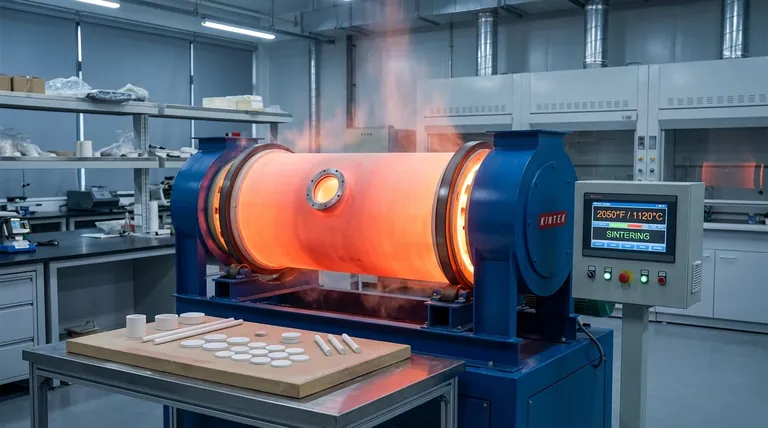
The temperature of a ceramic furnace is not one specific value but a highly controlled range determined by the exact material being fired. For example, some advanced ceramic composites are processed at 2,050°F (1,120°C). The key principle is that the temperature must be high enough to fuse the material's particles together but must remain below its actual melting point.

The correct temperature for a ceramic furnace is dictated entirely by the material being fired. The goal is always to heat the ceramic to a point where particles fuse together—a process called sintering—without reaching the material's melting point.
What is the temperature of a ceramic furnace? Master Precision Firing for Perfect Results

The Core Principle: Sintering, Not Melting

The fundamental process inside a ceramic furnace is not about melting. It's about a physical transformation that happens at a solid state.

What is Sintering?

Sintering is the process of compacting and forming a solid mass of material by heat without liquefying it.

The intense heat causes the individual grains or particles of the ceramic to fuse at their contact points, creating a strong, dense, and rigid structure.

Why Temperature Varies by Material

Different ceramic materials have vastly different chemical compositions. Earthenware clays sinter at much lower temperatures than high-performance porcelain or advanced technical ceramics.

Each type of ceramic has a specific temperature "window" where it will properly sinter to achieve its desired properties, such as strength, density, and porosity.

The Critical Need for Precision

Simply reaching a target temperature is not enough; maintaining it with extreme accuracy is essential for producing high-quality ceramics.

A High-Temperature Example

For certain advanced ceramic composites, the furnace is heated to a precise 2,050°F (1,120°C).

This temperature is not an approximation. It is an engineered setpoint designed to achieve specific material characteristics.

The Role of Temperature Uniformity

In professional applications, temperature uniformity is non-negotiable. The furnace must maintain the target temperature within a very tight tolerance, often as precise as ± 5°F (2.5°C).

Any deviation, or "cold spot," can result in an unevenly fired product with internal stresses, weaknesses, or defects that compromise its structural integrity.

The Consequences of Incorrect Temperatures

The success or failure of a ceramic firing hinges on temperature control. The margin for error is often very small.

The Risk of Over-firing

If the furnace temperature exceeds the material's sintering range, it will begin to melt, bloat, or warp.

The piece will lose its intended shape and structural integrity, often resulting in a complete failure of the product.

The Problem of Under-firing

If the temperature is too low, the particles will not fuse together properly.

The resulting ceramic will be weak, porous, and lack the durability expected of the finished product. It will be fragile and unable to perform its intended function.

Setting the Right Temperature for Your Goal

The correct approach depends entirely on the material you are working with and the outcome you need to achieve.

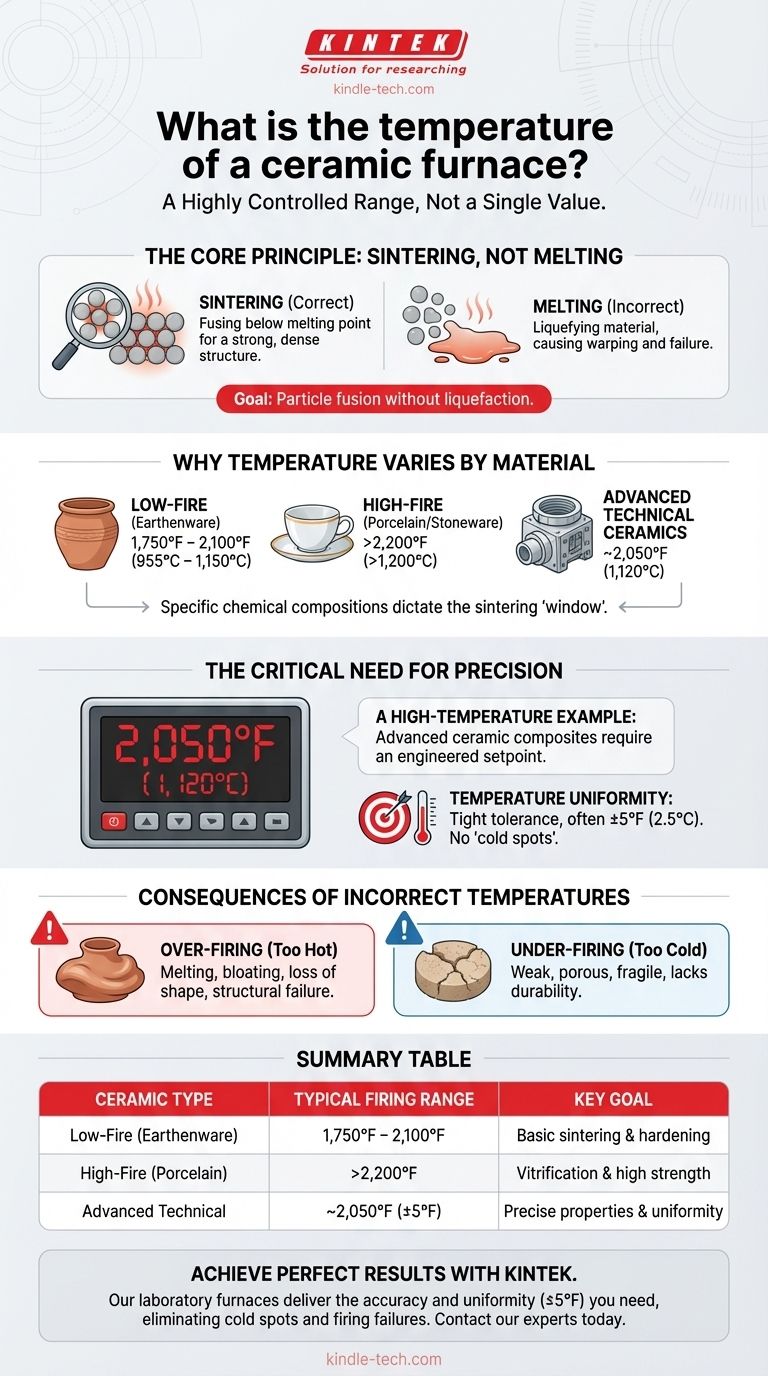
  • If your primary focus is low-fire pottery (e.g., earthenware): Your target temperatures will be on the lower end, typically between 1,750°F and 2,100°F (955°C and 1,150°C).
  • If your primary focus is high-fire ceramics (e.g., porcelain or stoneware): You will operate at higher temperatures, often exceeding 2,200°F (1,200°C), to achieve vitrification and strength.
  • If your primary focus is advanced technical ceramics: You will use precisely engineered temperatures, like the 2,050°F (1,120°C) example, where absolute accuracy and uniformity are critical for performance.

Ultimately, mastering temperature control is the key to transforming raw material into a durable and functional ceramic product.

Summary Table:

Ceramic Type Typical Firing Temperature Range Key Goal
Low-Fire (Earthenware) 1,750°F – 2,100°F (955°C – 1,150°C) Basic sintering and hardening
High-Fire (Porcelain/Stoneware) >2,200°F (>1,200°C) Vitrification and high strength
Advanced Technical Ceramics ~2,050°F (1,120°C) ±5°F Precise properties and uniformity

Achieve perfect ceramic results with precise temperature control. Whether you're firing earthenware, porcelain, or advanced technical ceramics, KINTEK's laboratory furnaces deliver the accuracy and uniformity you need. Our equipment ensures ±5°F tolerance, eliminating cold spots and firing failures. Contact our experts today to find the ideal furnace for your lab's specific ceramic applications.

Visual Guide
What is the temperature of a ceramic furnace? Master Precision Firing for Perfect Results Visual Guide

Related Products

People Also Ask

Related Products

Dental Porcelain Zirconia Sintering Ceramic Furnace Chairside with Transformer

Dental Porcelain Zirconia Sintering Ceramic Furnace Chairside with Transformer

Experience top-notch sintering with Chairside Sintering Furnace with Transformer. Easy to operate, noise-free pallet, and automatic temperature calibration. Order now!

Dental Porcelain Zirconia Sintering Ceramic Vacuum Press Furnace

Dental Porcelain Zirconia Sintering Ceramic Vacuum Press Furnace

Get precise dental results with Dental Vacuum Press Furnace. Automatic temperature calibration, low noise tray, and touch screen operation. Order now!

High Temperature Alumina (Al2O3) Furnace Tube for Engineering Advanced Fine Ceramics

High Temperature Alumina (Al2O3) Furnace Tube for Engineering Advanced Fine Ceramics

High temperature alumina furnace tube combines the advantages of high hardness of alumina, good chemical inertness and steel, and has excellent wear resistance, thermal shock resistance and mechanical shock resistance.

Vacuum Heat Treat Furnace with Ceramic Fiber Liner

Vacuum Heat Treat Furnace with Ceramic Fiber Liner

Vacuum furnace with polycrystalline ceramic fiber insulation liner for excellent heat insulation and uniform temperature field. Choose from 1200℃ or 1700℃ max. working temperature with high vacuum performance and precise temperature control.

Vacuum Dental Porcelain Sintering Furnace

Vacuum Dental Porcelain Sintering Furnace

Get precise and reliable results with KinTek's Vacuum Porcelain Furnace. Suitable for all porcelain powders, it features hyperbolic ceramic furnace function, voice prompt, and automatic temperature calibration.

High Temperature Muffle Oven Furnace for Laboratory Debinding and Pre Sintering

High Temperature Muffle Oven Furnace for Laboratory Debinding and Pre Sintering

KT-MD High temperature debinding and pre-sintering furnace for ceramic materials with various molding processes. Ideal for electronic components such as MLCC and NFC.

1200℃ Split Tube Furnace with Quartz Tube Laboratory Tubular Furnace

1200℃ Split Tube Furnace with Quartz Tube Laboratory Tubular Furnace

KT-TF12 split tube furnace: high-purity insulation, embedded heating wire coils, and max. 1200C. Widely used for new materials and chemical vapour deposition.

Vertical High Temperature Graphite Vacuum Graphitization Furnace

Vertical High Temperature Graphite Vacuum Graphitization Furnace

Vertical high temperature graphitization furnace for carbonization and graphitization of carbon materials up to 3100℃.Suitable for shaped graphitization of carbon fiber filaments and other materials sintered in a carbon environment.Applications in metallurgy, electronics, and aerospace for producing high-quality graphite products like electrodes and crucibles.

Laboratory Muffle Oven Furnace Bottom Lifting Muffle Furnace

Laboratory Muffle Oven Furnace Bottom Lifting Muffle Furnace

Efficiently produce batches with excellent temperature uniformity using our Bottom Lifting Furnace. Features two electric lifting stages and advanced temperature control up to 1600℃.

Ultra-High Temperature Graphite Vacuum Graphitization Furnace

Ultra-High Temperature Graphite Vacuum Graphitization Furnace

The ultra-high temperature graphitization furnace utilizes medium frequency induction heating in a vacuum or inert gas environment. The induction coil generates an alternating magnetic field, inducing eddy currents in the graphite crucible, which heats up and radiates heat to the workpiece, bringing it to the desired temperature. This furnace is primarily used for graphitization and sintering of carbon materials, carbon fiber materials, and other composite materials.

Advanced Engineering Fine Ceramics Alumina Ceramic Saggar for Fine Corundum

Advanced Engineering Fine Ceramics Alumina Ceramic Saggar for Fine Corundum

Alumina sagger products have the characteristics of high temperature resistance, good thermal shock stability, small expansion coefficient, anti-stripping, and good anti-powdering performance.

1700℃ Muffle Oven Furnace for Laboratory

1700℃ Muffle Oven Furnace for Laboratory

Get superior heat control with our 1700℃ Muffle Furnace. Equipped with intelligent temperature microprocessor, TFT touch screen controller & advanced insulation materials for precise heating up to 1700C. Order now!

1700℃ Controlled Atmosphere Furnace Nitrogen Inert Atmosphere Furnace

1700℃ Controlled Atmosphere Furnace Nitrogen Inert Atmosphere Furnace

KT-17A Controlled atmosphere furnace: 1700℃ heating, vacuum sealing technology, PID temperature control, and versatile TFT smart touch screen controller for laboratory and industrial use.

2200 ℃ Graphite Vacuum Heat Treat Furnace

2200 ℃ Graphite Vacuum Heat Treat Furnace

Discover the power of the KT-VG Graphite Vacuum Furnace - with a maximum working temperature of 2200℃, it's perfect for vacuum sintering of various materials. Learn more now.

Engineering Advanced Fine Ceramics Alumina Al2O3 Crucible With Lid Cylindrical Laboratory Crucible

Engineering Advanced Fine Ceramics Alumina Al2O3 Crucible With Lid Cylindrical Laboratory Crucible

Cylindrical Crucibles Cylindrical crucibles are one of the most common crucible shapes, suitable for melting and processing a wide variety of materials, and are easy to handle and clean.

Graphite Vacuum Furnace Bottom Discharge Graphitization Furnace for Carbon Materials

Graphite Vacuum Furnace Bottom Discharge Graphitization Furnace for Carbon Materials

Bottom-out graphitization furnace for carbon materials, ultra-high temperature furnace up to 3100°C, suitable for graphitization and sintering of carbon rods and carbon blocks. Vertical design, bottom discharging, convenient feeding and discharging, high temperature uniformity, low energy consumption, good stability, hydraulic lifting system, convenient loading and unloading.

1200℃ Muffle Furnace Oven for Laboratory

1200℃ Muffle Furnace Oven for Laboratory

Upgrade your lab with our 1200℃ Muffle Furnace. Achieve fast, precise heating with Japan alumina fibers and Molybdenum coils. Features TFT touch screen controller for easy programming and data analysis. Order now!

Horizontal High Temperature Graphite Vacuum Graphitization Furnace

Horizontal High Temperature Graphite Vacuum Graphitization Furnace

Horizontal Graphitization Furnace: This type of furnace is designed with the heating elements placed horizontally, allowing for uniform heating of the sample. It's well-suited for graphitizing large or bulky samples that require precise temperature control and uniformity.

Graphite Vacuum Continuous Graphitization Furnace

Graphite Vacuum Continuous Graphitization Furnace

High-temperature graphitization furnace is a professional equipment for graphitization treatment of carbon materials. It is a key equipment for the production of high-quality graphite products. It has high temperature, high efficiency and uniform heating. It is suitable for various high-temperature treatments and graphitization treatments. It is widely used in metallurgy, electronics, aerospace, etc. industry.

Mesh belt controlled atmosphere furnace

Mesh belt controlled atmosphere furnace

Discover our KT-MB mesh belt sintering furnace - perfect for high-temperature sintering of electronic components & glass insulators. Available for open air or controlled atmosphere environments.


Leave Your Message