Knowledge Vacuum Furnace What is the temperature of arc melting? Harness Extreme Heat for Refractory Metals
Author avatar

Tech Team · Kintek Solution

Updated 2 months ago

What is the temperature of arc melting? Harness Extreme Heat for Refractory Metals


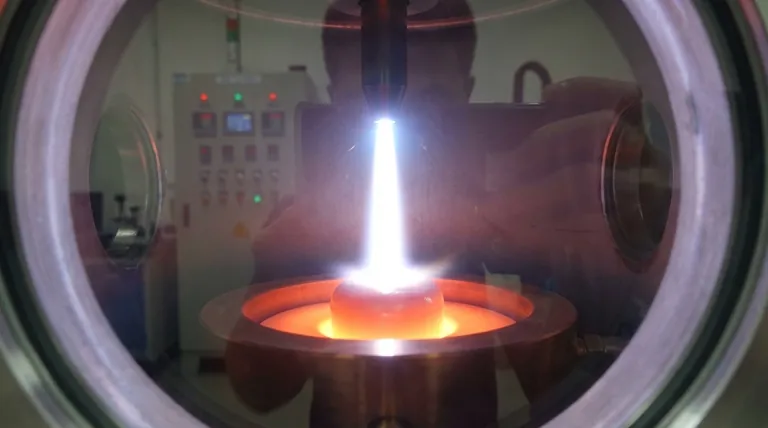
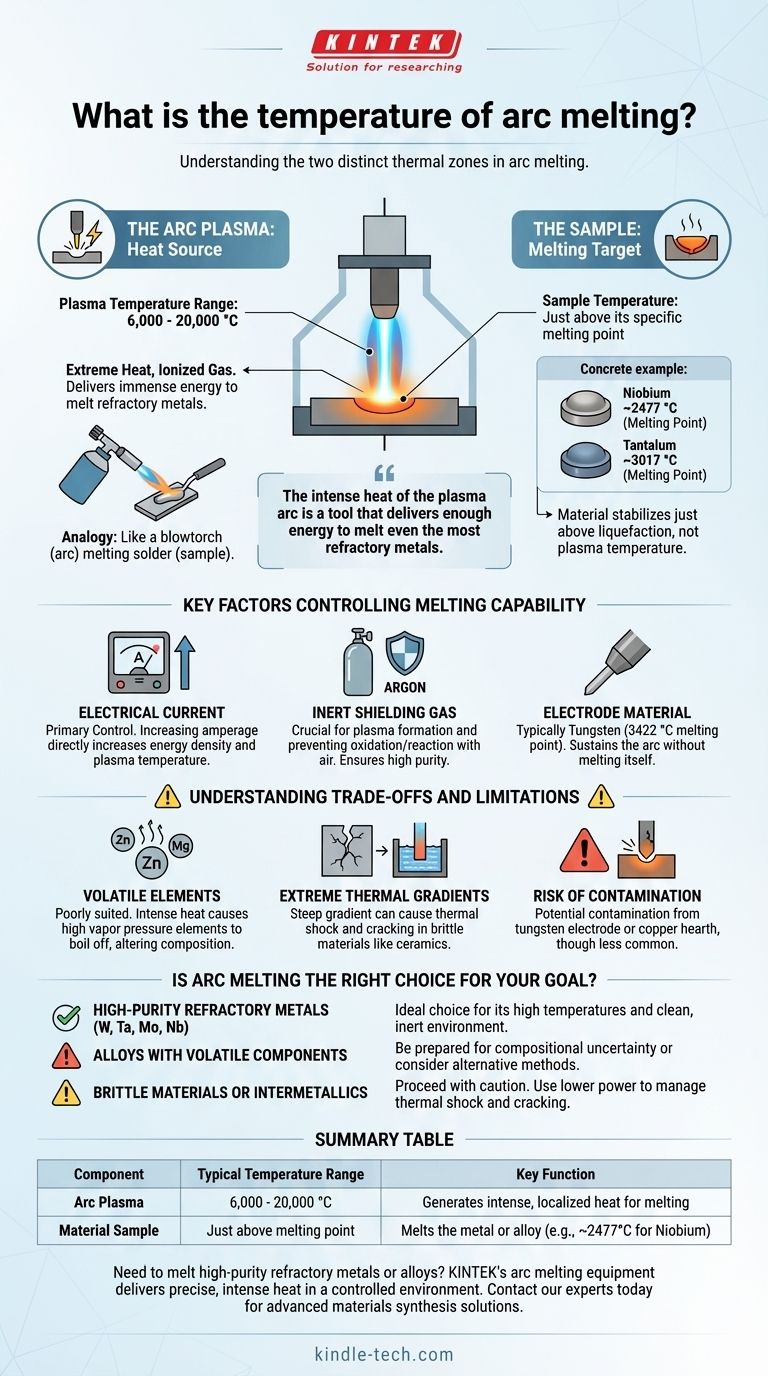
In arc melting, there is no single temperature. Instead, the process involves two distinct thermal zones: the electric arc plasma itself and the material being melted. The plasma arc can reach extreme temperatures, often between 6,000 and 20,000 °C (approximately 11,000 to 36,000 °F), while the material sample is heated just above its specific melting point.

The critical insight is not the temperature of the arc, but its capability. The intense heat жерт the plasma arc is a tool that delivers enough energy to melt even the most refractory metals, like tungsten, which melts at 3422 °C (6192 °F).
What is the temperature of arc melting? Harness Extreme Heat for Refractory Metals

The Two Temperatures of Arc Melting

To understand the process, it's essential to differentiate between the heat source and the object being heated. Think of it like using a blowtorch to melt solder; the flame is far hotter than the solder's melting point.

The Arc Plasma: The Heat Source

An electric arc is a channel of plasma—an ionized gas. In an arc melter, this is typically created by passing a high current through an inert gas like argon.

This plasma is exceptionally hot. Temperatures in the core of the arc can readily exceed 6,000 °C and, depending on the current and gas pressure, can reach as high as 20,000 °C. This is the source of the immense energy used for melting.

The Sample: The Melting Target

The purpose of this extreme plasma temperature is to transfer enough energy to the sample material (often called a "button") to raise its temperature above its melting point.

The sample itself will not reach 20,000 °C. Instead, its temperature will stabilizeFactional just above its liquefaction point. For example, if you are melting niobium, the button will be slightly above its melting point of 2477 °C. If melting tantalum, it will be just over 3017 °C.

Key Factors Controlling the Melting Capability

The ability市场 to melt a specific material is controlled by调 the energy delivered by the arc, which is influenced by several factors.

Electrical Current

This is the primary control. Increasing the amperage passed through the electrode directly increases the energy density and temperature of the plasma arc, allowing for the melting of higher-melting-point materials or larger samples.

Inert Shielding Gas

Arc melting is performed in a controlled atmosphere, almost always using a high-purity inert gas like argon.

The gas serves two purposes: it forms the plasma needed for the arc and, crucially, it prevents the molten metal from oxidizing or reacting with air, ensuring high purity.

Electrode Material

The non-consumable electrode is typically made of tungsten, chosen for its extremely high melting point (3422 °C). This allows the electrode to sustain the arc without melting itself and contaminating the sample.

Understanding the Trade-offs and Limitations

While powerful, arc melting is not universally applicable. Its unique characteristics present specific challenges.

Difficulty with Volatile Elements

The process is poorly suited for alloys containing elements with high vapor pressures (i.e., low boiling points), such as zinc, magnesium, or manganese. The intense, localized heat can cause these elements to boil off, leading to significant changes in the final alloy composition.

Extreme Thermal Gradients

The heat from the arc is incredibly concentrated. This creates a steep thermal gradient between the molten pool and the cool, water-chilled copper hearth below it. For brittle materials like certain intermetallics or ceramics, this thermal shock can cause cracking.

Risk of Contamination

Although it is a very clean melting technique, there is a small risk of contamination. If the arc becomes unstable or the current is too high, it can damage the tungsten electrode tip, introducing tungsten into the melt. Contamination from the copper hearth is also a possibility, though less common.

Is Arc Melting the Right Choice for Your Goal?

Use this guide to determine if arc melting suits your specific materials synthesis objective.

  • If your primary focus is high-purity refractory metals and alloys (W, Ta, Mo, Nb): Arc melting is the industry-standard technique and your ideal choice due to its high temperatures and clean, inert environment.
  • If your primary focus is alloys with volatile components (e.g., high-manganese steels): You must be prepared for compositional uncertainty due to element boiling, or consider alternative methods like induction melting in a pressurized chamber.
  • If your primary focus is brittle materials or intermetallics: Proceed with caution, using lower power and careful technique to manage the risk of thermal shock and cracking during solidification.

Ultimately, arc melting provides a powerful, localized heat source capable of exceeding the melting point of any known metal, making it a critical tool for advanced materials synthesis.

Summary Table:

Component Typical Temperature Range Key Function
Arc Plasma (Heat Source) 6,000 - 20,000 °C Generates intense, localized heat for melting
Material Sample (Target) Just above its specific melting point Melts the metal or alloy (e.g., ~2477°C for Niobium)

Need to melt high-purity refractory metals or alloys? KINTEK's arc melting equipment delivers the precise, intense heat required for materials like tungsten, tantalum, and molybdenum in a controlled, inert environment. Our solutions are designed for researchers and labs focused on advanced materials synthesis. Contact our experts today to discuss how our lab equipment can meet your specific melting challenges!

Visual Guide
What is the temperature of arc melting? Harness Extreme Heat for Refractory Metals Visual Guide

Related Products

People Also Ask

Related Products

Non Consumable Vacuum Arc Induction Melting Furnace

Non Consumable Vacuum Arc Induction Melting Furnace

Explore the benefits of Non-Consumable Vacuum Arc Furnace with high melting point electrodes. Small, easy to operate & eco-friendly. Ideal for laboratory research on refractory metals & carbides.

Vacuum Arc Induction Melting Furnace

Vacuum Arc Induction Melting Furnace

Discover the power of Vacuum Arc Furnace for melting active & refractory metals. High-speed, remarkable degassing effect, and free of contamination. Learn more now!

Vacuum Heat Treat Furnace and Levitation Induction Melting Furnace

Vacuum Heat Treat Furnace and Levitation Induction Melting Furnace

Experience precise melting with our Vacuum Levitation Melting Furnace. Ideal for high melting point metals or alloys, with advanced technology for effective smelting. Order now for high-quality results.

Lab-Scale Vacuum Induction Melting Furnace

Lab-Scale Vacuum Induction Melting Furnace

Get precise alloy composition with our Vacuum Induction Melting Furnace. Ideal for aerospace, nuclear energy, and electronic industries. Order now for effective smelting and casting of metals and alloys.

High Temperature Muffle Oven Furnace for Laboratory Debinding and Pre Sintering

High Temperature Muffle Oven Furnace for Laboratory Debinding and Pre Sintering

KT-MD High temperature debinding and pre-sintering furnace for ceramic materials with various molding processes. Ideal for electronic components such as MLCC and NFC.

Vertical High Temperature Graphite Vacuum Graphitization Furnace

Vertical High Temperature Graphite Vacuum Graphitization Furnace

Vertical high temperature graphitization furnace for carbonization and graphitization of carbon materials up to 3100℃.Suitable for shaped graphitization of carbon fiber filaments and other materials sintered in a carbon environment.Applications in metallurgy, electronics, and aerospace for producing high-quality graphite products like electrodes and crucibles.

Laboratory Muffle Oven Furnace Bottom Lifting Muffle Furnace

Laboratory Muffle Oven Furnace Bottom Lifting Muffle Furnace

Efficiently produce batches with excellent temperature uniformity using our Bottom Lifting Furnace. Features two electric lifting stages and advanced temperature control up to 1600℃.

Large Vertical Graphite Vacuum Graphitization Furnace

Large Vertical Graphite Vacuum Graphitization Furnace

A large vertical high-temperature graphitization furnace is a type of industrial furnace used for the graphitization of carbon materials, such as carbon fiber and carbon black. It is a high-temperature furnace that can reach temperatures of up to 3100°C.

Mesh belt controlled atmosphere furnace

Mesh belt controlled atmosphere furnace

Discover our KT-MB mesh belt sintering furnace - perfect for high-temperature sintering of electronic components & glass insulators. Available for open air or controlled atmosphere environments.

Vacuum Heat Treat and Pressure Sintering Furnace for High Temperature Applications

Vacuum Heat Treat and Pressure Sintering Furnace for High Temperature Applications

Vacuum pressure sintering furnaces are designed for high temperature hot pressing applications in metal and ceramic sintering. Its advanced features ensure precise temperature control, reliable pressure maintenance, and a robust design for seamless operation.

Horizontal High Temperature Graphite Vacuum Graphitization Furnace

Horizontal High Temperature Graphite Vacuum Graphitization Furnace

Horizontal Graphitization Furnace: This type of furnace is designed with the heating elements placed horizontally, allowing for uniform heating of the sample. It's well-suited for graphitizing large or bulky samples that require precise temperature control and uniformity.

Ultra-High Temperature Graphite Vacuum Graphitization Furnace

Ultra-High Temperature Graphite Vacuum Graphitization Furnace

The ultra-high temperature graphitization furnace utilizes medium frequency induction heating in a vacuum or inert gas environment. The induction coil generates an alternating magnetic field, inducing eddy currents in the graphite crucible, which heats up and radiates heat to the workpiece, bringing it to the desired temperature. This furnace is primarily used for graphitization and sintering of carbon materials, carbon fiber materials, and other composite materials.

600T Vacuum Induction Hot Press Furnace for Heat Treat and Sintering

600T Vacuum Induction Hot Press Furnace for Heat Treat and Sintering

Discover the 600T Vacuum Induction Hot Press Furnace, designed for high-temperature sintering experiments in vacuum or protected atmospheres. Its precise temperature and pressure control, adjustable working pressure, and advanced safety features make it ideal for nonmetal materials, carbon composites, ceramics, and metal powders.

1700℃ Controlled Atmosphere Furnace Nitrogen Inert Atmosphere Furnace

1700℃ Controlled Atmosphere Furnace Nitrogen Inert Atmosphere Furnace

KT-17A Controlled atmosphere furnace: 1700℃ heating, vacuum sealing technology, PID temperature control, and versatile TFT smart touch screen controller for laboratory and industrial use.

2200 ℃ Graphite Vacuum Heat Treat Furnace

2200 ℃ Graphite Vacuum Heat Treat Furnace

Discover the power of the KT-VG Graphite Vacuum Furnace - with a maximum working temperature of 2200℃, it's perfect for vacuum sintering of various materials. Learn more now.

Vacuum Heat Treat and Molybdenum Wire Sintering Furnace for Vacuum Sintering

Vacuum Heat Treat and Molybdenum Wire Sintering Furnace for Vacuum Sintering

A vacuum molybdenum wire sintering furnace is a vertical or bedroom structure, which is suitable for withdrawal, brazing, sintering and degassing of metal materials under high vacuum and high temperature conditions. It is also suitable for dehydroxylation treatment of quartz materials.

1700℃ Muffle Oven Furnace for Laboratory

1700℃ Muffle Oven Furnace for Laboratory

Get superior heat control with our 1700℃ Muffle Furnace. Equipped with intelligent temperature microprocessor, TFT touch screen controller & advanced insulation materials for precise heating up to 1700C. Order now!

Graphite Vacuum Furnace High Thermal Conductivity Film Graphitization Furnace

Graphite Vacuum Furnace High Thermal Conductivity Film Graphitization Furnace

The high thermal conductivity film graphitization furnace has uniform temperature, low energy consumption and can operate continuously.

Vacuum Heat Treat Furnace with Ceramic Fiber Liner

Vacuum Heat Treat Furnace with Ceramic Fiber Liner

Vacuum furnace with polycrystalline ceramic fiber insulation liner for excellent heat insulation and uniform temperature field. Choose from 1200℃ or 1700℃ max. working temperature with high vacuum performance and precise temperature control.

Graphite Vacuum Furnace Bottom Discharge Graphitization Furnace for Carbon Materials

Graphite Vacuum Furnace Bottom Discharge Graphitization Furnace for Carbon Materials

Bottom-out graphitization furnace for carbon materials, ultra-high temperature furnace up to 3100°C, suitable for graphitization and sintering of carbon rods and carbon blocks. Vertical design, bottom discharging, convenient feeding and discharging, high temperature uniformity, low energy consumption, good stability, hydraulic lifting system, convenient loading and unloading.


Leave Your Message



















