Knowledge evaporation boat What is the temperature of thermal evaporation deposition? It's Material-Dependent, Not a Fixed Number
Author avatar

Tech Team · Kintek Solution

Updated 2 months ago

What is the temperature of thermal evaporation deposition? It's Material-Dependent, Not a Fixed Number


In short, there is no single temperature for thermal evaporation deposition. The correct temperature is entirely dependent on the specific material being deposited, as each element or compound requires a different amount of heat to evaporate at a useful rate inside a vacuum.

The goal of thermal evaporation is not to reach a fixed temperature, but to heat a source material until it achieves a sufficient vapor pressure. The temperature required to do this varies dramatically from one material to another.
What is the temperature of thermal evaporation deposition? It's Material-Dependent, Not a Fixed Number

Why Temperature is a Variable, Not a Constant

Thinking about a single process temperature is a common misconception. The reality is that temperature is a means to an end, and that end is controlled evaporation.

The Central Role of Vapor Pressure

The entire process hinges on a property called vapor pressure. This is the pressure exerted by a vapor in equilibrium with its solid or liquid phase.

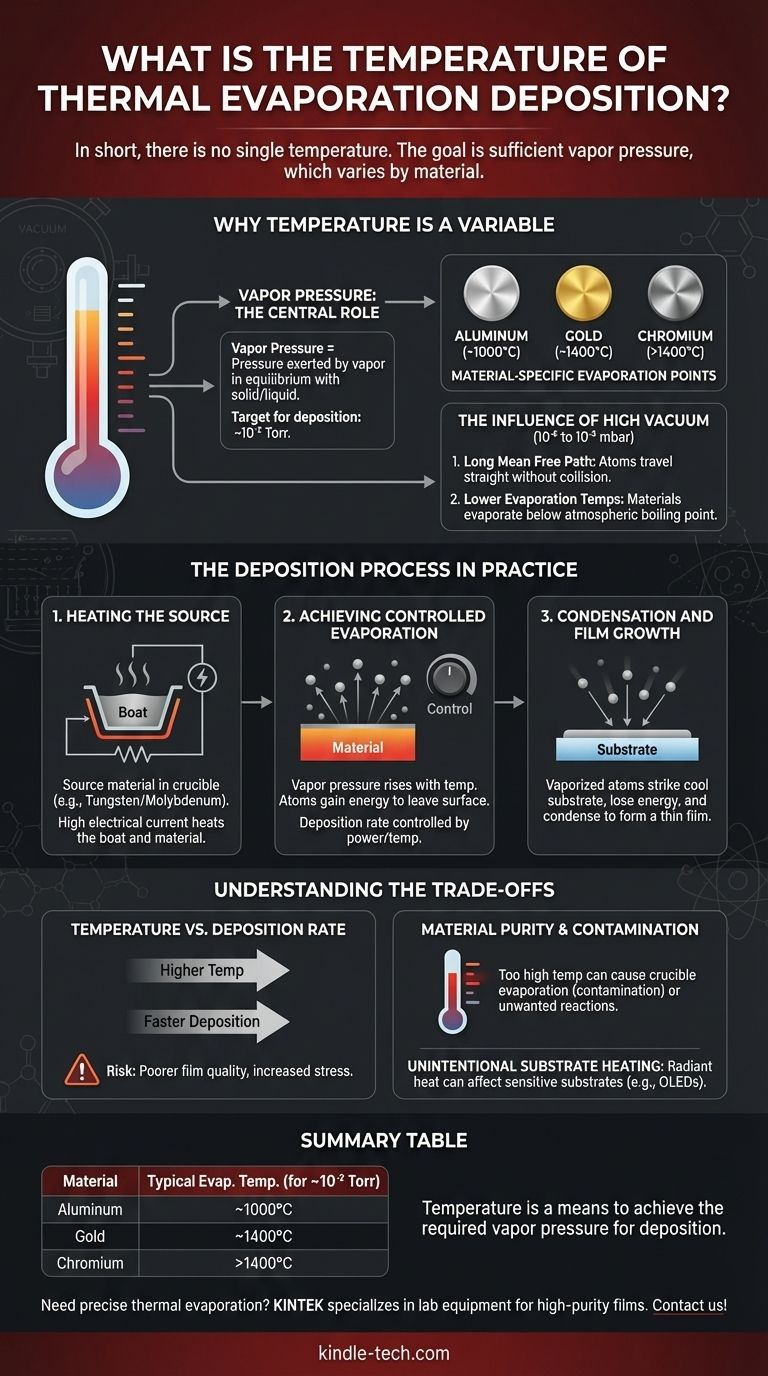
To deposit a film, you must heat the source material until its vapor pressure is significantly higher than the chamber's base pressure. A typical target vapor pressure for deposition is around 10⁻² Torr.

Material-Specific Evaporation Points

Every material has a unique relationship between temperature and vapor pressure.

For example, aluminum must be heated to approximately 1000°C to reach the target vapor pressure for deposition. In contrast, gold requires a much higher temperature, around 1400°C, to evaporate at a similar rate. Materials like chromium require even higher temperatures.

The Influence of High Vacuum

The process is performed in a high-vacuum chamber (typically 10⁻⁶ to 10⁻⁵ mbar) for two critical reasons.

First, the vacuum removes air molecules, which ensures a long mean free path. This allows the evaporated atoms to travel from the source to the substrate in a straight line without colliding with background gases.

Second, in a vacuum, materials can evaporate at temperatures well below their standard atmospheric boiling point.

The Deposition Process in Practice

Understanding the relationship between heat, material, and vacuum clarifies how the process works from start to finish.

Heating the Source

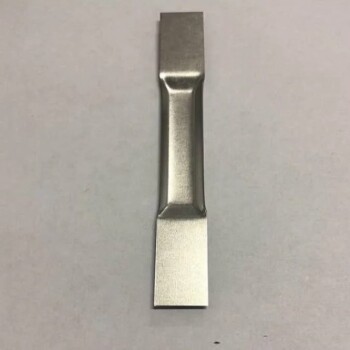
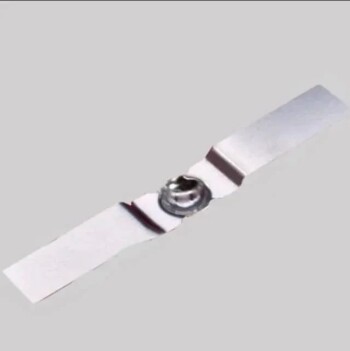
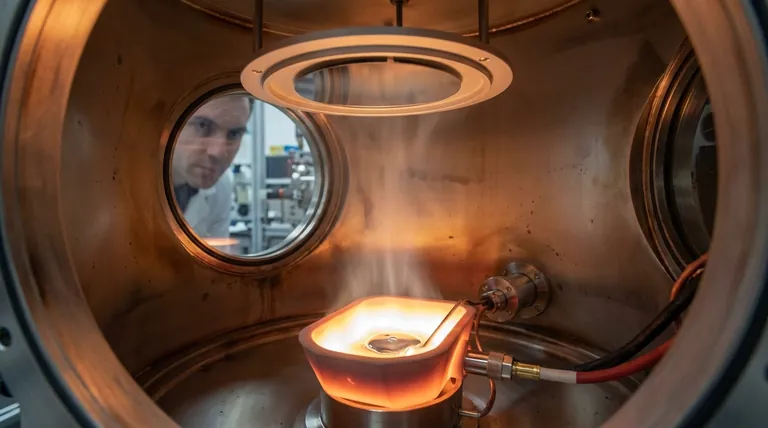
The source material, such as metal pellets or powder, is placed in a container called a crucible or "boat." This boat is often made of a refractory material like tungsten or molybdenum.

A very high electrical current is passed through the boat, causing it to heat up rapidly due to its electrical resistance. This heat is then transferred to the source material.

Achieving Controlled Evaporation

As the source material's temperature rises, its vapor pressure increases exponentially. Once the vapor pressure is high enough, atoms gain enough energy to leave the surface and travel outwards.

The operator controls the deposition rate by carefully adjusting the power supplied to the heating element, which in turn controls the source temperature and its resulting vapor pressure.

Condensation and Film Growth

The stream of vaporized atoms travels through the vacuum chamber and strikes the much cooler substrate (the surface being coated).

Upon hitting the cold substrate, the atoms lose their energy, condense back into a solid state, and gradually build up to form a thin, uniform film.

Understanding the Trade-offs

Simply increasing the temperature is not always the best approach. The choice of temperature involves critical trade-offs that affect the quality of the final film.

Temperature vs. Deposition Rate

A higher source temperature leads to a higher vapor pressure and therefore a faster deposition rate. While this can shorten process time, it can also lead to poorer film quality, increased stress, and a less uniform structure.

Material Purity and Contamination

If the temperature is too high, it can cause the crucible material itself to evaporate, contaminating the film. It can also cause undesirable reactions between the source material and the crucible.

Unintentional Substrate Heating

The hot evaporation source radiates a significant amount of heat. This radiant energy can heat the substrate, which is often undesirable, especially when coating sensitive materials like plastics or organic electronics (OLEDs).

How to Determine the Right Temperature for Your Project

The correct temperature setting is a function of your material, your equipment, and your desired outcome. Use published vapor pressure charts as your guide.

  • If your primary focus is depositing a standard metal (e.g., Aluminum): Consult a vapor pressure chart for aluminum and find the temperature that corresponds to a vapor pressure of ~10⁻² Torr as a starting point.
  • If your primary focus is achieving high film purity: Choose a temperature that provides a stable, moderate deposition rate rather than the fastest rate possible to minimize the risk of co-evaporation from the heating element.
  • If your primary focus is coating a temperature-sensitive substrate: Use the lowest possible source temperature that still gives you an acceptable deposition rate and consider using heat shields or increasing the source-to-substrate distance.

Ultimately, mastering thermal evaporation comes from understanding that temperature is the tool you use to control the material's fundamental vapor pressure.

Summary Table:

Material Typical Evaporation Temperature (for ~10⁻² Torr)
Aluminum ~1000°C
Gold ~1400°C
Chromium >1400°C

Temperature is a means to achieve the required vapor pressure for deposition.

Need precise thermal evaporation for your specific materials? KINTEK specializes in lab equipment and consumables, providing the exact solutions for your deposition challenges. Our expertise ensures high-purity films and optimal process parameters for materials from aluminum to gold. Contact our experts today to discuss your project and achieve superior thin-film results!

Visual Guide
What is the temperature of thermal evaporation deposition? It's Material-Dependent, Not a Fixed Number Visual Guide

Related Products

People Also Ask

Related Products

Aluminized Ceramic Evaporation Boat for Thin Film Deposition

Aluminized Ceramic Evaporation Boat for Thin Film Deposition

Vessel for depositing thin films; has an aluminum-coated ceramic body for improved thermal efficiency and chemical resistance. making it suitable for various applications.

HFCVD Machine System Equipment for Drawing Die Nano-Diamond Coating

HFCVD Machine System Equipment for Drawing Die Nano-Diamond Coating

The nano-diamond composite coating drawing die uses cemented carbide (WC-Co) as the substrate, and uses the chemical vapor phase method ( CVD method for short ) to coat the conventional diamond and nano-diamond composite coating on the surface of the inner hole of the mold.

Molybdenum Tungsten Tantalum Evaporation Boat for High Temperature Applications

Molybdenum Tungsten Tantalum Evaporation Boat for High Temperature Applications

Evaporation boat sources are used in thermal evaporation systems and are suitable for depositing various metals, alloys and materials. Evaporation boat sources are available in different thicknesses of tungsten, tantalum and molybdenum to ensure compatibility with a variety of power sources. As a container, it is used for vacuum evaporation of materials. They can be used for thin film deposition of various materials, or designed to be compatible with techniques such as electron beam fabrication.

Evaporation Boat for Organic Matter

Evaporation Boat for Organic Matter

The evaporation boat for organic matter is an important tool for precise and uniform heating during the deposition of organic materials.

Chemical Vapor Deposition CVD Equipment System Chamber Slide PECVD Tube Furnace with Liquid Gasifier PECVD Machine

Chemical Vapor Deposition CVD Equipment System Chamber Slide PECVD Tube Furnace with Liquid Gasifier PECVD Machine

KT-PE12 Slide PECVD System: Wide power range, programmable temp control, fast heating/cooling with sliding system, MFC mass flow control & vacuum pump.

Customer Made Versatile CVD Tube Furnace Chemical Vapor Deposition Chamber System Equipment

Customer Made Versatile CVD Tube Furnace Chemical Vapor Deposition Chamber System Equipment

Get your exclusive CVD furnace with KT-CTF16 Customer Made Versatile Furnace. Customizable sliding, rotating, and tilting functions for precise reactions. Order now!

Multi Heating Zones CVD Tube Furnace Machine Chemical Vapor Deposition Chamber System Equipment

Multi Heating Zones CVD Tube Furnace Machine Chemical Vapor Deposition Chamber System Equipment

KT-CTF14 Multi Heating Zones CVD Furnace - Precise Temperature Control and Gas Flow for Advanced Applications. Max temp up to 1200℃, 4 channels MFC mass flow meter, and 7" TFT touch screen controller.

RF PECVD System Radio Frequency Plasma-Enhanced Chemical Vapor Deposition RF PECVD

RF PECVD System Radio Frequency Plasma-Enhanced Chemical Vapor Deposition RF PECVD

RF-PECVD is an acronym for "Radio Frequency Plasma-Enhanced Chemical Vapor Deposition." It deposits DLC (Diamond-like carbon film) on germanium and silicon substrates. It is utilized in the 3-12um infrared wavelength range.

Microwave Plasma Chemical Vapor Deposition MPCVD Machine System Reactor for Lab and Diamond Growth

Microwave Plasma Chemical Vapor Deposition MPCVD Machine System Reactor for Lab and Diamond Growth

Get high-quality diamond films with our Bell-jar Resonator MPCVD machine designed for lab and diamond growth. Discover how Microwave Plasma Chemical Vapor Deposition works for growing diamonds using carbon gas and plasma.

Inclined Rotary Plasma Enhanced Chemical Vapor Deposition PECVD Equipment Tube Furnace Machine

Inclined Rotary Plasma Enhanced Chemical Vapor Deposition PECVD Equipment Tube Furnace Machine

Introducing our inclined rotary PECVD furnace for precise thin film deposition. Enjoy automatic matching source, PID programmable temperature control, and high accuracy MFC mass flowmeter control. Built-in safety features for peace of mind.

Tungsten Evaporation Boat for Thin Film Deposition

Tungsten Evaporation Boat for Thin Film Deposition

Learn about tungsten boats, also known as evaporated or coated tungsten boats. With a high tungsten content of 99.95%, these boats are ideal for high-temperature environments and widely used in various industries. Discover their properties and applications here.

Inclined Rotary Plasma Enhanced Chemical Vapor Deposition PECVD Equipment Tube Furnace Machine

Inclined Rotary Plasma Enhanced Chemical Vapor Deposition PECVD Equipment Tube Furnace Machine

Upgrade your coating process with PECVD coating equipment. Ideal for LED, power semiconductors, MEMS and more. Deposits high-quality solid films at low temps.

Hemispherical Bottom Tungsten Molybdenum Evaporation Boat

Hemispherical Bottom Tungsten Molybdenum Evaporation Boat

Used for gold plating, silver plating, platinum, palladium, suitable for a small amount of thin film materials. Reduce the waste of film materials and reduce heat dissipation.

Electron Beam Evaporation Coating Oxygen-Free Copper Crucible and Evaporation Boat

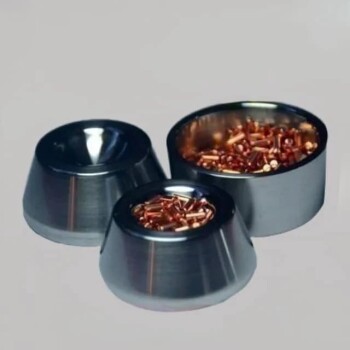
Electron Beam Evaporation Coating Oxygen-Free Copper Crucible and Evaporation Boat

Electron Beam Evaporation Coating Oxygen-Free Copper Crucible enables precise co-deposition of various materials. Its controlled temperature and water-cooled design ensure pure and efficient thin film deposition.

Ceramic Evaporation Boat Set Alumina Crucible for Laboratory Use

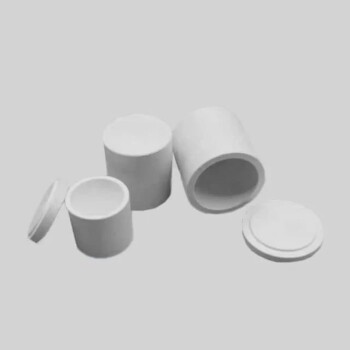
Ceramic Evaporation Boat Set Alumina Crucible for Laboratory Use

It can be used for vapor deposition of various metals and alloys. Most metals can be evaporated completely without loss. Evaporation baskets are reusable.1

Electron Beam Evaporation Coating Tungsten Crucible and Molybdenum Crucible for High Temperature Applications

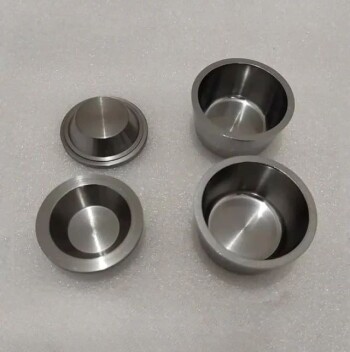
Electron Beam Evaporation Coating Tungsten Crucible and Molybdenum Crucible for High Temperature Applications

Tungsten and molybdenum crucibles are commonly used in electron beam evaporation processes due to their excellent thermal and mechanical properties.

High Purity Pure Graphite Crucible for Evaporation

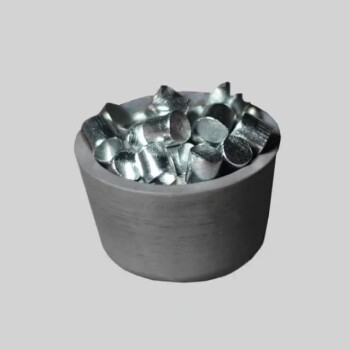
High Purity Pure Graphite Crucible for Evaporation

Vessels for high temperature applications, where materials are kept at extremely high temperatures to evaporate, allowing thin films to be deposited on substrates.

Electron Beam Evaporation Coating Gold Plating Tungsten Molybdenum Crucible for Evaporation

Electron Beam Evaporation Coating Gold Plating Tungsten Molybdenum Crucible for Evaporation

These crucibles act as containers for the gold material evaporated by the electron evaporation beam while precisely directing the electron beam for precise deposition.

Evaporation Crucible for Organic Matter

Evaporation Crucible for Organic Matter

An evaporation crucible for organic matter, referred to as an evaporation crucible, is a container for evaporating organic solvents in a laboratory environment.

Electron Beam Evaporation Coating Conductive Boron Nitride Crucible BN Crucible

Electron Beam Evaporation Coating Conductive Boron Nitride Crucible BN Crucible

High-purity and smooth conductive boron nitride crucible for electron beam evaporation coating, with high temperature and thermal cycling performance.


Leave Your Message