Knowledge universal laboratory press What is the unit of pressure in a hydraulic press? Understanding PSI, Tons, and Force
Author avatar

Tech Team · Kintek Solution

Updated 2 months ago

What is the unit of pressure in a hydraulic press? Understanding PSI, Tons, and Force


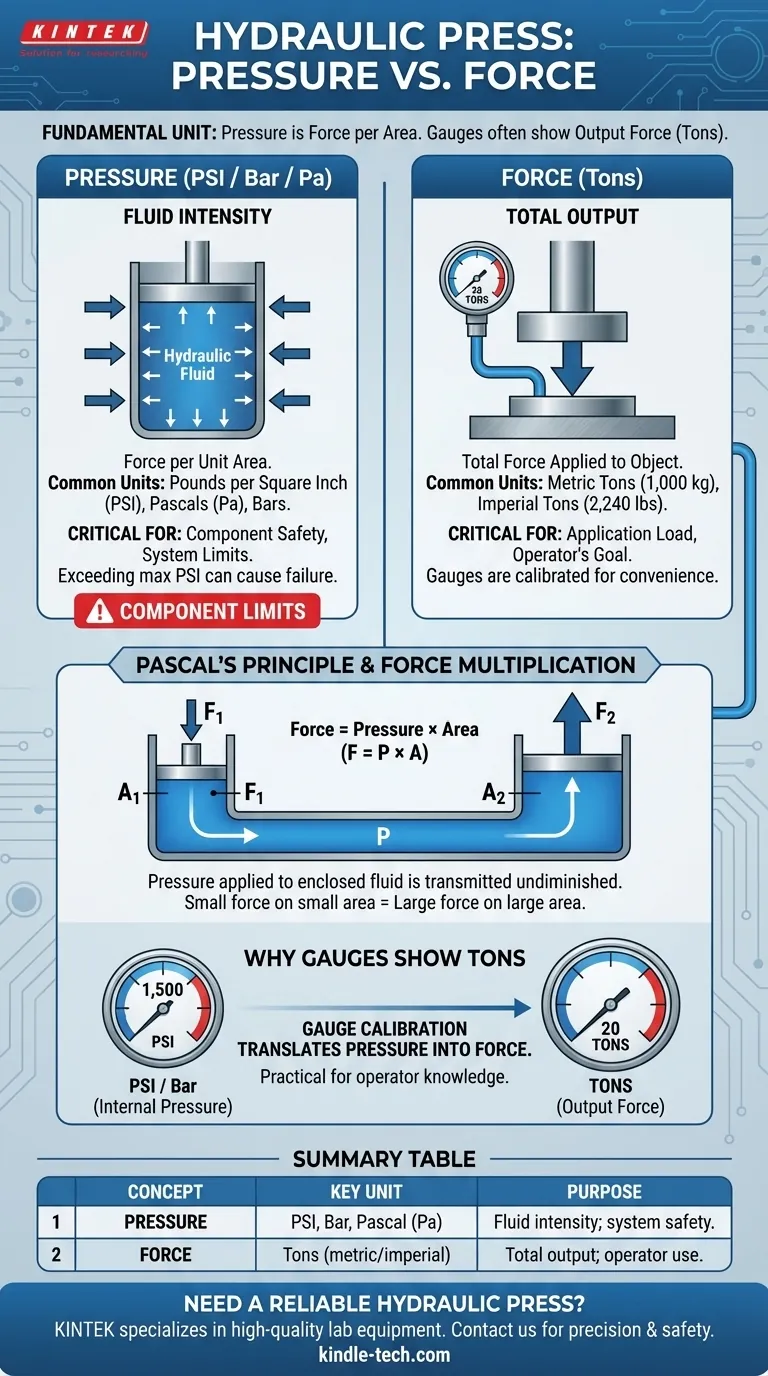
The fundamental unit of pressure in any hydraulic system is expressed as force per unit of area. The most common units are Pounds per Square Inch (PSI) in the imperial system and Pascals (Pa) or bars in the metric system. While a press gauge may be calibrated to show tons, this is a measure of the output force, not the internal fluid pressure.

The core distinction to understand is that a hydraulic press operates on fluid pressure (force per area), but its performance is often measured by the total output force (tons) it can generate. Gauges are frequently labeled in tons for operator convenience, translating the internal pressure into the resulting applied force.
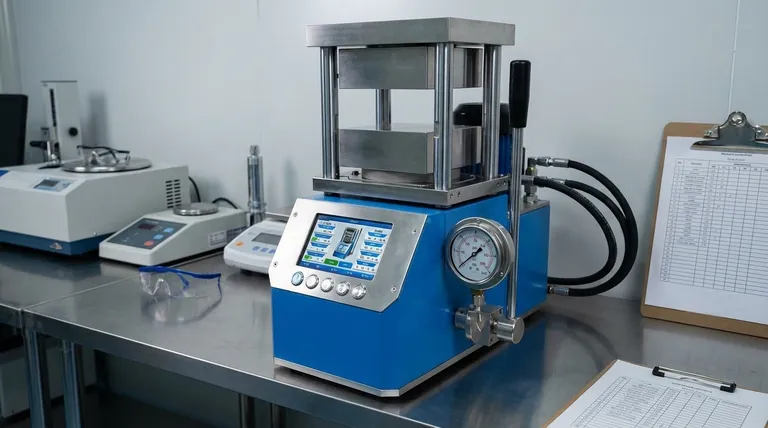
What is the unit of pressure in a hydraulic press? Understanding PSI, Tons, and Force

The Physics: Pressure vs. Force

The ability of a hydraulic press to generate immense force from a small input is governed by a core principle of fluid dynamics. Understanding the difference between the system's pressure and its output force is critical.

The True Unit: Pressure

Pressure is the amount of force exerted over a specific area. Think of it as the intensity of the force within the hydraulic fluid.

The standard scientific unit is the Pascal (Pa), which is one Newton of force per square meter. In industrial applications, you will more commonly encounter PSI (Pounds per Square Inch) or bars (1 bar is roughly equal to atmospheric pressure at sea level, or 100,000 Pa).

The Measured Result: Force

While pressure does the work, the operator's goal is to apply a specific force to an object. This is why many gauges are simplified to show the end result.

The units you see on the gauge—metric tons (1,000 kg) or imperial tons (2,240 lbs)—are direct measurements of the total output force the press is exerting at that moment.

How Pressure Creates Force: Pascal's Principle

The magic of a hydraulic system comes from Pascal's Principle, which states that pressure applied to an enclosed fluid is transmitted undiminished to every portion of the fluid and the walls of the containing vessel.

The Force Multiplication Formula

The relationship is defined by the formula: Force = Pressure × Area.

A small force applied to a small piston creates pressure in the fluid. This same pressure then acts on a much larger piston, and because its area is larger, the resulting output force is magnified significantly.

Why Gauges Show Tons

It is far more practical for an operator to know they are applying "20 tons of force" than to calculate that force from a reading of "1,500 PSI" acting on a piston with a 26-square-inch area.

The gauge does the math for you. It measures the internal fluid pressure but the dial is calibrated to display the corresponding output force in tons.

Common Pitfalls to Avoid

Confusing the concepts of pressure and force can lead to operational errors and safety risks. Understanding the distinction is not just academic; it's essential for correct and safe operation.

Overlooking Component Limits

Hydraulic components like hoses, seals, and cylinders are rated for a maximum pressure (e.g., 3,000 PSI). Exceeding this pressure can cause a catastrophic failure, even if the output force seems within a normal range for a different press.

Assuming Force is Constant

If you were to switch out the main cylinder on a press for one with a larger diameter (a larger area), the same internal fluid pressure would now produce a much greater output force. The "tons" reading on the old gauge would become inaccurate.

Making the Right Choice for Your Goal

Your interpretation of the system depends entirely on your objective.

  • If your primary focus is applying a specific load: Trust the force reading on your gauge (tons). It is designed to tell you the direct output you are applying to your workpiece.
  • If your primary focus is maintenance or system design: You must work with the pressure rating (PSI or bar) of the individual components to ensure the system is operating safely within its design limits.

Ultimately, mastering a hydraulic press means understanding that pressure is the cause and force is the effect.

Summary Table:

Concept Key Unit Purpose
Pressure PSI, Bar, Pascal (Pa) Measures fluid intensity; critical for system safety and component limits.
Force Tons (metric/imperial) Measures total output on the workpiece; what the operator directly uses.

Need a reliable hydraulic press for your lab or production line? KINTEK specializes in high-quality lab equipment, including hydraulic presses designed for precision and safety. Our experts can help you select the right press with the correct pressure and force ratings for your specific application. Contact us today to ensure your operations are both efficient and safe!

Visual Guide
What is the unit of pressure in a hydraulic press? Understanding PSI, Tons, and Force Visual Guide

Related Products

People Also Ask

Related Products

Heated Hydraulic Press Machine with Heated Plates for Vacuum Box Laboratory Hot Press

Heated Hydraulic Press Machine with Heated Plates for Vacuum Box Laboratory Hot Press

Enhance your lab's precision with our lab press for vacuum box. Press pills and powders with ease and precision in a vacuum environment, reducing oxidation and improving consistency. Compact and easy to use with a digital pressure gauge.

Automatic High Temperature Heated Hydraulic Press Machine with Heated Plates for Lab

Automatic High Temperature Heated Hydraulic Press Machine with Heated Plates for Lab

The High Temperature Hot Press is a machine specifically designed for pressing, sintering and processing materials in a high temperature environment. It is capable of operating in the range of hundreds of degrees Celsius to thousands of degrees Celsius for a variety of high temperature process requirements.

Manual High Temperature Heated Hydraulic Press Machine with Heated Plates for Lab

Manual High Temperature Heated Hydraulic Press Machine with Heated Plates for Lab

The High Temperature Hot Press is a machine specifically designed for pressing, sintering and processing materials in a high temperature environment. It is capable of operating in the range of hundreds of degrees Celsius to thousands of degrees Celsius for a variety of high temperature process requirements.

24T 30T 60T Heated Hydraulic Press Machine with Heated Plates for Laboratory Hot Press

24T 30T 60T Heated Hydraulic Press Machine with Heated Plates for Laboratory Hot Press

Looking for a reliable Hydraulic Heated Lab Press? Our 24T / 40T model is perfect for material research labs, pharmacy, ceramics, and more. With a small footprint and the ability to work inside a vacuum glove box, it's the efficient and versatile solution for your sample preparation needs.

Heated Hydraulic Press Machine with Integrated Manual Heated Plates for Lab Use

Heated Hydraulic Press Machine with Integrated Manual Heated Plates for Lab Use

Efficiently process heat-pressing samples with our Integrated Manual Heated Lab Press. With a heating range up to 500°C, it's perfect for various industries.

Laboratory Hydraulic Press Split Electric Lab Pellet Press

Laboratory Hydraulic Press Split Electric Lab Pellet Press

Efficiently prepare samples with a split electric lab press - available in various sizes and ideal for material research, pharmacy, and ceramics. Enjoy greater versatility and higher pressure with this portable and programmable option.

Laboratory Hydraulic Pellet Press for XRF KBR FTIR Lab Applications

Laboratory Hydraulic Pellet Press for XRF KBR FTIR Lab Applications

Efficiently prepare samples with the Electric Hydraulic Press. Compact and portable, it's perfect for labs and can work in a vacuum environment.

Heated Hydraulic Press Machine with Heated Plates for Vacuum Box Laboratory Hot Press

Heated Hydraulic Press Machine with Heated Plates for Vacuum Box Laboratory Hot Press

The lab press for vacuum box is a specialized piece of equipment designed for laboratory use. Its main purpose is to press pills and powders according to specific requirements.

Laboratory Hydraulic Press Lab Pellet Press Machine for Glove Box

Laboratory Hydraulic Press Lab Pellet Press Machine for Glove Box

Controlled environment lab press machine for glove box. Specialized equipment for material pressing and shaping with high precision digital pressure gauge.

Hydraulic Diaphragm Lab Filter Press for Laboratory Filtration

Hydraulic Diaphragm Lab Filter Press for Laboratory Filtration

Hydraulic diaphragm lab press filter is one type lab scale filter press, it takes small footprint, and higher pressing power.

Automatic Heated Hydraulic Press Machine with Heated Plates for Laboratory Hot Press 25T 30T 50T

Automatic Heated Hydraulic Press Machine with Heated Plates for Laboratory Hot Press 25T 30T 50T

Efficiently prepare your samples with our Automatic Heated Lab Press. With a pressure range up to 50T and precise control, it's perfect for various industries.

Automatic Laboratory Hydraulic Press for XRF & KBR Pellet Press

Automatic Laboratory Hydraulic Press for XRF & KBR Pellet Press

Fast and easy xrf sample pellet preparation with KinTek Automatic Lab Pellet Press. Versatile and accurate results for X-ray fluorescence analysis.

Laboratory Hydraulic Press Lab Pellet Press for Button Battery

Laboratory Hydraulic Press Lab Pellet Press for Button Battery

Efficiently prepare samples with our 2T Button Battery Press. Ideal for material research labs and small-scale production. Small footprint, lightweight, and vacuum-compatible.

Laboratory Manual Hydraulic Pellet Press for Lab Use

Laboratory Manual Hydraulic Pellet Press for Lab Use

Efficient sample preparation with small footprint Manual Lab Hydraulic Press. Ideal for material researching labs, pharmacy, catalytic reaction, and ceramics.

Laboratory Manual Hydraulic Pellet Press for Lab Use

Laboratory Manual Hydraulic Pellet Press for Lab Use

Efficient Manure Lab Hydraulic Press with Safety Cover for sample preparation in material research, pharmacy, and electronic industries. Available in 15T to 60T.

Automatic Laboratory Hydraulic Pellet Press Machine for Lab Use

Automatic Laboratory Hydraulic Pellet Press Machine for Lab Use

Experience efficient sample preparation with our Automatic Lab Press Machine. Ideal for material research, pharmacy, ceramics, and more. Features a compact size and hydraulic press functionality with heating plates. Available in various sizes.

30T 40T Split Automatic Heated Hydraulic Press Machine with Heated Plates for Laboratory Hot Press

30T 40T Split Automatic Heated Hydraulic Press Machine with Heated Plates for Laboratory Hot Press

Discover our split automatic heated lab press 30T/40T for precise sample preparation in material research, pharmacy, ceramics, and electronics industries. With a small footprint and heating up to 300°C, it's perfect for processing under vacuum environment.

Manual Heated Hydraulic Press Machine with Heated Plates for Laboratory Hot Press

Manual Heated Hydraulic Press Machine with Heated Plates for Laboratory Hot Press

The Manual Heat Press is a versatile piece of equipment suitable for a variety of applications, operated by a manual hydraulic system that applies controlled pressure and heat to the material placed on the piston.

Heated Hydraulic Press Machine with Heated Plates Split Manual Laboratory Hot Press

Heated Hydraulic Press Machine with Heated Plates Split Manual Laboratory Hot Press

Efficiently prepare your samples with our Split Manual Heated Lab Press. With a pressure range up to 40T and heating plates up to 300°C, it's perfect for various industries.

Ball Press Mold for Lab

Ball Press Mold for Lab

Explore versatile Hydraulic Hot Press molds for precise compression molding. Ideal for creating various shapes and sizes with uniform stability.


Leave Your Message
















