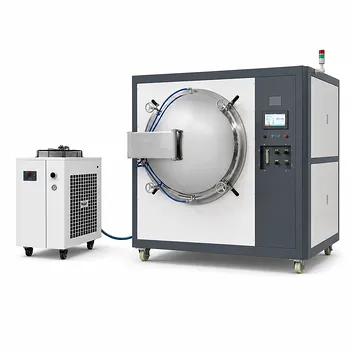
Vacuum brazing is a specialized metal-joining process performed inside a vacuum furnace to create high-strength, leak-proof joints. Unlike traditional welding, this technique melts a filler metal—not the base material—allowing it to flow between close-fitting parts via capillary action. Because the process occurs in a vacuum, it eliminates the need for chemical flux, resulting in exceptionally clean parts free of corrosive residues or oxidation.
The Core Insight: Vacuum brazing is not just about joining metals; it is about preserving their integrity. By removing air from the equation, you eliminate oxidation and the need for flux, creating a joint that is often stronger and more corrosion-resistant than the parent materials themselves.
The Mechanics of the Process
The Solid-Solid Joining Principle
Vacuum brazing is a solid-solid joining method. The components you are joining (the base metals) never melt. Instead, you utilize a filler metal with a melting point lower than that of the base materials.
The Role of the Vacuum Environment
The critical differentiator is the vacuum chamber. In a standard atmosphere, heating metal causes oxidation, which prevents bonding. In this process, the vacuum environment actively removes oxide films from the surface. This creates a pristine surface for bonding without requiring flux, a chemical cleaning agent that can leave behind corrosive residue.
Capillary Action and Wetting
Once the furnace reaches the correct temperature, the filler metal melts and "wets" the surface of the base metal. Because the surfaces are chemically clean, the molten filler flows into even the most complex, narrow channels through capillary action.
Diffusion Bonding
As the filler fills the gap, a mutual diffusion occurs. The filler material and the base metal dissolve into one another at the atomic level. This results in a connection that is metallurgical rather than just mechanical, offering superior strength.
The Operational Workflow
Evacuation
The process begins by placing the assembled workpiece into the vacuum chamber. A mechanical pump initiates the vacuum, followed by a diffusion pump to achieve the required high-vacuum levels.
Controlled Heating
The system heats the assembly according to a precise schedule. The heating speed is carefully controlled to prevent outgassing from degrading the vacuum level. This ensures the temperature remains uniform across the entire assembly, preventing distortion.
Cooling and Solidification
After the filler has flowed, the furnace creates a cooling cycle. Crucially, the parts must remain in the vacuum or a controlled inert gas atmosphere until they have cooled sufficiently. Opening the furnace too early would cause the hot metal to instantly oxidize upon contact with air.
Understanding the Trade-offs
Precision vs. Preparation
While vacuum brazing produces flawless joints, it requires impeccable preparation. Because the process relies on capillary action, the gap between parts must be extremely tight and consistent. Poor fit-up will result in weak joints or voids.
Processing Speed
This is a batch process, meaning it generally has longer cycle times than continuous atmospheric brazing or manual welding. It is designed for high-value or high-volume batches where quality is non-negotiable, rather than for rapid, one-off repairs.
Making the Right Choice for Your Project
- If your primary focus is corrosion resistance: Choose vacuum brazing because the flux-free process eliminates the risk of entrapped chemicals that cause corrosion later.
- If your primary focus is complex geometries: Rely on this method for its ability to pull filler metal into deep, narrow, or blind joints via capillary action.
- If your primary focus is aesthetic finish: Select this process to ensure parts emerge bright, clean, and free of discoloration or scale.
Vacuum brazing is the definitive choice when the structural integrity and cleanliness of the joint are as important as the geometry of the part itself.
Summary Table:
| Feature | Vacuum Brazing Detail | Benefit to User |
|---|---|---|
| Environment | High-Vacuum Chamber | Eliminates oxidation and scale |
| Joining Agent | Low-melt Filler Metal | Preserves base metal integrity |
| Cleaning | Flux-Free Process | No corrosive residues or cleaning required |
| Bonding | Capillary Action & Diffusion | Superior joint strength and leak-proof seals |
| Finish | Controlled Cooling | Bright, clean parts with minimal distortion |
Elevate Your Material Joining Precision with KINTEK
Achieving flawless, high-strength joints requires the right environment. KINTEK specializes in high-performance laboratory equipment, offering a comprehensive range of vacuum, atmosphere, and CVD furnaces specifically engineered for advanced processes like vacuum brazing.
Whether you are conducting battery research, developing aerospace components, or performing dental applications, our portfolio provides the temperature uniformity and vacuum integrity your projects demand. From high-temperature high-pressure reactors to crushing and milling systems, we empower your lab with tools that ensure repeatable, professional results.
Ready to optimize your brazing workflow? Contact our experts today to find the perfect furnace solution for your specific requirements!
Related Products
- Vacuum Hot Press Furnace Heated Vacuum Press Machine Tube Furnace
- 600T Vacuum Induction Hot Press Furnace for Heat Treat and Sintering
- Vacuum Hot Press Furnace Machine Heated Vacuum Press
- Vacuum Heat Treat Furnace and Levitation Induction Melting Furnace
- 2200 ℃ Tungsten Vacuum Heat Treat and Sintering Furnace
People Also Ask
- What advantages does a vacuum hot press furnace provide for LSLBO ceramic electrolytes? Achieve 94% Relative Density
- What role does a Vacuum Hot Press (VHP) furnace play in the densification of austenitic stainless steel 316 composites?
- What are the advantages of using a vacuum hot pressing furnace? Superior Densification for 2024Al/Gr/SiC Composites
- What are the advantages of a vacuum hot press furnace for LTPO solid electrolytes? Boost Density and Conductivity
- What core processing conditions does a vacuum hot press furnace provide? Achieve High-Density Cu-SiC/Diamond Composites