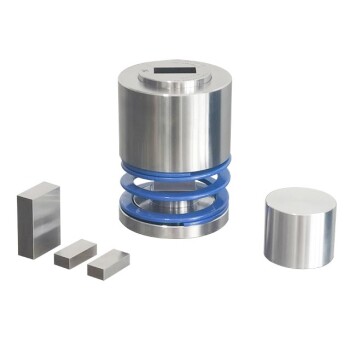
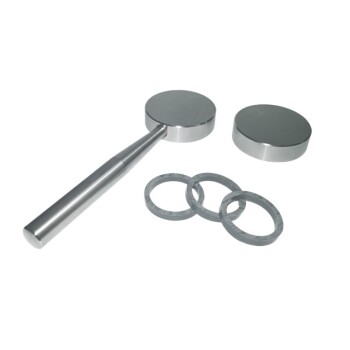
Laboratory hydraulic presses and molds function as the central mechanism for transforming loose mixed waste powders into solid composite materials. By utilizing the compression molding process, this equipment applies high pressure and temperature to compact disparate particles—rubber, plastic, and wood—into a unified, dense structure.
The primary function of this equipment is to eliminate trapped air and force mechanical interlocking between waste particles. This process converts a heterogeneous mix of powders into a high-density, mechanically strong composite with a defined geometric shape.
The Mechanics of Material Transformation
Eliminating Trapped Air
The initial function of the hydraulic press is to address the natural porosity of waste powders. As pressure is applied, air trapped between particles is forced out of the mixture. This is critical because retained air creates voids that inevitably weaken the final product.
Increasing Material Density
Once the air is removed, the equipment forces the loose material to compact. This process significantly increases the density of the composite by reducing the volume of the mixed waste powders. High density is a prerequisite for a durable, usable material.
Promoting Physical Interaction
The combination of heat and pressure drives the rubber, plastic, and wood components into intimate contact. This proximity promotes physical interaction, ensuring the different materials do not simply sit next to each other but actively press against one another.
Facilitating Mechanical Anchoring
Beyond simple contact, the press forces a phenomenon known as mechanical anchoring. The particles lock together physically under the strain of the press, creating a cohesive bond without necessarily relying on chemical adhesives.
Determining Final Properties
Defining Geometric Shape
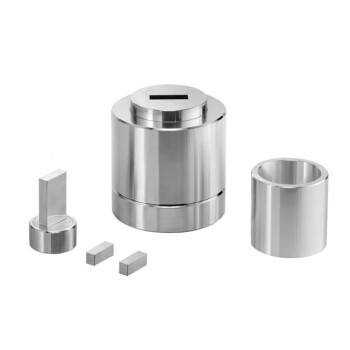
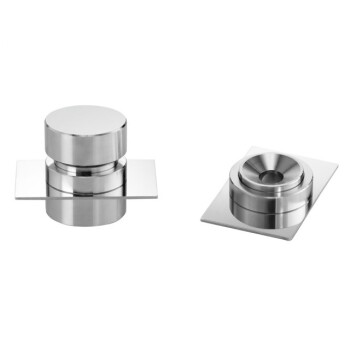
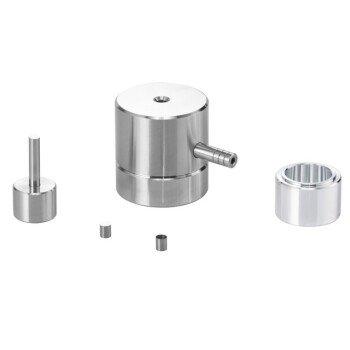
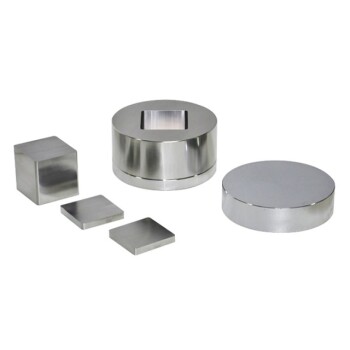
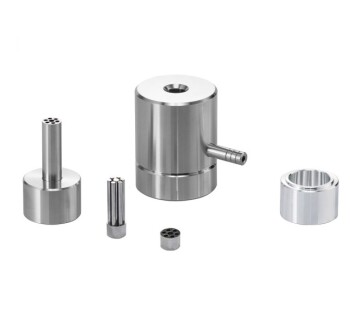
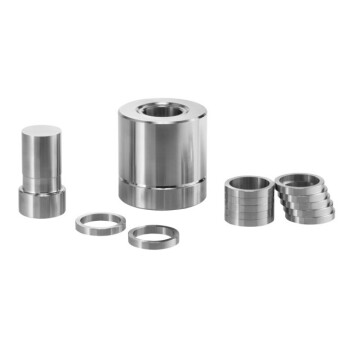
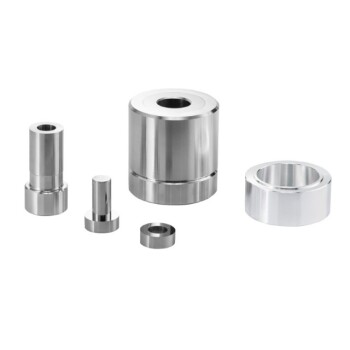
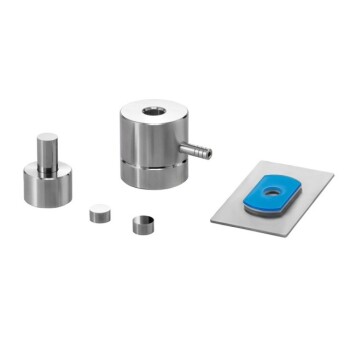
The specialized molds serve the specific function of constraining the material during compression. They dictate the final geometric shape of the sample, ensuring uniformity for testing or production.
Establishing Mechanical Strength
The ultimate output of the press and mold system is structural integrity. The degree of compaction and anchoring achieved directly determines the mechanical strength of the composite. If the equipment fails to apply sufficient pressure, the material will lack the necessary internal cohesion to bear loads.
Understanding Process Dependencies
The Role of Temperature and Pressure
While the machinery provides the force, the process relies heavily on the correct environmental settings. The high-pressure environment is the catalyst that enables the physical changes described above.
The Limits of Mechanical Interlocking
It is important to note that this equipment primarily facilitates physical, mechanical bonding. The press maximizes the potential of the waste mix, but the final quality relies heavily on the compatibility of the mixed powders prior to compression.
Making the Right Choice for Your Goal
When setting up your evaluation process for rubber-plastic-wood composites, consider your primary testing objectives:
- If your primary focus is Structural Integrity: Ensure your press is capable of sustaining high pressures to maximize density and mechanical anchoring, which are the primary drivers of strength.
- If your primary focus is Product Consistency: Prioritize high-precision molds to ensure the geometric shape is identical across all samples, removing variables from your physical testing.
The effectiveness of your evaluation relies on the press's ability to turn loose powder into a dense, unified solid through sheer force and heat.
Summary Table:
| Function | Description | Impact on Final Composite |
|---|---|---|
| Air Elimination | Removes trapped air from powders | Prevents internal voids and structural weak points |
| Densification | Compresses loose particles into solids | Increases material durability and weight-to-volume ratio |
| Mechanical Anchoring | Forces physical interlocking of materials | Creates a cohesive bond and high structural integrity |
| Shape Definition | Constrains material within specialized molds | Ensures uniform geometric samples for consistent testing |
| Heat & Pressure Application | Provides the catalyst for material bonding | Drives physical interaction between disparate waste types |
Maximize Your Material Research with KINTEK Precision
Ready to transform your rubber-plastic-wood waste into high-performance composites? KINTEK specializes in advanced laboratory equipment designed for the most demanding research environments. Our precision hydraulic presses (pellet, hot, and isostatic) and custom molds provide the exact pressure and temperature control needed to ensure superior mechanical anchoring and material density.
Whether you are evaluating complex waste streams or developing next-generation sustainable materials, our comprehensive portfolio—including high-temperature furnaces, crushing and milling systems, and essential lab consumables—is engineered to deliver consistent, repeatable results.
Take the next step in material innovation. Contact KINTEK today to find the perfect solution for your laboratory needs!
References
- Mihaela Coşniţă, Cristina Cazan. The Influence of Fly Ash on the Mechanical Properties of Water Immersed All Waste Composites. DOI: 10.3390/polym14101957
This article is also based on technical information from Kintek Solution Knowledge Base .
Related Products
- Ball Press Mold for Lab
- Assemble Square Lab Press Mold for Laboratory Applications
- Anti-Cracking Press Mold for Lab Use
- Round Bidirectional Press Mold for Lab
- Cylindrical Lab Electric Heating Press Mold for Laboratory Applications
People Also Ask
- What are the advantages of using a laboratory hydraulic press for hot pressing? Achieve Peak Nano-Composite Density
- How to use a press mold? Master the Art of Creating Consistent Ceramic Forms
- What is the press mould method? A Guide to Consistent, Detailed Ceramic Forms
- What is the purpose of specialized pressure devices in sulfide solid-state batteries? Ensure Chemo-Mechanical Stability
- Why are pressure molds with non-conductive resin inner walls required for battery testing? Ensure Data Accuracy