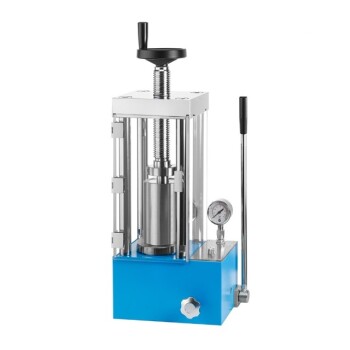
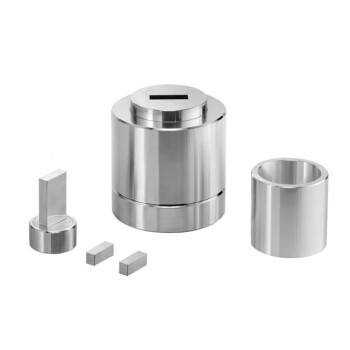
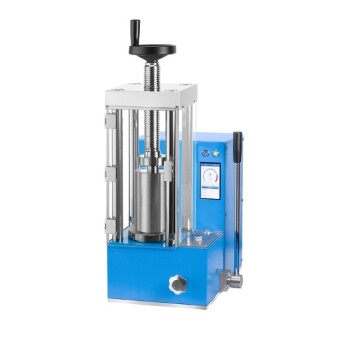
A laboratory hydraulic press and steel molds serve a critical preparatory role in the fabrication of Diamond/Al-Cu composites. They are utilized to mechanically compress loose powder mixtures into a cohesive "green body," providing the necessary structural strength for handling and the initial density required for effective sintering.
By transforming loose powders into a solid preform prior to heating, you establish a stable geometric foundation. This process eliminates trapped air and maximizes particle contact, ensuring that the subsequent vacuum hot pressing stage results in a high-density, defect-free composite.
Establishing Physical Integrity
The primary challenge in powder metallurgy is managing loose, aerated mixtures. Cold pressing addresses the logistical and structural hurdles of moving material from a mixing environment to a sintering furnace.
Creating the "Green Body"
The immediate output of this process is a green body (or preform). By applying pressure via steel molds, you transform the loose Diamond/Al-Cu mixture into a semi-solid compact. This compact holds its shape without the aid of binders or heat, relying solely on mechanical interlocking and plastic deformation of the metal particles.
Facilitating Safe Material Transfer
Loose powders are difficult to load directly into the graphite molds typically used for vacuum hot pressing. They are prone to spilling, segregation, or uneven loading. Cold pressing creates a solid pellet that can be safely handled, transported, and inserted into the hot-pressing die without delaminating or crumbling.
Optimizing Material Density
Beyond simple handling, cold pressing acts as the first stage of densification. It sets the baseline for the material's final properties.
Increasing Initial Packing Density
The hydraulic press forces powder particles closer together, significantly increasing the initial packing density. By mechanically reducing the distance between the diamond reinforcement and the Al-Cu matrix, you reduce the amount of work the vacuum hot press must do later to achieve full density.
Minimizing Volume Shrinkage
Because the particles are already packed tightly, the material undergoes less volume shrinkage during the high-temperature sintering phase. This dimensional stability is crucial for maintaining the precise shape of the final component and preventing warping.
Expelling Trapped Air
Loose powders contain a significant volume of interstitial air. Cold pressing expels this air before the material enters the vacuum furnace. Removing air early is vital to prevent voids, pores, or oxidation pockets that could compromise the internal structure of the final composite.
Enhancing Microstructural Uniformity
The quality of the interface between the diamond and the metal matrix determines the composite's thermal and mechanical performance.
Improving Particle Contact
Effective "reaction bonding" requires intimate contact between particles. Cold pressing establishes this initial contact, creating a continuous network of metal and diamond. This ensures that when heat is applied, the sintering reaction proceeds uniformly throughout the material.
Preventing Segregation
Transporting loose powders can cause heavy particles (like copper) and lighter particles (like aluminum or diamond) to separate. Compressing them into a solid block locks the distribution in place, ensuring the material remains homogenous.
Common Pitfalls to Avoid
While cold pressing is beneficial, it requires careful control of process variables to avoid introducing new defects.
The Risk of Density Gradients
If the aspect ratio of the steel mold is too high (too tall relative to its width), friction against the mold walls can cause uneven pressure distribution. This results in a "green body" that is dense on the ends but porous in the middle, leading to uneven sintering later.
Balancing Pressure Levels
The pressure applied must be calculated carefully.
- Too low: The preform will be too fragile to handle and may crumble during transfer.
- Too high: Excessive pressure can damage the diamond particles (crushing them) or cause the green body to crack due to "spring-back" when the pressure is released.
Making the Right Choice for Your Goal
The specific parameters you use for cold pressing should depend on your primary objective for the Diamond/Al-Cu composite.
- If your primary focus is Ease of Handling: Use lower pressures (e.g., 2–10 MPa) to simply consolidate the powder into a shape that fits your graphite sintering die, focusing on preventing spills and segregation.
- If your primary focus is Maximum Density: Use higher pressures (e.g., closer to 500 MPa) to mechanically eliminate voids and maximize particle contact, reducing the time and pressure required during the hot-pressing stage.
Ultimately, the cold-pressing stage is not just a shaping step; it is a quality control checkpoint that determines the structural uniformity and final density of your composite material.
Summary Table:
| Purpose of Cold Pressing | Key Benefit | Impact on Final Composite |
|---|---|---|
| Green Body Creation | Transforms loose powder into a solid preform | Facilitates safe material handling and transfer |
| Initial Densification | Increases packing density/reduces air gaps | Minimizes volume shrinkage during sintering |
| Air Expulsion | Removes interstitial air before vacuum heating | Prevents internal voids, pores, and oxidation |
| Microstructural Control | Locks particle distribution in place | Prevents segregation and ensures thermal uniformity |
Elevate Your Composite Fabrication with KINTEK
Precision in the cold-pressing stage is the foundation of high-performance material science. KINTEK specializes in providing the robust laboratory equipment needed to achieve perfect density and structural integrity. From our high-precision hydraulic presses (pellet, hot, isostatic) and custom steel molds to advanced vacuum and CVD furnaces, we offer the tools required for sophisticated sintering and powder metallurgy workflows.
Our extensive portfolio also includes:
- High-temperature furnaces (Muffle, Tube, Rotary, Vacuum)
- Crushing and milling systems for powder preparation
- High-temperature high-pressure reactors and autoclaves
- Essential consumables like PTFE products, ceramics, and crucibles
Don't settle for less than industrial-grade precision. Contact KINTEK today to discover how our expert solutions can optimize your lab's efficiency and research outcomes!
Related Products
- Automatic Laboratory Hydraulic Pellet Press Machine for Lab Use
- kbr pellet press 2t
- Manual Cold Isostatic Pressing Machine CIP Pellet Press
- Automatic Laboratory Hydraulic Press for XRF & KBR Pellet Press
- Laboratory Hydraulic Press Split Electric Lab Pellet Press
People Also Ask
- What is the role of a laboratory hydraulic pellet press and stainless steel molds in the fabrication of RuO2/NbC anodes?
- What role does a laboratory pellet press play in the enhancement of biomass energy products? Optimize Fuel Efficiency
- What is the purpose of using a laboratory pellet press when evaluating the electronic conductivity of carbon powders? Guide
- How does a laboratory hydraulic pellet press contribute to SiCw/2024 aluminum composite preforms? Optimize Densification
- What is the significance of applying 200 MPa of pressure with a laboratory hydraulic pellet press for composite ceramics?