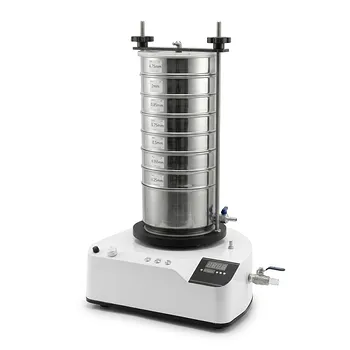
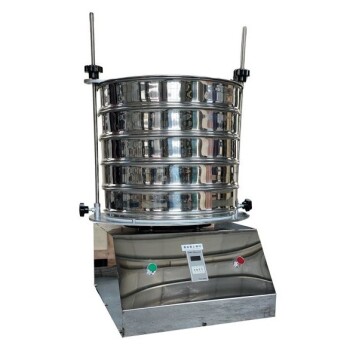
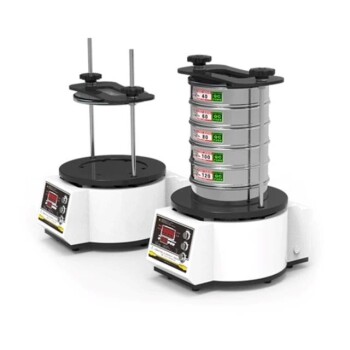
The critical role of sieving equipment prior to mold loading is to mechanically separate and remove hard agglomerates that form during the drying of Silicon Carbide (SiC) and Zirconia Toughened Alumina (ZTA) powders. By typically utilizing a 200-mesh sieve, this process ensures the feedstock possesses the high degree of fluidity and particle size uniformity necessary for consistent processing.
Sieving is the definitive quality control step that prevents processing inconsistencies from becoming structural failures. It ensures uniform mold filling to eliminate internal density gradients, directly preventing large pore defects and maximizing the density of the final sintered body.
The Mechanics of Powder Preparation
Removing Hard Agglomerates
During the drying phase of ceramic powder preparation, particles often bind together to form large, hard clumps or "agglomerates."
If left unchecked, these agglomerates act as contaminants. Sieving equipment, specifically using a 200-mesh screen for SiC/ZTA, physically blocks these irregularities from entering the mold.
Enhancing Fluidity
For a mold to fill correctly, the ceramic powder must behave almost like a fluid.
Sieving breaks down loose clusters and ensures only particles within a specific size range pass through. This uniformity significantly improves the flowability of the powder, allowing it to settle quickly and evenly into complex mold geometries.
Impact on the Final Sintered Body
Eliminating Density Gradients
A major cause of component failure is uneven density within the "green" (unsintered) body.
When powder flows poorly or contains agglomerates, it packs unevenly, creating regions of high and low density. Sieving ensures a consistent packing density, which eliminates these internal gradients and ensures the material shrinks uniformly during sintering.
Preventing Large Pore Defects
Large pores in a finished ceramic are often the "ghosts" of agglomerates that prevented proper particle bonding.
By removing these oversized particles before they enter the mold, sieving prevents the formation of large pore defects. This leads to a final product with significantly enhanced overall density and superior mechanical properties.
Common Pitfalls to Avoid
Inconsistent Mesh Sizing
While a 200-mesh sieve is standard for SiC/ZTA, using a screen that is too coarse (lower mesh number) renders the process ineffective.
Allowing even small agglomerates to pass through can reintroduce density gradients. Conversely, using a screen that is excessively fine may impede production speed or separate out necessary constituent particles, altering the material composition.
Ignoring Environmental Humidity
Sieving improves flowability, but humidity can counteract this by causing immediate re-agglomeration.
Ideally, sieving should occur immediately prior to mold loading. Storing sieved powder for long periods without environmental controls can negate the benefits of the process.
Making the Right Choice for Your Goal
To ensure the integrity of your ceramic components, apply the following principles:
- If your primary focus is Structural Integrity: strict adherence to a 200-mesh (or finer) sieving protocol is non-negotiable to minimize pore defects and maximize sintered density.
- If your primary focus is Process Consistency: Prioritize the fluidity of the powder post-sieving to ensure repeatable mold filling and eliminate internal density gradients.
The uniformity of your powder dictates the reliability of your final product.
Summary Table:
| Feature | Role in SiC/ZTA Preparation | Impact on Final Ceramic |
|---|---|---|
| Agglomerate Removal | Uses 200-mesh sieve to block hard clumps | Eliminates large pore defects and structural weak points |
| Fluidity Enhancement | Ensures uniform particle size for better flow | Achieves consistent mold filling and uniform packing |
| Density Control | Prevents internal density gradients | Ensures uniform shrinkage and maximum sintered density |
| Quality Control | Acts as the final check before mold loading | Guarantees process repeatability and mechanical integrity |
Elevate Your Ceramic Processing with KINTEK Precision Solutions
Don't let powder inconsistencies compromise your material performance. KINTEK specializes in high-performance laboratory equipment designed for the most demanding ceramic research and production environments. Whether you are working with SiC, ZTA, or advanced composites, our comprehensive range of sieving equipment, crushing and milling systems, and high-pressure hydraulic presses ensures your feedstock meets the highest standards of uniformity.
Why choose KINTEK?
- Superior Material Integrity: Prevent pore defects with our precise sieving and milling solutions.
- Total Lab Workflow: From powder preparation to high-temperature sintering in our advanced muffle and vacuum furnaces, we provide the tools you need at every stage.
- Expert Support: Our team understands the nuances of density gradients and particle fluidity.
Optimize your sintering results today! Contact our technical experts at KINTEK to find the perfect equipment for your laboratory.
Related Products
- Three-dimensional electromagnetic sieving instrument
- Laboratory Vibratory Sieve Shaker Machine for Dry and Wet Three-Dimensional Sieving
- Laboratory Test Sieves and Sieving Machines
- Laboratory Wet Three-Dimensional Vibratory Sieve Shaker Machine
- Laboratory Test Sieves and Vibratory Sieve Shaker Machine
People Also Ask
- Why is sieving equipment essential for the classification of processed bio-activated carbon? Optimize Performance
- What are the limitations of sieving? Understanding the Constraints of Particle Size Analysis
- What are advantages and disadvantages of sieving method? A Guide to Reliable & Cost-Effective Particle Sizing
- How is sieving important? The Critical Role of Particle Size Analysis in Quality Control
- What is sieving and how does it work? A Guide to Accurate Particle Size Analysis