Knowledge dental furnace What material is typically used to calibrate a porcelain furnace? Use Your Porcelain Powder for Perfect Results
Author avatar

Tech Team · Kintek Solution

Updated 2 months ago

What material is typically used to calibrate a porcelain furnace? Use Your Porcelain Powder for Perfect Results


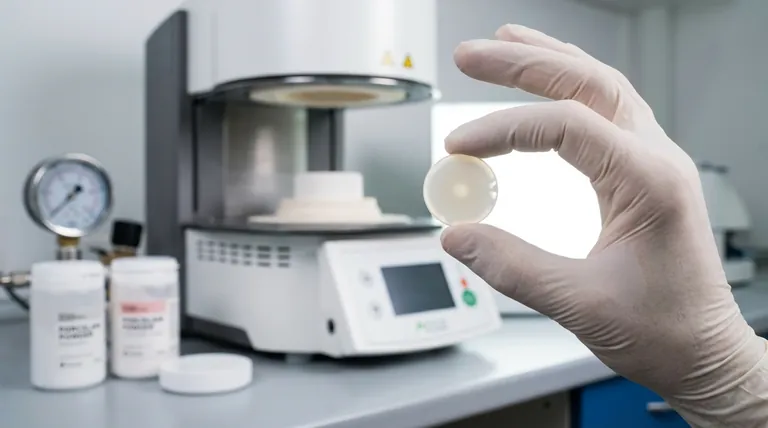
The most effective material for calibrating a porcelain furnace is not a third-party kit, but a sample of the clearest powder from the specific porcelain system you are using. Experienced ceramists fire this sample and evaluate its translucency and surface texture to fine-tune the furnace's firing cycle. This approach ensures the furnace is optimized for the exact materials being used in your restorations.

True furnace calibration is less about hitting a specific temperature on a display and more about achieving a specific, predictable result in the ceramic itself. It is a visual and tactile process aimed at producing maximum clarity and sharply defined edges in the final porcelain.
What material is typically used to calibrate a porcelain furnace? Use Your Porcelain Powder for Perfect Results

Why Calibration Is About the Ceramic, Not Just the Furnace

A porcelain furnace's job is to apply heat and vacuum precisely. However, over time, the heating element (muffle) ages and the thermocouple that measures temperature can drift. The number on the display may no longer represent the true temperature inside the chamber, leading to inconsistent results.

The Role of the Porcelain Powder

The most reliable way to check a furnace's true firing temperature is to see how it affects the porcelain you use every day.

Using the clearest (most translucent) powder in your specific porcelain system acts as a highly sensitive indicator. This is because translucency is directly impacted by achieving the perfect maturation temperature—too low and it's opaque, too high and it becomes milky or glassy with rounded edges.

Key Visual Indicators for Calibration

When you fire a sample of the translucent powder, you are looking for a very specific outcome.

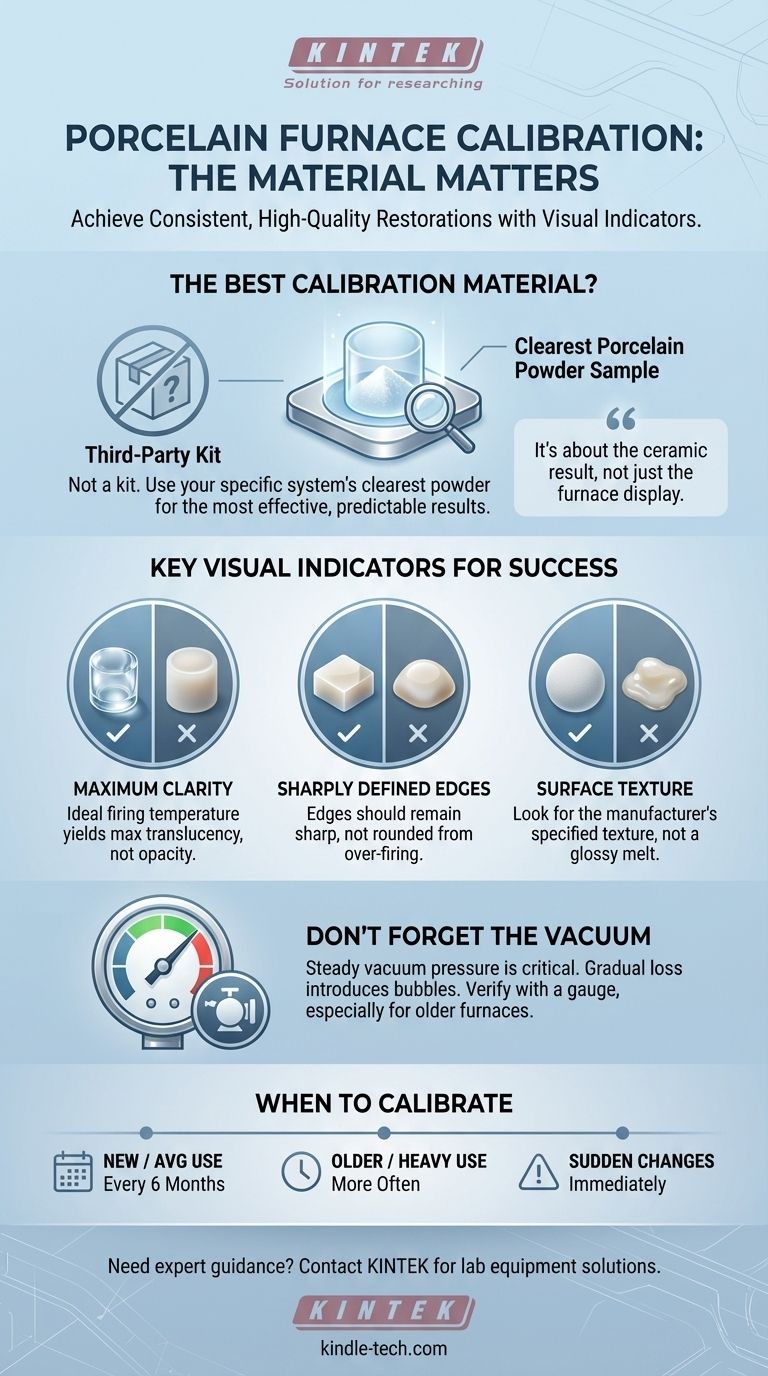
  • Maximum Clarity: The sample should be as clear and translucent as possible, indicating it has reached its ideal firing temperature without being over-fired.
  • Sharply Defined Edges: The edges of the fired sample should remain sharp and not appear rounded. Rounded edges are a classic sign that the temperature was too high.
  • Surface Texture: The surface should have the correct texture as defined by the manufacturer, not a glossy, melted appearance.

Understanding the Critical Factors

Achieving a perfect restoration involves more than just temperature. A comprehensive calibration process must account for other variables that can change over time.

It's Not Just Heat: The Vacuum Factor

Vacuum pressure is equally critical. A gradual loss of vacuum can introduce bubbles or porosity into the ceramic, even if the temperature is perfectly calibrated.

For older furnaces especially, a slow leak in the vacuum system is a common cause of sudden changes in porcelain quality. Confirming the vacuum level with a simple, inexpensive vacuum gauge can quickly diagnose this issue.

How Often Should You Calibrate?

The required frequency depends on your furnace's age and your workload.

  • New, Well-Maintained Furnaces: For a furnace under average production levels, calibrating every six months is generally sufficient.
  • Older or Heavily Used Furnaces: As the muffle ages or the frequency of use increases, calibration should be performed more often.
  • Sudden Changes: You should always perform a calibration firing whenever you notice a sudden change in the appearance of your porcelain restorations.

Making the Right Choice for Your Lab

Calibrating your furnace is an essential step for quality control. Use this guidance to establish a reliable protocol for your specific needs.

  • If your primary focus is routine maintenance: Fire a sample of your system's clearest porcelain powder every six months to verify that you are still achieving maximum translucency and sharp edges.
  • If you are troubleshooting inconsistent results: Immediately fire a test sample and, just as importantly, verify your vacuum pressure is holding steady throughout the cycle.
  • If you are working with an older furnace: Increase your calibration frequency and consider investing in a hardware store vacuum gauge to monitor for pressure drops, a common failure point in aging equipment.

Ultimately, successful calibration is measured not by the furnace's display, but by the consistent, high-quality results of your final restorations.

Summary Table:

Key Calibration Factor Why It Matters Key Indicator
Porcelain Powder Acts as a sensitive indicator of true temperature. Maximum clarity and sharp edges in the fired sample.
Vacuum Pressure Prevents bubbles and porosity in the ceramic. Holds steady pressure throughout the cycle.
Calibration Frequency Maintains consistent results as the furnace ages. New furnaces: every 6 months. Older/heavy-use: more often.

Achieve consistent, high-quality dental restorations with a properly calibrated furnace.

KINTEK specializes in providing reliable lab equipment and consumables for dental laboratories. If you are experiencing inconsistent porcelain results or need guidance on establishing a robust calibration protocol for your specific furnace, our experts can help.

Contact KINTEK today to discuss your lab's needs and ensure your equipment is performing optimally for every restoration.

Visual Guide
What material is typically used to calibrate a porcelain furnace? Use Your Porcelain Powder for Perfect Results Visual Guide

Related Products

People Also Ask

Related Products

Dental Porcelain Zirconia Sintering Ceramic Vacuum Press Furnace

Dental Porcelain Zirconia Sintering Ceramic Vacuum Press Furnace

Get precise dental results with Dental Vacuum Press Furnace. Automatic temperature calibration, low noise tray, and touch screen operation. Order now!

Vacuum Dental Porcelain Sintering Furnace

Vacuum Dental Porcelain Sintering Furnace

Get precise and reliable results with KinTek's Vacuum Porcelain Furnace. Suitable for all porcelain powders, it features hyperbolic ceramic furnace function, voice prompt, and automatic temperature calibration.

Dental Porcelain Zirconia Sintering Ceramic Furnace Chairside with Transformer

Dental Porcelain Zirconia Sintering Ceramic Furnace Chairside with Transformer

Experience top-notch sintering with Chairside Sintering Furnace with Transformer. Easy to operate, noise-free pallet, and automatic temperature calibration. Order now!

Ultra-High Temperature Graphite Vacuum Graphitization Furnace

Ultra-High Temperature Graphite Vacuum Graphitization Furnace

The ultra-high temperature graphitization furnace utilizes medium frequency induction heating in a vacuum or inert gas environment. The induction coil generates an alternating magnetic field, inducing eddy currents in the graphite crucible, which heats up and radiates heat to the workpiece, bringing it to the desired temperature. This furnace is primarily used for graphitization and sintering of carbon materials, carbon fiber materials, and other composite materials.

Vertical High Temperature Graphite Vacuum Graphitization Furnace

Vertical High Temperature Graphite Vacuum Graphitization Furnace

Vertical high temperature graphitization furnace for carbonization and graphitization of carbon materials up to 3100℃.Suitable for shaped graphitization of carbon fiber filaments and other materials sintered in a carbon environment.Applications in metallurgy, electronics, and aerospace for producing high-quality graphite products like electrodes and crucibles.

High Temperature Muffle Oven Furnace for Laboratory Debinding and Pre Sintering

High Temperature Muffle Oven Furnace for Laboratory Debinding and Pre Sintering

KT-MD High temperature debinding and pre-sintering furnace for ceramic materials with various molding processes. Ideal for electronic components such as MLCC and NFC.

Molybdenum Vacuum Heat Treat Furnace

Molybdenum Vacuum Heat Treat Furnace

Discover the benefits of a high-configuration molybdenum vacuum furnace with heat shield insulation. Ideal for high-purity, vacuum environments like sapphire crystal growth and heat treatment.

2200 ℃ Graphite Vacuum Heat Treat Furnace

2200 ℃ Graphite Vacuum Heat Treat Furnace

Discover the power of the KT-VG Graphite Vacuum Furnace - with a maximum working temperature of 2200℃, it's perfect for vacuum sintering of various materials. Learn more now.

Horizontal High Temperature Graphite Vacuum Graphitization Furnace

Horizontal High Temperature Graphite Vacuum Graphitization Furnace

Horizontal Graphitization Furnace: This type of furnace is designed with the heating elements placed horizontally, allowing for uniform heating of the sample. It's well-suited for graphitizing large or bulky samples that require precise temperature control and uniformity.

Graphite Vacuum Furnace Bottom Discharge Graphitization Furnace for Carbon Materials

Graphite Vacuum Furnace Bottom Discharge Graphitization Furnace for Carbon Materials

Bottom-out graphitization furnace for carbon materials, ultra-high temperature furnace up to 3100°C, suitable for graphitization and sintering of carbon rods and carbon blocks. Vertical design, bottom discharging, convenient feeding and discharging, high temperature uniformity, low energy consumption, good stability, hydraulic lifting system, convenient loading and unloading.

Laboratory Muffle Oven Furnace Bottom Lifting Muffle Furnace

Laboratory Muffle Oven Furnace Bottom Lifting Muffle Furnace

Efficiently produce batches with excellent temperature uniformity using our Bottom Lifting Furnace. Features two electric lifting stages and advanced temperature control up to 1600℃.

1200℃ Split Tube Furnace with Quartz Tube Laboratory Tubular Furnace

1200℃ Split Tube Furnace with Quartz Tube Laboratory Tubular Furnace

KT-TF12 split tube furnace: high-purity insulation, embedded heating wire coils, and max. 1200C. Widely used for new materials and chemical vapour deposition.

1200℃ Muffle Furnace Oven for Laboratory

1200℃ Muffle Furnace Oven for Laboratory

Upgrade your lab with our 1200℃ Muffle Furnace. Achieve fast, precise heating with Japan alumina fibers and Molybdenum coils. Features TFT touch screen controller for easy programming and data analysis. Order now!

1700℃ Muffle Oven Furnace for Laboratory

1700℃ Muffle Oven Furnace for Laboratory

Get superior heat control with our 1700℃ Muffle Furnace. Equipped with intelligent temperature microprocessor, TFT touch screen controller & advanced insulation materials for precise heating up to 1700C. Order now!

1200℃ Controlled Atmosphere Furnace Nitrogen Inert Atmosphere Furnace

1200℃ Controlled Atmosphere Furnace Nitrogen Inert Atmosphere Furnace

Discover our KT-12A Pro Controlled atmosphere furnace - high precision, heavy duty vacuum chamber, versatile smart touch screen controller, and excellent temperature uniformity up to 1200C. Ideal for both laboratory and industrial application.

1700℃ Controlled Atmosphere Furnace Nitrogen Inert Atmosphere Furnace

1700℃ Controlled Atmosphere Furnace Nitrogen Inert Atmosphere Furnace

KT-17A Controlled atmosphere furnace: 1700℃ heating, vacuum sealing technology, PID temperature control, and versatile TFT smart touch screen controller for laboratory and industrial use.

High Temperature Alumina (Al2O3) Furnace Tube for Engineering Advanced Fine Ceramics

High Temperature Alumina (Al2O3) Furnace Tube for Engineering Advanced Fine Ceramics

High temperature alumina furnace tube combines the advantages of high hardness of alumina, good chemical inertness and steel, and has excellent wear resistance, thermal shock resistance and mechanical shock resistance.

1400℃ Muffle Oven Furnace for Laboratory

1400℃ Muffle Oven Furnace for Laboratory

Get precise high-temperature control up to 1500℃ with KT-14M Muffle furnace. Equipped with a smart touch screen controller and advanced insulation materials.

Vacuum Heat Treat Furnace with Ceramic Fiber Liner

Vacuum Heat Treat Furnace with Ceramic Fiber Liner

Vacuum furnace with polycrystalline ceramic fiber insulation liner for excellent heat insulation and uniform temperature field. Choose from 1200℃ or 1700℃ max. working temperature with high vacuum performance and precise temperature control.

Mesh belt controlled atmosphere furnace

Mesh belt controlled atmosphere furnace

Discover our KT-MB mesh belt sintering furnace - perfect for high-temperature sintering of electronic components & glass insulators. Available for open air or controlled atmosphere environments.


Leave Your Message