Knowledge What metals can be PVD coated? A Guide to Choosing the Right Substrate
Author avatar

Tech Team · Kintek Solution

Updated 6 days ago

What metals can be PVD coated? A Guide to Choosing the Right Substrate


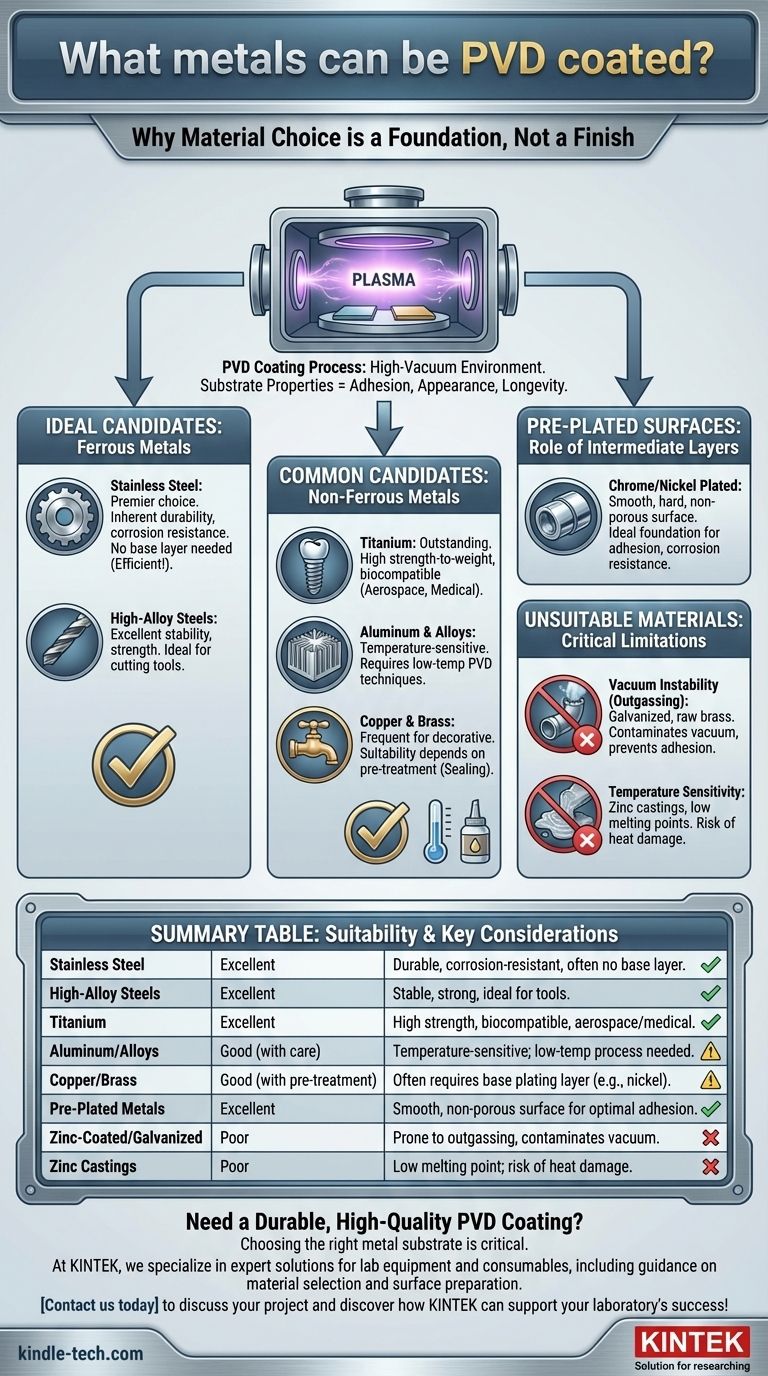
Virtually any metal can receive a PVD coating, but its success and durability are not universal. The most common and suitable candidates include stainless steel, high-alloy steels, titanium, aluminum, and copper alloys. Additionally, metals that have already been plated with materials like chrome or nickel are excellent substrates for PVD application.

The critical factor for a successful PVD finish is not just the type of metal, but its ability to withstand a vacuum environment and its surface preparation. The best results are achieved on materials that are stable under vacuum and have a pristine, non-porous surface.
What metals can be PVD coated? A Guide to Choosing the Right Substrate

Why Material Choice is a Foundation, Not a Finish

Physical Vapor Deposition (PVD) occurs in a high-vacuum chamber. The properties of the base metal, or substrate, directly impact the adhesion, appearance, and longevity of the final coating.

Ideal Candidates: Ferrous Metals

The most reliable and widely used substrates for PVD are often iron-based alloys.

Stainless steel is considered a premier choice. Its inherent durability and corrosion resistance mean it provides an excellent foundation for the coating to bond to.

Crucially, stainless steel generally does not require a base layer of nickel or chrome, which makes the process more efficient and economical.

High-alloy steels, such as high-speed steels used for cutting tools, are also excellent candidates due to their stability and strength.

Common Candidates: Non-Ferrous Metals

Many non-ferrous metals are also compatible, though some require special considerations.

Titanium is an outstanding substrate for PVD, prized in aerospace and medical fields for its high strength-to-weight ratio and biocompatibility.

Aluminum and its alloys can be coated but are more temperature-sensitive. They often require specialized low-temperature PVD techniques to prevent warping or damage to the substrate.

Copper and brass are also frequently coated, particularly for decorative applications. However, their suitability depends heavily on pre-treatment.

The Role of Pre-Plated Surfaces

Some applications benefit from an intermediate layer between the base metal and the PVD coating.

Metals plated with chrome or nickel create a very smooth, hard, and non-porous surface. This provides an ideal foundation for the PVD layer to adhere to, significantly enhancing both corrosion resistance and final appearance.

Critical Limitations and Unsuitable Materials

Not all metals are suitable for PVD coating in their raw state. The limitations are almost always related to how the material behaves in a vacuum or at elevated temperatures.

The Vacuum Instability Problem

The PVD process requires a deep vacuum. Materials that release gases under these conditions, a process known as outgassing, can disrupt the coating process and lead to defects.

Galvanized materials (zinc-coated steel) and raw brass are classic examples of "vacuum-unfriendly" substrates. The zinc and other elements within these alloys can vaporize in the chamber, contaminating the environment and preventing proper coating adhesion.

The Temperature Sensitivity Factor

While specialized low-temperature PVD processes exist, the standard process involves heat.

Materials with low melting points or those that can be structurally compromised by heat, like zinc castings, require careful process control. If not managed correctly, the part can be damaged before the coating is even applied.

Making the Right Choice for Your Goal

Selecting the right substrate is the first step toward a successful PVD finish. Your primary goal will dictate the best path forward.

  • If your primary focus is durability and process efficiency: Use stainless steel, as it provides superior adhesion and rarely requires an intermediate plating step.
  • If your primary focus is coating a lightweight or softer material: Choose aluminum or titanium, but ensure your provider uses the correct low-temperature process to protect the substrate's integrity.
  • If your primary focus is a decorative finish on a material like brass: Ensure the part is first properly sealed with a base plating layer, such as nickel, to create a stable and non-porous foundation.

Ultimately, the quality of your base material and its preparation will define the quality of the final PVD coated product.

Summary Table:

Metal Type Suitability for PVD Key Considerations
Stainless Steel Excellent Durable, corrosion-resistant, often requires no base layer.
High-Alloy Steels Excellent Stable and strong, ideal for tools.
Titanium Excellent High strength, biocompatible, great for aerospace/medical.
Aluminum/Alloys Good (with care) Temperature-sensitive; needs low-temperature PVD process.
Copper/Brass Good (with pre-treatment) Often requires a base plating layer (e.g., nickel) for best results.
Pre-Plated Metals (e.g., nickel/chrome) Excellent Provides a smooth, non-porous surface for optimal adhesion.
Zinc-Coated/Galvanized Poor Prone to outgassing, can contaminate the vacuum chamber.
Zinc Castings Poor Low melting point; risk of damage from heat.

Need a Durable, High-Quality PVD Coating?

Choosing the right metal substrate is critical for a successful PVD coating that enhances durability, corrosion resistance, and appearance. At KINTEK, we specialize in providing expert solutions for your lab equipment and consumable needs, including guidance on material selection and surface preparation for optimal PVD results.

Let our expertise ensure your components receive the perfect finish. Contact us today to discuss your project and discover how KINTEK can support your laboratory's success!

Visual Guide
What metals can be PVD coated? A Guide to Choosing the Right Substrate Visual Guide

Related Products

People Also Ask

Related Products

Vacuum Hot Press Furnace Machine for Lamination and Heating

Vacuum Hot Press Furnace Machine for Lamination and Heating

Experience clean and precise lamination with Vacuum Lamination Press. Perfect for wafer bonding, thin-film transformations, and LCP lamination. Order now!

HFCVD Machine System Equipment for Drawing Die Nano-Diamond Coating

HFCVD Machine System Equipment for Drawing Die Nano-Diamond Coating

The nano-diamond composite coating drawing die uses cemented carbide (WC-Co) as the substrate, and uses the chemical vapor phase method ( CVD method for short ) to coat the conventional diamond and nano-diamond composite coating on the surface of the inner hole of the mold.

915MHz MPCVD Diamond Machine Microwave Plasma Chemical Vapor Deposition System Reactor

915MHz MPCVD Diamond Machine Microwave Plasma Chemical Vapor Deposition System Reactor

915MHz MPCVD Diamond Machine and its multi-crystal effective growth, the maximum area can reach 8 inches, the maximum effective growth area of single crystal can reach 5 inches. This equipment is mainly used for the production of large-size polycrystalline diamond films, the growth of long single crystal diamonds, the low-temperature growth of high-quality graphene, and other materials that require energy provided by microwave plasma for growth.

Laboratory Sterilizer Lab Autoclave Pulse Vacuum Lifting Sterilizer

Laboratory Sterilizer Lab Autoclave Pulse Vacuum Lifting Sterilizer

The pulse vacuum lifting sterilizer is a state-of-the-art equipment for efficient and precise sterilization. It uses pulsating vacuum technology, customizable cycles, and a user-friendly design for easy operation and safety.

Anti-Cracking Press Mold for Lab Use

Anti-Cracking Press Mold for Lab Use

The anti-cracking press mold is a specialized equipment designed for molding various shapes and sizes of film using high pressure and electric heating.

CVD Diamond Cutting Tool Blanks for Precision Machining

CVD Diamond Cutting Tool Blanks for Precision Machining

CVD Diamond Cutting Tools: Superior Wear Resistance, Low Friction, High Thermal Conductivity for Non-Ferrous Materials, Ceramics, Composites Machining

Laboratory Sterilizer Lab Autoclave Vertical Pressure Steam Sterilizer for Liquid Crystal Display Automatic Type

Laboratory Sterilizer Lab Autoclave Vertical Pressure Steam Sterilizer for Liquid Crystal Display Automatic Type

Liquid crystal display automatic vertical sterilizer is a safe, reliable and automatic control sterilization equipment, which is composed of heating system, microcomputer control system and overheating and overvoltage protection system.

Benchtop Laboratory Vacuum Freeze Dryer

Benchtop Laboratory Vacuum Freeze Dryer

Benchtop laboratory freeze dryer for efficient lyophilization of biological, pharmaceutical, and food samples. Features intuitive touchscreen, high-performance refrigeration, and durable design. Preserve sample integrity—consult now!

Laboratory Vibratory Sieve Shaker Machine Slap Vibrating Sieve

Laboratory Vibratory Sieve Shaker Machine Slap Vibrating Sieve

KT-T200TAP is a slapping and oscillating sieving instrument for laboratory desktop use, with 300 rpm horizontal circular motion and 300 vertical slapping motions to simulate manual sieving to help sample particles pass through better.

Graphite Vacuum Furnace IGBT Experimental Graphitization Furnace

Graphite Vacuum Furnace IGBT Experimental Graphitization Furnace

IGBT experimental graphitization furnace, a tailored solution for universities and research institutions, with high heating efficiency, user-friendliness, and precise temperature control.

Graphite Vacuum Furnace High Thermal Conductivity Film Graphitization Furnace

Graphite Vacuum Furnace High Thermal Conductivity Film Graphitization Furnace

The high thermal conductivity film graphitization furnace has uniform temperature, low energy consumption and can operate continuously.

Laboratory Test Sieves and Sieving Machines

Laboratory Test Sieves and Sieving Machines

Precision lab test sieves & sieving machines for accurate particle analysis. Stainless steel, ISO-compliant, 20μm-125mm range. Request specs now!

Benchtop Laboratory Freeze Dryer for Lab Use

Benchtop Laboratory Freeze Dryer for Lab Use

Premium benchtop laboratory freeze dryer for lyophilization, preserving samples with ≤ -60°C cooling. Ideal for pharmaceuticals & research.

Ultra-High Temperature Graphite Vacuum Graphitization Furnace

Ultra-High Temperature Graphite Vacuum Graphitization Furnace

The ultra-high temperature graphitization furnace utilizes medium frequency induction heating in a vacuum or inert gas environment. The induction coil generates an alternating magnetic field, inducing eddy currents in the graphite crucible, which heats up and radiates heat to the workpiece, bringing it to the desired temperature. This furnace is primarily used for graphitization and sintering of carbon materials, carbon fiber materials, and other composite materials.

Vacuum Heat Treat and Molybdenum Wire Sintering Furnace for Vacuum Sintering

Vacuum Heat Treat and Molybdenum Wire Sintering Furnace for Vacuum Sintering

A vacuum molybdenum wire sintering furnace is a vertical or bedroom structure, which is suitable for withdrawal, brazing, sintering and degassing of metal materials under high vacuum and high temperature conditions. It is also suitable for dehydroxylation treatment of quartz materials.

Vacuum Dental Porcelain Sintering Furnace

Vacuum Dental Porcelain Sintering Furnace

Get precise and reliable results with KinTek's Vacuum Porcelain Furnace. Suitable for all porcelain powders, it features hyperbolic ceramic furnace function, voice prompt, and automatic temperature calibration.

Small Vacuum Heat Treat and Tungsten Wire Sintering Furnace

Small Vacuum Heat Treat and Tungsten Wire Sintering Furnace

The small vacuum tungsten wire sintering furnace is a compact experimental vacuum furnace specially designed for universities and scientific research institutes. The furnace features a CNC welded shell and vacuum piping to ensure leak-free operation. Quick-connect electrical connections facilitate relocation and debugging, and the standard electrical control cabinet is safe and convenient to operate.

1200℃ Split Tube Furnace with Quartz Tube Laboratory Tubular Furnace

1200℃ Split Tube Furnace with Quartz Tube Laboratory Tubular Furnace

KT-TF12 split tube furnace: high-purity insulation, embedded heating wire coils, and max. 1200C. Widely used for new materials and chemical vapour deposition.

High Energy Vibratory Laboratory Ball Mill Grinding Mill Single Tank Type

High Energy Vibratory Laboratory Ball Mill Grinding Mill Single Tank Type

High-energy vibration ball mill is a small desktop laboratory grinding instrument.It can be ball-milled or mixed with different particle sizes and materials by dry and wet methods.

High Energy Vibratory Ball Mill for Lab Use

High Energy Vibratory Ball Mill for Lab Use

The high-energy vibrating ball mill is a high-energy oscillating and impacting multifunctional laboratory ball mill. The table-top type is easy to operate, small in size, comfortable and safe.


Leave Your Message