Knowledge What metals can be sintered? A Guide to Materials and Processes for Stronger Parts
Author avatar

Tech Team · Kintek Solution

Updated 6 days ago

What metals can be sintered? A Guide to Materials and Processes for Stronger Parts


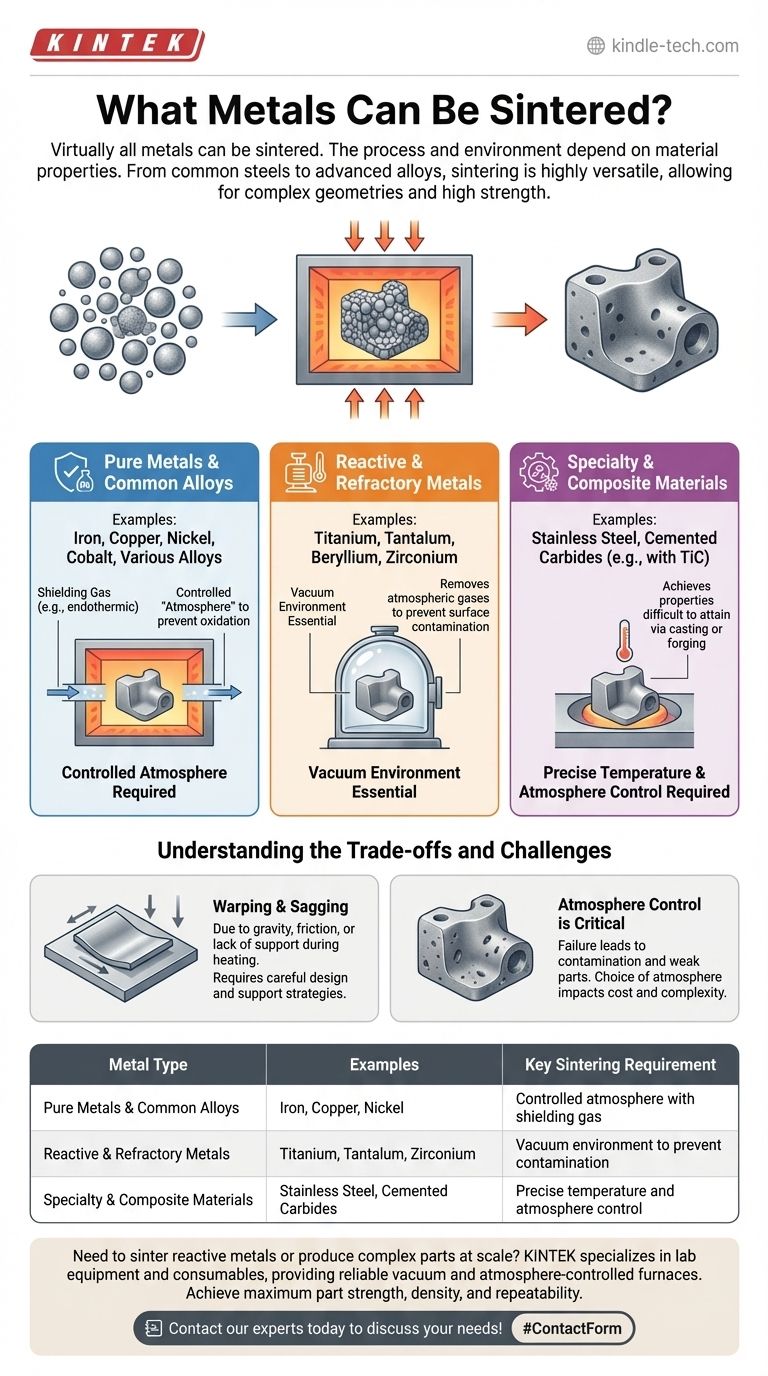
Virtually all metals can be sintered, but the specific process and required environment depend heavily on the metal's properties. Pure metals are excellent candidates, while reactive or refractory metals like titanium and tantalum require specialized conditions, such as a vacuum, to prevent surface contamination and ensure successful bonding.

Sintering is a highly versatile manufacturing process applicable to a wide range of metals, from common steels to advanced alloys. The critical factor is not if a metal can be sintered, but how it must be sintered to control its atmosphere and achieve the desired final properties.

What metals can be sintered? A Guide to Materials and Processes for Stronger Parts

The Principle of Metal Sintering

How It Works

Sintering is a thermal process that bonds metal powders together at a temperature below the material's melting point. By applying heat and sometimes pressure, atoms in the powder particles diffuse across the boundaries, fusing the particles into a solid, coherent piece.

This method allows for the creation of parts with complex geometries or internal features that are often difficult or impossible to produce with traditional subtractive manufacturing methods like machining.

Key Benefits of the Process

The primary advantage of sintering is its ability to create strong, durable parts with high consistency across large production volumes.

The process minimizes the porosity of an object's surface, which directly enhances its final strength and density. It is a reliable and repeatable method, making it ideal for large-scale manufacturing where uniformity is critical.

Which Metals Are Suitable for Sintering?

Pure Metals and Common Alloys

Most common metals can be sintered effectively. This includes iron, copper, nickel, cobalt, and their various alloys.

When sintering these materials at atmospheric pressure, a shielding gas (such as an endothermic gas) is typically required to prevent oxidation, which would inhibit proper bonding between the metal particles.

Reactive and Refractory Metals

Reactive metals like beryllium, titanium, and zirconium, as well as refractory metals like tantalum, are prime candidates for sintering. These materials have very high melting points or are highly susceptible to atmospheric contamination.

For these metals, vacuum sintering is essential. Performing the process in a vacuum removes atmospheric gases that would otherwise react with the metal surfaces, ensuring a clean and strong bond.

Specialty and Composite Materials

Sintering is also widely used for advanced materials. This includes various grades of stainless steel and cemented carbides, which often contain alloys like Titanium Carbide (TiC).

These materials leverage sintering to achieve properties that would be difficult to attain through casting or forging.

Understanding the Trade-offs and Challenges

The Critical Role of Atmosphere

The single most important process variable is the atmosphere. Failure to control it results in contamination and weak parts.

A vacuum is the ultimate protection for highly reactive metals, while a controlled gas atmosphere is sufficient for less reactive alloys. The choice directly impacts equipment cost and complexity.

Potential for Physical Defects

Despite its reliability, the process is not without challenges. Parts can suffer from warping due to gravity or friction between the part and the surface it rests on during heating.

Sagging of unsupported features can also occur, leading to dimensional inaccuracies in the final product. Careful design and support strategies are necessary to mitigate these risks.

Making the Right Choice for Your Application

Choosing to use sintering depends entirely on your material, the complexity of your part, and your production volume.

  • If your primary focus is manufacturing with reactive or refractory metals: Vacuum sintering is the most reliable and often the only viable path to success.
  • If your primary focus is high-volume production of complex parts: Sintering offers exceptional repeatability and cost-effectiveness at scale compared to machining.
  • If your primary focus is achieving maximum material strength and density: Sintering is a proven method for creating strong, non-porous components from metal powders.

Ultimately, understanding your material's specific needs determines the correct approach to this powerful manufacturing process.

Summary Table:

Metal Type Examples Key Sintering Requirement
Pure Metals & Common Alloys Iron, Copper, Nickel Controlled atmosphere with shielding gas
Reactive & Refractory Metals Titanium, Tantalum, Zirconium Vacuum environment to prevent contamination
Specialty & Composite Materials Stainless Steel, Cemented Carbides Precise temperature and atmosphere control

Need to sinter reactive metals or produce complex parts at scale? KINTEK specializes in lab equipment and consumables, providing the reliable vacuum and atmosphere-controlled furnaces essential for successful metal sintering. Our solutions help you achieve maximum part strength, density, and repeatability. Contact our experts today to discuss your specific material and production needs!

Visual Guide
What metals can be sintered? A Guide to Materials and Processes for Stronger Parts Visual Guide

Related Products

People Also Ask

Related Products

Vacuum Heat Treat and Sintering Furnace with 9MPa Air Pressure

Vacuum Heat Treat and Sintering Furnace with 9MPa Air Pressure

The air pressure sintering furnace is a high-tech equipment commonly used for the sintering of advanced ceramic materials. It combines vacuum sintering and pressure sintering techniques to achieve high-density and high-strength ceramics.

600T Vacuum Induction Hot Press Furnace for Heat Treat and Sintering

600T Vacuum Induction Hot Press Furnace for Heat Treat and Sintering

Discover the 600T Vacuum Induction Hot Press Furnace, designed for high-temperature sintering experiments in vacuum or protected atmospheres. Its precise temperature and pressure control, adjustable working pressure, and advanced safety features make it ideal for nonmetal materials, carbon composites, ceramics, and metal powders.

Vacuum Heat Treat and Molybdenum Wire Sintering Furnace for Vacuum Sintering

Vacuum Heat Treat and Molybdenum Wire Sintering Furnace for Vacuum Sintering

A vacuum molybdenum wire sintering furnace is a vertical or bedroom structure, which is suitable for withdrawal, brazing, sintering and degassing of metal materials under high vacuum and high temperature conditions. It is also suitable for dehydroxylation treatment of quartz materials.

Vacuum Heat Treat Sintering Brazing Furnace

Vacuum Heat Treat Sintering Brazing Furnace

A vacuum brazing furnace is a type of industrial furnace used for brazing, a metalworking process that joins two pieces of metal using a filler metal that melts at a lower temperature than the base metals. Vacuum brazing furnaces are typically used for high-quality applications where a strong, clean joint is required.

Molybdenum Vacuum Heat Treat Furnace

Molybdenum Vacuum Heat Treat Furnace

Discover the benefits of a high-configuration molybdenum vacuum furnace with heat shield insulation. Ideal for high-purity, vacuum environments like sapphire crystal growth and heat treatment.

Vacuum Heat Treat Furnace with Ceramic Fiber Liner

Vacuum Heat Treat Furnace with Ceramic Fiber Liner

Vacuum furnace with polycrystalline ceramic fiber insulation liner for excellent heat insulation and uniform temperature field. Choose from 1200℃ or 1700℃ max. working temperature with high vacuum performance and precise temperature control.

Controlled Nitrogen Inert Hydrogen Atmosphere Furnace

Controlled Nitrogen Inert Hydrogen Atmosphere Furnace

KT-AH Hydrogen atmosphere furnace - induction gas furnace for sintering/annealing with built-in safety features, dual housing design, and energy-saving efficiency. Ideal for lab and industrial use.

1200℃ Controlled Atmosphere Furnace Nitrogen Inert Atmosphere Furnace

1200℃ Controlled Atmosphere Furnace Nitrogen Inert Atmosphere Furnace

Discover our KT-12A Pro Controlled atmosphere furnace - high precision, heavy duty vacuum chamber, versatile smart touch screen controller, and excellent temperature uniformity up to 1200C. Ideal for both laboratory and industrial application.

1700℃ Controlled Atmosphere Furnace Nitrogen Inert Atmosphere Furnace

1700℃ Controlled Atmosphere Furnace Nitrogen Inert Atmosphere Furnace

KT-17A Controlled atmosphere furnace: 1700℃ heating, vacuum sealing technology, PID temperature control, and versatile TFT smart touch screen controller for laboratory and industrial use.

Vacuum Hot Press Furnace Heated Vacuum Press Machine Tube Furnace

Vacuum Hot Press Furnace Heated Vacuum Press Machine Tube Furnace

Reduce forming pressure & shorten sintering time with Vacuum Tube Hot Press Furnace for high-density, fine-grain materials. Ideal for refractory metals.

Spark Plasma Sintering Furnace SPS Furnace

Spark Plasma Sintering Furnace SPS Furnace

Discover the benefits of Spark Plasma Sintering Furnaces for rapid, low-temperature material preparation. Uniform heating, low cost & eco-friendly.

Ultra-High Temperature Graphite Vacuum Graphitization Furnace

Ultra-High Temperature Graphite Vacuum Graphitization Furnace

The ultra-high temperature graphitization furnace utilizes medium frequency induction heating in a vacuum or inert gas environment. The induction coil generates an alternating magnetic field, inducing eddy currents in the graphite crucible, which heats up and radiates heat to the workpiece, bringing it to the desired temperature. This furnace is primarily used for graphitization and sintering of carbon materials, carbon fiber materials, and other composite materials.

1400℃ Controlled Atmosphere Furnace with Nitrogen and Inert Atmosphere

1400℃ Controlled Atmosphere Furnace with Nitrogen and Inert Atmosphere

Achieve precise heat treatment with KT-14A controlled atmosphere furnace. Vacuum sealed with a smart controller, it's ideal for lab and industrial use up to 1400℃.

Dental Porcelain Zirconia Sintering Ceramic Furnace Chairside with Transformer

Dental Porcelain Zirconia Sintering Ceramic Furnace Chairside with Transformer

Experience top-notch sintering with Chairside Sintering Furnace with Transformer. Easy to operate, noise-free pallet, and automatic temperature calibration. Order now!

Rotary Tube Furnace Split Multi Heating Zone Rotating Tube Furnace

Rotary Tube Furnace Split Multi Heating Zone Rotating Tube Furnace

Multi zone rotary furnace for high-precision temperature control with 2-8 independent heating zones. Ideal for lithium ion battery electrode materials and high-temperature reactions. Can work under vacuum and controlled atmosphere.

High Temperature Muffle Oven Furnace for Laboratory Debinding and Pre Sintering

High Temperature Muffle Oven Furnace for Laboratory Debinding and Pre Sintering

KT-MD High temperature debinding and pre-sintering furnace for ceramic materials with various molding processes. Ideal for electronic components such as MLCC and NFC.

High Pressure Laboratory Vacuum Tube Furnace Quartz Tubular Furnace

High Pressure Laboratory Vacuum Tube Furnace Quartz Tubular Furnace

KT-PTF High Pressure Tube Furnace: Compact split tube furnace with strong positive pressure resistance. Working temp up to 1100°C and pressure up to 15Mpa. Also works under controller atmosphere or high vacuum.

1700℃ Laboratory Quartz Tube Furnace with Alumina Tube Tubular Furnace

1700℃ Laboratory Quartz Tube Furnace with Alumina Tube Tubular Furnace

Looking for a high-temperature tube furnace? Check out our 1700℃ Tube Furnace with Alumina Tube. Perfect for research and industrial applications up to 1700C.

Vacuum Dental Porcelain Sintering Furnace

Vacuum Dental Porcelain Sintering Furnace

Get precise and reliable results with KinTek's Vacuum Porcelain Furnace. Suitable for all porcelain powders, it features hyperbolic ceramic furnace function, voice prompt, and automatic temperature calibration.

Laboratory Vacuum Tilt Rotary Tube Furnace Rotating Tube Furnace

Laboratory Vacuum Tilt Rotary Tube Furnace Rotating Tube Furnace

Discover the versatility of Laboratory Rotary Furnace: Ideal for calcination, drying, sintering, and high-temperature reactions. Adjustable rotating and tilting functions for optimal heating. Suitable for vacuum and controlled atmosphere environments. Learn more now!


Leave Your Message