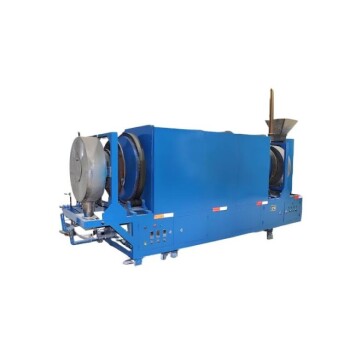
A tube heating furnace provides a precisely controlled thermal environment and a stable chemical atmosphere necessary for the complete reduction of iron oxide. By maintaining a constant temperature—typically around 550°C for one hour—the furnace ensures the chemical reaction reaches completion while utilizing a constant temperature zone to manipulate the particle size and distribution of the resulting iron powder.
The core function of a tube furnace in iron reduction is to balance precise temperature regulation with atmospheric control. This dual-action environment allows for the total conversion of oxides into pure iron while simultaneously tailoring the powder's microstructure through phenomena like Ostwald ripening.
Precise Thermal Regulation
The Role of Sustained High Temperature
The furnace is designed to maintain a steady temperature of 550°C, which is the critical threshold for ensuring the chemical reduction reaction is fully completed. Holding this temperature for a specific duration, such as one hour, allows the heat to penetrate the material uniformly.
Advanced Temperature Programming
High-precision furnaces allow for stepped heating profiles, where the temperature is increased at defined rates, such as 5°C/min. This controlled ramping is essential for separating components with different thermal stabilities, such as polysaccharides or carbonates, before the primary reduction begins.
Temperature Ranges and Material Purity
While 550°C is standard for many processes, lower ranges (350°C to 500°C) can be used to influence the chemical purity (α-Fe content). Higher temperature ranges, sometimes reaching 1150°C to 1350°C in horizontal tube furnaces, are employed for intensive carbothermic reduction of hematite and magnetite.
Atmospheric Stability and Gas Control
Maintaining a Hydrogen-Rich Environment
The sealed structure of a tube furnace is vital for introducing and maintaining a stable hydrogen reduction atmosphere. This controlled flow of gas effectively strips oxygen from the iron oxide, leaving behind pure metal.
Regulating Microstructure and Porosity
The furnace environment dictates the physical texture of the final powder. Lower temperatures tend to maintain a smooth particle surface, while higher temperatures promote grain sintering and pore coarsening.
Phase Composition Control
Precise atmospheric and thermal control allows operators to regulate the phase composition of the iron. This is critical for converting non-active magnetite (Fe3O4) into active hematite (Fe2O3) or pure iron, depending on the desired end-use.
Morphological Control via the Constant Temperature Zone
Utilizing the Ostwald Ripening Effect
The constant temperature zone within the tube allows for Ostwald ripening, a process where smaller particles merge into larger ones. This controlled merging is a technical necessity for achieving the specific particle morphology required for industrial applications.
Achieving Specific Particle Distributions
By manipulating the ripening effect, the furnace helps produce the bimodal particle size distribution required for complex feedstocks. This ensures that the resulting iron powder meets the exact density and flow requirements for manufacturing.
Understanding the Trade-offs
Temperature vs. Surface Texture
There is a direct trade-off between reaction speed and particle smoothness. While higher temperatures accelerate the reduction process, they often lead to a porous network structure due to sintering, which may not be desirable for all powder metallurgy applications.
Energy Consumption vs. Reaction Completion
Longer dwell times at high temperatures ensure full chemical reduction but significantly increase energy costs. Precise programming is required to find the "sweet spot" where the reaction is completed without unnecessary thermal exposure.
Atmosphere Integrity Risks
The reliance on a sealed environment means that any leak in the tube furnace can contaminate the reduction atmosphere. Even minor oxygen infiltration can halt the reduction process or lead to the re-oxidation of the pure iron powder.
How to Apply This to Your Project
Recommendations Based on Production Goals
- If your primary focus is high chemical purity (α-Fe content): Utilize a tube furnace with high-precision temperature programming to maintain a steady range between 350°C and 500°C.
- If your primary focus is achieving specific bimodal feedstocks: Focus on the furnace's constant temperature zone to leverage Ostwald ripening for controlled particle merging.
- If your primary focus is rapid carbothermic reduction: Opt for a horizontal tube furnace capable of sustained operation between 1150°C and 1350°C.
- If your primary focus is structural porosity: Increase the furnace temperature beyond the standard reduction threshold to encourage grain sintering and pore coarsening.
By mastering the furnace's thermal and atmospheric variables, you can transform raw iron oxide into a highly specialized pure iron powder tailored for your specific industrial application.
Summary Table:
| Key Condition | Parameter / Range | Primary Industrial Outcome |
|---|---|---|
| Thermal Regulation | 550°C (Standard) / 1150°C+ (Carbothermic) | Ensures complete chemical reduction and reaction uniform penetration |
| Atmospheric Control | Hydrogen-Rich / Sealed Environment | Prevents re-oxidation and strips oxygen to produce pure metal |
| Heating Profile | Controlled Ramping (e.g., 5°C/min) | Separates components with different thermal stabilities |
| Morphological Control | Constant Temperature Zone | Facilitates Ostwald ripening for specific particle size distribution |
| Phase Control | 350°C to 500°C | Regulates chemical purity (α-Fe content) and surface texture |
Elevate Your Powder Metallurgy with KINTEK Expertise
Precision is the difference between raw oxide and high-purity iron powder. KINTEK specializes in advanced laboratory equipment designed to meet the rigorous demands of thermal processing. Whether you are conducting iron reduction research or industrial manufacturing, our comprehensive range of high-temperature furnaces (tube, muffle, vacuum, CVD, and rotary) provides the atmospheric stability and thermal precision you need.
Beyond furnaces, KINTEK supports your entire workflow with:
- High-pressure reactors and autoclaves for complex chemical synthesis.
- Hydraulic presses (pellet, hot, isostatic) for superior powder compaction.
- Crushing, milling, and sieving systems for precise feedstock preparation.
- Essential consumables, including high-purity ceramics, PTFE products, and crucibles.
Ready to optimize your reduction process? Contact our technical team today to discover how KINTEK’s precision tools can enhance your lab's efficiency and material quality.
References
- Heungseok Oh, Caroline Sunyong Lee. Study of solid loading of feedstock using trimodal iron powders for extrusion based additive manufacturing. DOI: 10.1038/s41598-023-32095-5
This article is also based on technical information from Kintek Solution Knowledge Base .
Related Products
- Rotary Tube Furnace Split Multi Heating Zone Rotating Tube Furnace
- Laboratory Rapid Thermal Processing (RTP) Quartz Tube Furnace
- Multi Heating Zones CVD Tube Furnace Machine Chemical Vapor Deposition Chamber System Equipment
- 1400℃ Laboratory High Temperature Tube Furnace with Alumina Tube
- 1700℃ Laboratory High Temperature Tube Furnace with Alumina Tube
People Also Ask
- What are the process advantages of using a rotary tube furnace for WS2 powder? Achieve Superior Material Crystallinity
- What are the advantages of using a rotary tube furnace for MoVOx catalysts? Elevate Uniformity and Crystallinity
- Why is a rotary tube furnace preferred over a fixed tube furnace for the carbonization of asphaltenes? Superior Quality
- What is a rotary tube furnace? Achieve Superior Uniformity for Powders and Granules
- Why is a rotary tube furnace recommended for the calcination stage of potassium vanadium oxide catalysts? Optimize Purity