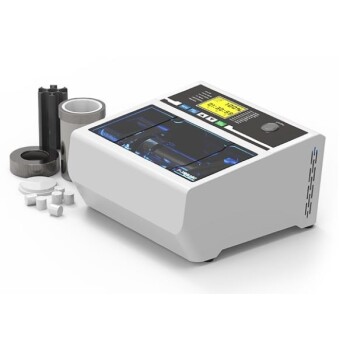
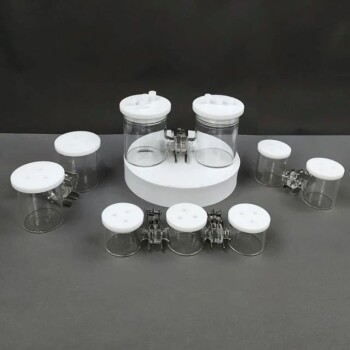
High-Throughput Microreactor Arrays function as precise, parallel processing engines for chemical research. By integrating a large number of miniaturized reaction units onto a single platform, they allow researchers to evaluate multiple catalysts simultaneously. This approach ensures that all samples are subjected to identical pressure, temperature, and space velocities, thereby eliminating environmental fluctuations and drastically accelerating the collection of kinetic data.
The Core Value of Parallelization In traditional testing, environmental fluctuations between experiments can distort results. High-throughput arrays solve this by locking all variables across a unified platform, ensuring that observed differences in performance are caused solely by the catalyst’s chemistry, not the experimental setup.
The Engineering Behind the Consistency
To understand the reliability of these arrays, one must look at how they standardize the testing environment.
Unified Environmental Control
The primary innovation is the integration of multiple reaction units onto a single temperature and flow control platform.
rather than managing separate heaters or controllers for each test, the array ensures every unit experiences the exact same thermal environment.
Standardization of Reaction Variables
Consistency is the bedrock of kinetic evaluation.
These arrays guarantee that critical parameters—specifically reaction pressure, temperature, and space velocities—are identical across all units. This establishes a true baseline for comparison.
Advantages Over Sequential Testing
The shift from sequential (one-by-one) testing to parallel experimentation offers distinct advantages for data integrity.
Eliminating External Interference
Sequential experiments are vulnerable to "fluctuations in external conditions" that occur over time.
By running experiments in parallel mode, the array removes time-dependent variables from the equation. If a fluctuation occurs, it affects all units equally, preventing false positives or negatives in the data.
Accelerating Data Collection
The most immediate benefit is speed.
Researchers can gather reaction kinetic data and conduct comparative studies of catalyst lifespans much faster than traditional methods allow. This compresses the timeline for discovering viable catalyst candidates.
Understanding the Constraints
While highly effective, using microreactor arrays requires an understanding of the inherent limitations of the format.
The Scale of Miniaturization
The primary reference highlights that these units are miniaturized.
This implies that the sample size for each catalyst is small. Researchers must ensure that the small quantity of catalyst used is truly representative of the bulk material to avoid sampling errors.
Dependency on Uniformity
The system relies entirely on the assumption of perfect uniformity across the platform.
If the flow control platform fails to distribute reactants evenly, the "identical conditions" promise is broken. The reliability of the data is directly tied to the engineering precision of the array hardware.
Making the Right Choice for Your Goal
When deciding whether to implement High-Throughput Microreactor Arrays, consider your specific research objectives.
- If your primary focus is comparative accuracy: These arrays are the superior choice, as the parallel experimental mode eliminates environmental noise that plagues sequential testing.
- If your primary focus is process speed: The ability to simultaneously test lifespan and kinetics makes this the most efficient method for screening large libraries of materials.
Ultimately, these arrays transform kinetic evaluation from a series of isolated tests into a cohesive, highly reliable dataset.
Summary Table:
| Feature | Sequential Testing | High-Throughput Microreactor Arrays |
|---|---|---|
| Efficiency | Low (One sample at a time) | High (Multiple simultaneous units) |
| Environmental Control | Variable across experiments | Unified (Identical T, P, and flow) |
| Data Integrity | Prone to time-dependent noise | High (Eliminates external fluctuations) |
| Primary Goal | Detailed single-study analysis | Rapid comparative kinetics & lifespan testing |
| Resource Usage | High time consumption | Optimized throughput and material usage |
Revolutionize Your Catalysis Research with KINTEK
Accelerate your discovery timeline and eliminate experimental noise with high-precision laboratory solutions. KINTEK specializes in providing researchers with the advanced tools required for rigorous chemical analysis and material synthesis.
Our extensive portfolio includes:
- Reaction & Synthesis: High-temperature high-pressure reactors, autoclaves, and specialized high-temperature furnaces (Muffle, Tube, Vacuum, CVD/PECVD).
- Material Processing: Advanced crushing and milling systems, hydraulic presses (Pellet, Hot, Isostatic), and sieving equipment.
- Specialized Lab Tools: Electrolytic cells, battery research consumables, and high-performance cooling solutions like ULT freezers and freeze dryers.
Ready to scale your throughput and achieve superior data accuracy? Contact our experts today to find the perfect equipment for your specific laboratory needs.
References
- Jovine Kamuhabwa Emmanuel. Combinatorial high throughput methodologies: the potentials in heterogeneous catalysts synthesis, screening and discovery—a review. DOI: 10.1186/s42269-024-01180-8
This article is also based on technical information from Kintek Solution Knowledge Base .
Related Products
- Mini SS High Pressure Autoclave Reactor for Laboratory Use
- Customizable Laboratory High Temperature High Pressure Reactors for Diverse Scientific Applications
- Visual High-Pressure Reactor for In-Situ Observation
- Customizable High Pressure Reactors for Advanced Scientific and Industrial Applications
- Multifunctional Electrolytic Electrochemical Cell Water Bath Single Layer Double Layer
People Also Ask
- Why use high-pressure reactors for molecular sieve synthesis? Unlock Superior Crystallinity and Framework Control
- What is the function of a high-pressure reactor autoclave? Enhancing Cu/N Co-Doped Carbon Catalyst Synthesis
- What are the advantages of using a high-pressure reactor like an autoclave? Maximize Liquefaction Speed & Yield
- Why are high-pressure reactors or autoclaves necessary for the synthesis of new functional materials? Unlock Precision.
- How are high-pressure reactors used to prepare metaphosphate electrocatalysts? Master In-Situ Precursor Growth