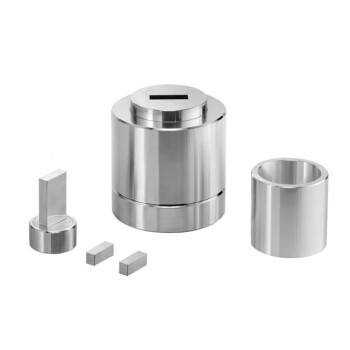
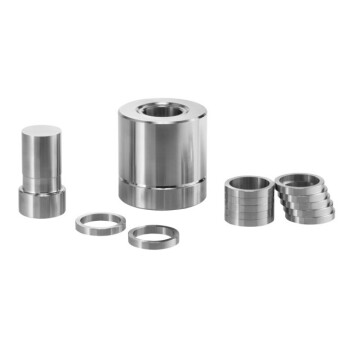
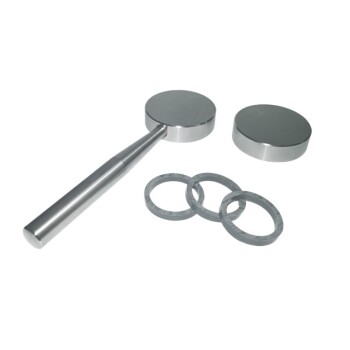
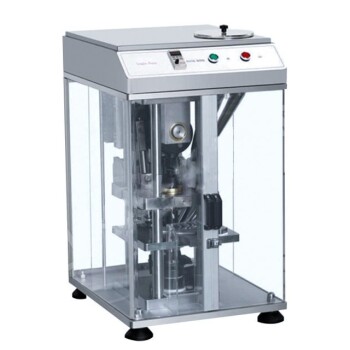
Laboratory hydraulic presses and stainless steel molds act as essential densification tools in the pre-treatment of LLZO powders. Their primary function is to compress mixed precursor powders into compacted units known as "green pellets" using a pressure of approximately 100 MPa.
The purpose of this compression is to overcome the physical distance between particles. By maximizing packing density, you enable the solid-state diffusion required to achieve a high-quality, pure-phase LLZO structure during calcination.
The Mechanics of Pre-Treatment
Creating the Green Pellet
Before the high-temperature calcination step, the loose precursor mixture must be consolidated. The hydraulic press applies force to the powder, which is contained within a stainless steel mold, shaping it into a solid geometric form called a green pellet.
The Role of High Pressure
The process specifically requires significant force, typically around 100 MPa. This level of pressure is necessary to mechanically lock the particles together, transforming a chaotic mixture into a cohesive solid body.
Why Densification Drives the Reaction
Increasing Contact Area
The primary goal of using the press and mold is to significantly increase the contact area between the different powder particles. In a loose powder state, air gaps separate the reactants, preventing them from interacting efficiently.
Promoting Solid-State Diffusion
LLZO synthesis relies on a solid-state diffusion reaction, which is inherently difficult because atoms must move through solid material rather than a liquid or gas. By increasing the packing density through compression, you shorten the diffusion distances, directly promoting the formation of the desired pure-phase LLZO structure.
Critical Process Variables
The Importance of Sufficient Pressure
While the equipment is simple, the parameter of pressure is critical. The reference highlights that 100 MPa is the standard benchmark for this process.
Risks of Inadequate Compression
If the pressure is insufficient, the packing density will remain low. This results in poor particle contact, which can inhibit the diffusion reaction and prevent the material from achieving the correct crystalline phase during heating.
Making the Right Choice for Your Goal
To ensure your LLZO synthesis is successful, you must view the pressing stage as a chemical enabler, not just a shaping step.
- If your primary focus is Phase Purity: Ensure your hydraulic press is calibrated to deliver at least 100 MPa to maximize particle contact and diffusion efficiency.
- If your primary focus is Consistency: Use high-quality stainless steel molds to ensure uniform pellet density, which leads to predictable reaction kinetics across the entire batch.
Compressing your precursors is the physical key to unlocking the chemical potential of your LLZO material.
Summary Table:
| Process Step | Equipment Used | Key Parameter | Purpose |
|---|---|---|---|
| Powder Consolidation | Laboratory Hydraulic Press | ~100 MPa Pressure | Create cohesive green pellets |
| Densification | Stainless Steel Molds | Uniform Geometric Shaping | Maximize packing density |
| Pre-treatment Goal | Press & Mold System | Particle Contact Area | Enable solid-state diffusion |
| Chemical Outcome | Integrated System | Phase Purity | Achieve high-quality LLZO structure |
Elevate Your Solid-State Battery Research with KINTEK
Precision in pre-treatment is the foundation of high-performance LLZO synthesis. KINTEK provides the specialized laboratory equipment necessary to achieve the 100 MPa pressures and uniform densification required for your solid-state electrolytes.
From our robust manual and automatic hydraulic presses (pellet, hot, and isostatic) to precision-engineered stainless steel and ceramic molds, we offer the tools to maximize particle contact and drive efficient solid-state diffusion. Beyond pelletizing, KINTEK supports your entire workflow with high-temperature muffle and vacuum furnaces, crushing systems, and advanced battery research consumables.
Ready to optimize your material synthesis? Contact KINTEK today to find the perfect pressing solution for your lab’s unique requirements.
Related Products
- Automatic Laboratory Hydraulic Pellet Press Machine for Lab Use
- Laboratory Hydraulic Press Lab Pellet Press Machine for Glove Box
- Laboratory Manual Hydraulic Pellet Press for Lab Use
- Laboratory Manual Hydraulic Pellet Press for Lab Use
- Laboratory Hydraulic Press Split Electric Lab Pellet Press
People Also Ask
- What is the role of a laboratory hydraulic pellet press and stainless steel molds in the fabrication of RuO2/NbC anodes?
- What role does a laboratory pellet press play in the enhancement of biomass energy products? Optimize Fuel Efficiency
- What is the purpose of using a laboratory pellet press when evaluating the electronic conductivity of carbon powders? Guide
- How does a laboratory hydraulic pellet press contribute to SiCw/2024 aluminum composite preforms? Optimize Densification
- What is the significance of applying 200 MPa of pressure with a laboratory hydraulic pellet press for composite ceramics?