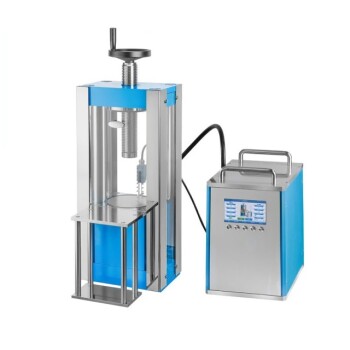
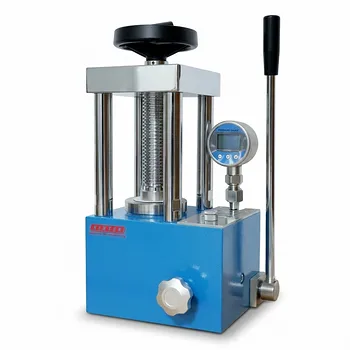
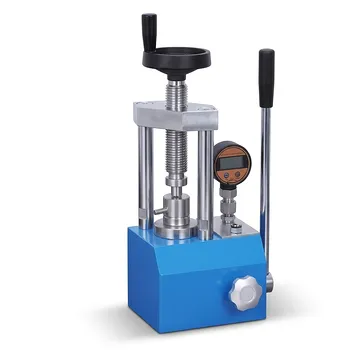
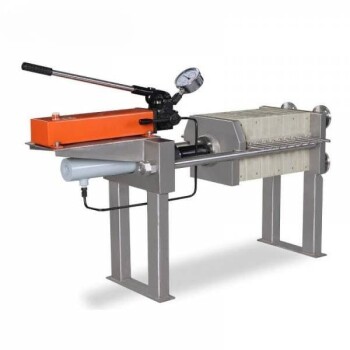
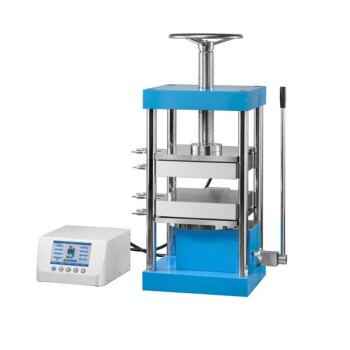
Laboratory hydraulic presses and roller equipment serve as the critical bonding agents in the direct transfer of graphene membranes. These devices apply precise, uniform mechanical pressure to fuse a graphene layer—while it is still attached to its metal growth substrate—onto a porous polymer support membrane.
Core Takeaway The primary function of this equipment is to ensure optimal interfacial adhesion between the graphene and the polymer support. By eliminating microscopic air gaps and wrinkles, the press creates a robust bond that prevents the delicate graphene from tearing when the metal substrate is eventually removed.
The Mechanics of Adhesion
Creating the Composite Interface
The direct transfer method involves a "sandwich" structure consisting of the metal substrate, the synthesized graphene layer, and the target polymer support.
The Role of Uniform Pressure
Hydraulic presses or rollers apply controlled force across this entire stack. This ensures that the polymer support makes complete, consistent contact with the graphene surface at every point.
Enhancing Interfacial Bonding
By forcing the materials together, the equipment facilitates a tight mechanical bond. This step transforms two separate layers into a unified composite structure capable of withstanding subsequent processing steps.
Defect Mitigation and Quality Control
Eliminating Air Traps
One of the most significant risks in transfer fabrication is the entrapment of air between layers. The pressure from the equipment forces air out, significantly reducing the occurrence of bubbles and voids that would otherwise ruin the membrane's performance.
Smoothing Surface Irregularities
Graphene is extremely thin and prone to folding. The application of even pressure flattens the material against the support, minimizing wrinkles that could disrupt the electronic or filtration properties of the final membrane.
Stabilizing for Substrate Removal
After bonding, the metal substrate (often copper or nickel) must be chemically etched away. If the bond between the graphene and the polymer is weak, the graphene will float away or tear; the press ensures the adhesion is strong enough to anchor the graphene during this harsh removal process.
Understanding the Trade-offs
The Risk of Insufficient Pressure
If the pressure applied is too low, the interfacial adhesion will be spotty. This often leads to delamination, where the graphene peels off the polymer support along with the metal substrate, resulting in a failed transfer.
The Risk of Excessive Force
While a tight bond is necessary, excessive pressure can be detrimental. Over-compressing can crush the porous structure of the polymer support or induce strain and cracks in the graphene lattice itself, compromising its structural integrity.
Making the Right Choice for Your Goal
To maximize the success of your graphene transfer, tailor your equipment usage to your specific requirements:
- If your primary focus is large-scale uniformity: Utilize roller equipment, as it provides continuous, even pressure across larger surface areas, ideal for industrial scalability.
- If your primary focus is high-precision lab samples: Utilize a hydraulic press, which offers static, highly controllable pressure settings to dial in the exact force needed for specific polymer-graphene combinations.
The success of a direct transfer hinges not just on the chemistry, but on the mechanical precision of the initial bonding phase.
Summary Table:
| Aspect | Hydraulic Press | Roller Equipment |
|---|---|---|
| Primary Application | High-precision lab samples | Large-scale, continuous production |
| Pressure Delivery | Static, highly controllable force | Continuous, uniform linear pressure |
| Key Advantage | Ideal for specific material research | Optimized for industrial scalability |
| Core Function | Eliminates air traps and wrinkles | Ensures consistent interfacial contact |
Elevate Your Graphene Research with KINTEK Precision
Achieving flawless interfacial adhesion is critical for high-performance graphene membranes. KINTEK specializes in high-precision laboratory equipment designed to meet the rigorous demands of materials science.
Whether you require specialized hydraulic presses (pellet, hot, or isostatic) for exact pressure control or advanced crushing and milling systems for material preparation, our portfolio provides the reliability your research deserves. We also offer a comprehensive range of high-temperature furnaces, high-pressure reactors, and PTFE consumables to support your entire fabrication workflow.
Ready to eliminate transfer defects and enhance your lab's efficiency?
Contact KINTEK today for expert equipment solutions!
References
- de Souza Figueiredo Katia Cecilia, André S. Ferlauto. Graphene Membranes: From Reverse Osmosis to Gas Separation. DOI: 10.15379/2410-1869.2021.08.02.01
This article is also based on technical information from Kintek Solution Knowledge Base .
Related Products
- Laboratory Hydraulic Press Split Electric Lab Pellet Press
- Laboratory Hydraulic Press Lab Pellet Press Machine for Glove Box
- Laboratory Hydraulic Press Lab Pellet Press for Button Battery
- Automatic Laboratory Hydraulic Pellet Press Machine for Lab Use
- Automatic Laboratory Hydraulic Press for XRF & KBR Pellet Press
People Also Ask
- What role does a laboratory hydraulic press play in platinum recovery research? Enhancing Sample Precision
- What are the specific applications of a lab hydraulic press in biochar evaluation? Optimize density and data accuracy.
- What are the roles of a laboratory hydraulic press and stainless steel molds in the preparation of graphite samples?
- What is the role of a laboratory hydraulic press in electrode prep? Maximize Energy Density & Sealing Precision
- Why must a laboratory hydraulic press equipped with cylindrical molds be used when preparing BZY green bodies? High Density