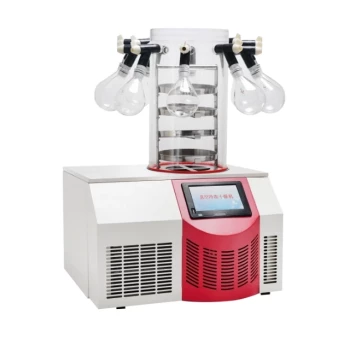
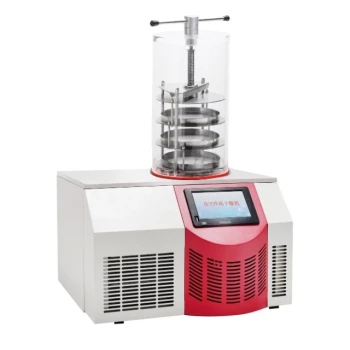
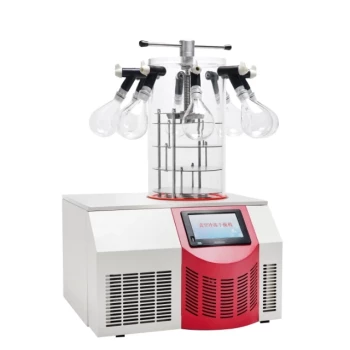
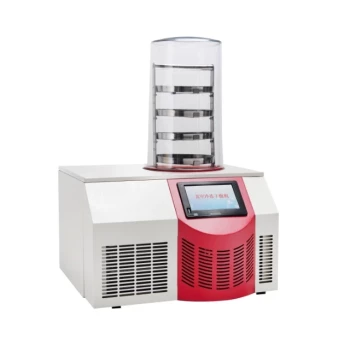
The freeze dryer functions as a critical structural preservation tool in the fabrication of NASICON electrolytes. Its specific role is to remove frozen solvents (ice crystals) from a directionally frozen slurry through sublimation. This creates ordered, vertical pore channels without damaging the delicate ceramic scaffold.
By converting ice directly into vapor, the freeze dryer creates a "negative image" of the ice crystals within the ceramic. This creates the open, low-tortuosity architecture required for high-performance ion transport.
The Mechanism of Structure Formation
The freeze dryer is not merely a drying device; it is the key to locking in the alignment achieved during the freezing phase.
Enabling Sublimation
The device lowers the pressure surrounding the frozen slurry. This forces the ice solvent to transition directly from a solid state to a gas phase.
Bypassing Liquid Tension
By avoiding a liquid phase transition, the process eliminates the capillary forces and surface tension that typically occur during standard evaporation.
If these forces were present, they would likely collapse the fragile ceramic walls of the scaffold.
Preserving Vertical Alignment
The freeze dryer leaves behind pores that perfectly mimic the shape and orientation of the removed ice crystals.
This results in a rigid ceramic framework with vertically aligned, open channels.
Impact on Electrolyte Performance
The physical structure created by the freeze dryer directly dictates the electrochemical performance of the NASICON electrolyte.
Creating Low-Tortuosity Highways
The primary output of this process is the creation of low-tortuosity channels.
In materials science, tortuosity refers to how twisted a path is; the freeze dryer ensures these paths remain straight and direct.
Facilitating Ion Transport
These vertical channels are subsequently filled with polymers to create a composite electrolyte.
Because the channels are straight (low tortuosity), ions can move through the "highways" with minimal resistance, significantly increasing vertical ionic conductivity.
Understanding the Process Challenges
While effective, the freeze-drying stage introduces specific manufacturing variables that must be managed.
Risk of Structural Collapse
While sublimation minimizes force, the resulting scaffold is initially highly porous and brittle.
Handling the material immediately after freeze-drying requires extreme care before the polymer filling step provides mechanical reinforcement.
Dependency on Freezing Kinetics
The freeze dryer can only preserve the structure that already exists.
If the initial directional freezing step failed to align the ice crystals correctly, the freeze dryer will permanently lock in that disordered structure.
Making the Right Choice for Your Goal
To maximize the effectiveness of the ice-templating method, consider the following based on your specific engineering targets:
- If your primary focus is Maximum Conductivity: Ensure the freeze-drying cycle is long enough to remove all solvent traces; any residual moisture will block the polymer from filling the "highways."
- If your primary focus is Structural Integrity: Monitor the sublimation rate carefully; aggressive vacuum levels can sometimes disrupt very fine microstructures.
The freeze dryer transforms a temporary arrangement of ice into a permanent, high-performance ceramic architecture.
Summary Table:
| Feature | Role of Freeze Dryer in Ice-Templating | Impact on Electrolyte Performance |
|---|---|---|
| Mechanism | Sublimation (Direct solid-to-gas transition) | Prevents capillary collapse of ceramic walls |
| Structure | Preserves negative image of ice crystals | Creates straight, vertical pore channels |
| Geometry | Minimizes tortuosity | Provides high-speed 'highways' for ion transport |
| Stability | Locks in directional alignment | Ensures uniform polymer infiltration and conductivity |
Elevate Your Advanced Material Research with KINTEK
Precision in microstructure engineering starts with the right equipment. At KINTEK, we specialize in providing cutting-edge laboratory solutions designed for the rigorous demands of energy storage and materials science. Whether you are developing NASICON electrolytes using ice-templating or engineering next-generation solid-state batteries, our high-performance freeze dryers and cooling solutions ensure structural integrity and low-tortuosity results every time.
Our extensive portfolio supports every stage of your workflow, including:
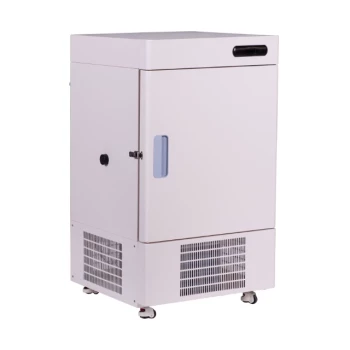
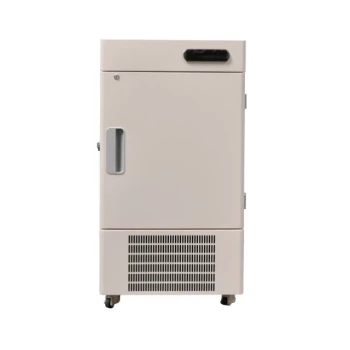
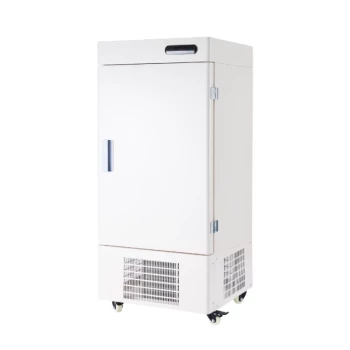
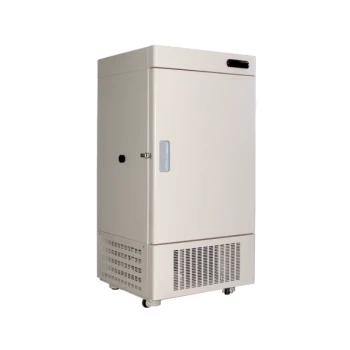
- Advanced Cooling: ULT freezers, cold traps, and precision freeze dryers.
- Sintering & Synthesis: High-temperature muffle, tube, and vacuum furnaces.
- Sample Preparation: Hydraulic pellet presses, crushing systems, and high-purity ceramic crucibles.
- Battery Research: Electrolytic cells, electrodes, and specialized consumables.
Ready to optimize your vertical ionic conductivity? Contact our technical experts today to find the perfect equipment configuration for your lab's specific needs.
Related Products
- High Performance Laboratory Freeze Dryer
- High Performance Laboratory Freeze Dryer for Research and Development
- Benchtop Laboratory Freeze Dryer for Lab Use
- Benchtop Laboratory Vacuum Freeze Dryer
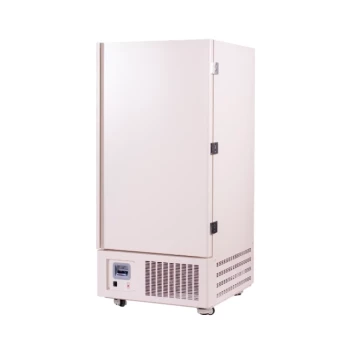
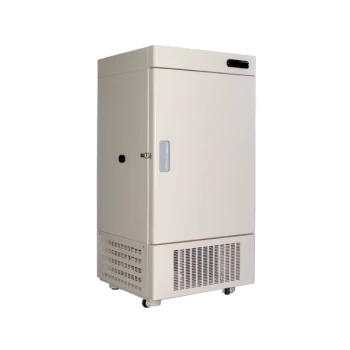
- 108L Vertical Ultra Low Temperature ULT Freezer
People Also Ask
- What role does a laboratory freeze dryer play in the synthesis of graphene-based electrocatalysts? Preserve 3D Structures
- What are the technical advantages of using a laboratory freeze dryer for porous carbon precursors? Preserve 3D Networks
- What types of liquid samples can be processed using a laboratory freeze dryer? Preserve Your Sensitive Materials
- How do laboratory freeze dryers support scientific research? Preserve Sample Integrity for Reproducible Results
- Why is a laboratory freeze dryer preferred over traditional heating? Preserve Biochar Structure & Maximize Porosity