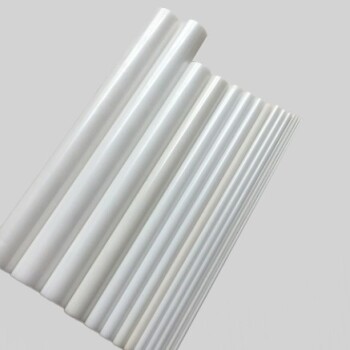
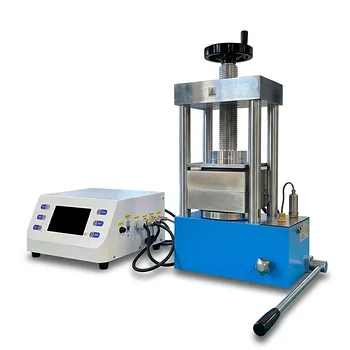
A high-precision laboratory hydraulic press acts as the fundamental shaping tool in the fabrication of ceramic supports for inorganic-carbonate dual-phase (ICDP) membranes. By utilizing the dry pressing method, it applies force to compress loose ceramic powders—such as LSCF or YSZ—into solid, geometrically defined "green bodies" prior to sintering.
Core Takeaway The hydraulic press does more than simply shape the material; it provides the uniform, controllable pressure necessary to minimize density gradients and eliminate micro-pores. This precise compaction establishes the critical baseline for the support’s mechanical strength and pore size distribution, which determines the final membrane's separation efficiency.
The Mechanics of Structural Formation
Particle Rearrangement and Bonding
The primary technical function of the press is to force the rearrangement of ceramic powder particles. Under high pressure, these particles shift from a loose, aerated state into a tightly packed configuration. This proximity ensures the particles are bonded closely enough to maintain structural integrity before high-temperature treatment.
Elimination of Internal Defects
High-precision control allows the operator to apply pressure that is both consistent and uniform. This consistency is vital for reducing density gradients—areas where the powder is packed unevenly. By minimizing these gradients, the press effectively reduces the occurrence of uncontrolled micro-pores that could lead to structural failure.
Impact on Final Membrane Performance
Defining Pore Size Distribution
The pressure applied during the green body stage directly influences the porosity of the final product. While pore-forming agents are often mixed with the powder, the hydraulic press determines how tightly the matrix material surrounds these agents. Proper pressure ensures that after sintering, the resulting pore network is uniform, which is essential for stable ion transport in ICDP membranes.
Ensuring Mechanical Integrity
The "green strength" achieved during pressing dictates whether the part can survive handling and firing. A high-precision press ensures the green body is robust enough to maintain its dimensional stability during the sintering process. This prevents warping or cracking, providing a reliable foundation for the dual-phase membrane assembly.
Understanding the Trade-offs
The Balance of Pressure vs. Porosity
There is a critical inverse relationship between the pressure applied and the permeability of the support. Applying excessive pressure yields high mechanical strength but may crush the pore structure, limiting gas transport. Conversely, insufficient pressure preserves porosity but results in a weak support that may crumble or fail during operation.
Unidirectional vs. Isostatic Limitations
While laboratory hydraulic presses provide excellent unidirectional control, this can introduce limitations for complex shapes. Unidirectional pressing can sometimes result in density variations along the height of the sample due to wall friction. For complex geometries, isostatic molds (applying pressure from all sides) may be required to maintain the uniformity that a standard unidirectional setup might compromise.
Making the Right Choice for Your Goal
To maximize the effectiveness of your hydraulic press in ICDP support preparation, consider your specific research priorities:
- If your primary focus is mechanical reliability: Prioritize higher pressure settings to maximize particle contact and green strength, accepting a potential reduction in total porosity.
- If your primary focus is gas transport efficiency: Utilize precise, lower-pressure settings to maintain an open pore structure, relying on binders to maintain green body shape.
Precision at the pressing stage is the single most controllable variable for ensuring the consistency of your ceramic supports.
Summary Table:
| Factor | Role in ICDP Support Preparation | Impact on Performance |
|---|---|---|
| Particle Rearrangement | Compresses powders into a tightly packed configuration. | Increases initial green body strength. |
| Density Uniformity | Minimizes gradients through precise pressure control. | Prevents structural failure and micro-pores. |
| Compaction Force | Determines the spacing between matrix particles. | Directly influences final pore size distribution. |
| Green Strength | Ensures dimensional stability during handling. | Prevents cracking or warping during sintering. |
| Pressure Balance | Balances mechanical strength vs. gas permeability. | Determines overall ion transport efficiency. |
Elevate Your Membrane Research with KINTEK Precision
Achieving the perfect balance between porosity and mechanical strength in inorganic-carbonate dual-phase (ICDP) membranes requires absolute control over compaction. KINTEK specializes in high-performance laboratory equipment designed for the most demanding material science applications.
Our extensive portfolio includes:
- High-Precision Hydraulic Presses: Manual, electric, and hot presses for perfect pellet and green body preparation.
- Advanced Sintering Solutions: High-temperature muffle, tube, and vacuum furnaces for critical heat treatment.
- Material Processing: Crushing, milling, and sieving systems to ensure powder consistency.
- Specialized Labware: PTFE products, ceramics, and crucibles for contamination-free processing.
Whether you are developing next-generation fuel cells or carbon capture membranes, KINTEK provides the tools to ensure reproducible results and superior material integrity.
Ready to optimize your ceramic support fabrication? Contact our technical experts today to find the ideal hydraulic press solution for your laboratory!
References
- Liyin Fu, Tianjia Chen. Progress and Perspectives in the Development of Inorganic-Carbonate Dual-Phase Membrane for CO2 Separation. DOI: 10.3390/pr12020240
This article is also based on technical information from Kintek Solution Knowledge Base .
Related Products
- Automatic High Temperature Heated Hydraulic Press Machine with Heated Plates for Lab
- Manual High Temperature Heated Hydraulic Press Machine with Heated Plates for Lab
- Precision Machined Yttrium Stabilized Zirconia Ceramic Rod for Engineering Advanced Fine Ceramics
- Automatic Laboratory Hydraulic Press for XRF & KBR Pellet Press
- kbr pellet press 2t
People Also Ask
- Why is a heated hydraulic press used for warm pressing NASICON green tapes? Optimize Your Solid Electrolyte Density
- What is a heated hydraulic press used for? Essential Tool for Curing, Molding, and Laminating
- Why is a heated laboratory hydraulic press necessary for composite laminates? Achieve Void-Free Structural Integrity
- What is a hot hydraulic press? Harness Heat and Pressure for Advanced Manufacturing
- What are heated hydraulic presses used for? Molding Composites, Vulcanizing Rubber, and More