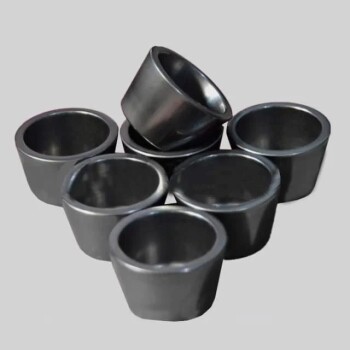
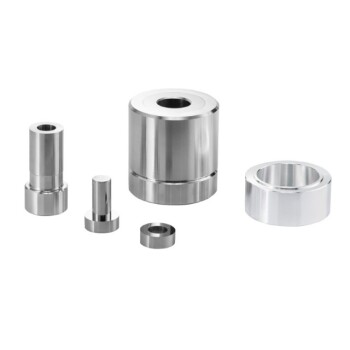
In the vacuum hot pressing of TiB2-based ceramics, the high-purity graphite die functions as both a containment vessel and a mechanical transmission tool. It is specifically engineered to withstand extreme processing environments, holding the ceramic powder in place while transmitting uniaxial pressures of up to 20 MPa at temperatures as high as 1850°C. This dual capability is essential for converting loose powder into a dense, sintered body.
Core Takeaway: The graphite die is the critical interface between the furnace’s energy and the material. Its superior thermal conductivity ensures uniform heating, while its high-temperature strength allows it to apply the massive mechanical pressure required to force particle rearrangement and achieve high density in the ceramic.
The Mechanics of Densification
Acting as a Thermal and Structural Container
The primary role of the die is to serve as a high-temperature resistant container.
TiB2-based ceramics require sintering temperatures around 1850°C. The graphite die maintains its structural integrity in this environment, effectively containing the powder without deforming or melting.
Transmitting Uniaxial Pressure
Beyond containment, the die acts as a piston system to transmit mechanical pressure.
It applies a specific force, typically around 20 MPa, directly to the powder particles. This external pressure is necessary to overcome the material's resistance to sintering, forcing the particles closer together.
Facilitating Particle Rearrangement
The combination of heat and the pressure transmitted by the die drives particle rearrangement.
By physically compressing the powder while it is pliable from the heat, the die reduces porosity. This mechanical intervention is crucial for densifying materials that are difficult to sinter using heat alone.
Ensuring Uniform Heating
Graphite possesses superior thermal conductivity, which is vital for the quality of the final product.
The die transfers heat evenly from the furnace elements to the ceramic powder. This prevents thermal gradients—hot spots or cold spots—that could lead to inconsistent sintering or internal stresses within the ceramic body.
Understanding the Operational Trade-offs
The Die is a Consumable
It is important to recognize that the high-purity graphite die is a critical consumable, not a permanent fixture.
While it has excellent high-temperature strength, the harsh conditions of vacuum hot pressing eventually degrade the tool. It must be replaced regularly to maintain dimensional accuracy and surface finish.
Environmental Interaction
Graphite contributes to a reducing atmosphere within the vacuum chamber.
While this can be beneficial for preventing oxidation in certain non-oxide ceramics, it introduces a chemical variable that must be managed. The die is not chemically inert; it interacts with the sintering environment.
Making the Right Choice for Your Goal
To maximize the effectiveness of vacuum hot pressing for your specific application, consider the following:
- If your primary focus is maximum density: Ensure your graphite die is rated for pressures exceeding 20 MPa to maximize particle rearrangement at 1850°C.
- If your primary focus is microstructural homogeneity: Prioritize graphite grades with the highest available thermal conductivity to eliminate thermal gradients across the sample.
Success in sintering TiB2 lies in selecting a die that balances structural rigidity with exceptional thermal transfer capabilities.
Summary Table:
| Feature | Role in Vacuum Hot Pressing | Impact on TiB2 Ceramics |
|---|---|---|
| Temperature Resistance | Operates up to 1850°C | Maintains structural integrity during sintering |
| Pressure Transmission | Applies uniaxial force (up to 20 MPa) | Drives particle rearrangement and densification |
| Thermal Conductivity | Even heat distribution | Prevents thermal gradients and internal stresses |
| Material Interaction | Creates reducing atmosphere | Prevents oxidation of non-oxide ceramic powder |
Elevate Your Advanced Material Research with KINTEK
Precision in vacuum hot pressing starts with the right equipment and consumables. At KINTEK, we specialize in providing high-performance laboratory solutions tailored for demanding sintering processes. Whether you are working with TiB2-based ceramics or other advanced materials, our expertise in vacuum hot pressing systems, high-temperature graphite dies, and hydraulic presses ensures you achieve maximum density and microstructural homogeneity.
Our value to you includes:
- High-Purity Graphite Consumables: Specifically engineered for extreme 1850°C environments and high-pressure transmission.
- Comprehensive Equipment Range: From CVD/PECVD systems and induction melting furnaces to isostatic presses and high-temperature reactors.
- Expert Support: Helping you select the right grade of graphite and furnace configuration to eliminate thermal gradients and optimize results.
Ready to enhance your lab's efficiency and material quality? Contact us today to discuss your specific application and find the perfect sintering solution.
Related Products
- Ultra-High Temperature Graphite Vacuum Graphitization Furnace
- High Purity Pure Graphite Crucible for Evaporation
- 2200 ℃ Graphite Vacuum Heat Treat Furnace
- Vertical High Temperature Graphite Vacuum Graphitization Furnace
- Horizontal High Temperature Graphite Vacuum Graphitization Furnace
People Also Ask
- What is the disadvantage of graphite furnace? Managing Reactivity and Contamination Risks
- Is a graphite melting point high or low? Discover Its Extreme Thermal Resilience
- What are the advantages and disadvantages of graphite furnace? Unlock Extreme Heat Performance
- What gas is used in graphite furnace? Maximize Accuracy with the Right Inert Gas
- What are the disadvantages of graphite furnace? Key Limitations and Operational Costs