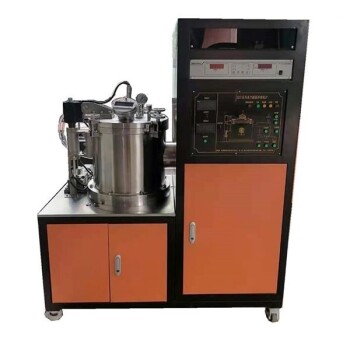
A high-vacuum environment is the fundamental enabler for producing defect-free Tungsten-Copper (W-Cu) composites via combustion synthesis infiltration. Specifically, maintaining a vacuum level of approximately 100 Pa completely evacuates air from the internal porous skeleton prior to reaction. This ensures that when the reaction heat triggers the instantaneous melting of copper, there are no trapped gases to impede flow or create voids.
Core Insight: The success of combustion synthesis relies on the total exclusion of air. By removing gases before the reaction begins, the vacuum environment prevents high-temperature oxidation and eliminates the formation of macroscopic defects, guaranteeing a fully dense composite.
The Mechanics of Defect Prevention
Eliminating Gas Entrapment
In combustion synthesis, the chemical reaction releases significant heat, causing the copper phase to melt almost instantly.
If air is present within the internal skeleton during this rapid phase change, it becomes trapped by the liquid metal.
A high-vacuum environment extracts these gases beforehand, ensuring the pore volume is empty and ready to accept the molten copper.
Preventing High-Temperature Oxidation
The extreme temperatures reached during combustion synthesis make metals highly reactive.
Any presence of oxygen would lead to the immediate oxidation of the tungsten skeleton or the copper melt.
By maintaining a vacuum (e.g., 100 Pa), the process removes the reactants required for oxidation, preserving the chemical purity of the interface.
Driving Material Density
Facilitating Instant Infiltration
For W-Cu composites to achieve high performance, the copper must fully penetrate the tungsten framework.
The vacuum environment reduces the resistance to liquid flow, allowing the copper to fill the microscopic voids of the skeleton immediately upon melting.
This unimpeded flow is critical for obtaining a homogeneous structure.
Ensuring Structural Integrity
The primary enemy of composite strength is the "macroscopic defect"—large voids caused by gas pockets.
These defects act as stress concentrators and thermal barriers, ruining the material's utility.
The vacuum environment is the specific control mechanism used to prevent these defects from forming.
Common Pitfalls: The Cost of Insufficient Vacuum
The Risk of Residual Pressure
It is not enough to simply reduce pressure; the vacuum must be "high" enough (reaching levels like 100 Pa) to be effective.
If the pressure remains too high, residual air pockets will prevent the copper from wetting the tungsten surface properly.
The Consequence of Partial Infiltration
Insufficient vacuum leads to partial infiltration, where the copper coats the surface but fails to penetrate the core.
This results in a part that looks sound on the outside but contains a porous, weak interior.
Making the Right Choice for Your Goal
To maximize the quality of your W-Cu composites, align your process parameters with your specific performance requirements:
- If your primary focus is Maximum Density: Ensure your furnace can maintain a stable 100 Pa vacuum to eliminate all macroscopic defects during the melt phase.
- If your primary focus is Material Purity: Prioritize the evacuation cycle before heating begins to prevent oxidation of the internal skeleton.
Ultimately, the vacuum level is not just a variable; it is the primary safeguard against the structural failure of W-Cu composites.
Summary Table:
| Feature | Role of High-Vacuum (approx. 100 Pa) | Impact on W-Cu Composite Quality |
|---|---|---|
| Gas Removal | Evacuates air from porous skeleton before reaction | Eliminates gas entrapment and macroscopic voids |
| Oxidation Control | Removes oxygen from the reaction chamber | Preserves chemical purity and interface integrity |
| Infiltration Flow | Reduces resistance to liquid copper flow | Facilitates instant, uniform penetration of the skeleton |
| Structural Density | Prevents internal gas pocket formation | Ensures a fully dense, high-strength homogeneous structure |
Elevate Your Material Performance with KINTEK Precision
Achieving the perfect W-Cu composite requires more than just heat; it requires an uncompromising vacuum environment. At KINTEK, we specialize in high-performance vacuum and atmosphere furnaces designed to maintain the precise pressure levels (down to 100 Pa and beyond) necessary for flawless combustion synthesis and infiltration.
From high-temperature furnaces and crushing systems to isostatic presses and ceramic crucibles, KINTEK provides the advanced laboratory equipment and consumables needed to eliminate macroscopic defects and ensure material purity. Whether you are conducting battery research or developing high-strength alloys, our technical experts are ready to help you optimize your process.
Ready to achieve 100% density in your composites? Contact KINTEK today to find the perfect furnace solution!
References
- Jiří Matějíček. Preparation of W-Cu composites by infiltration of W skeletons – review. DOI: 10.37904/metal.2021.4248
This article is also based on technical information from Kintek Solution Knowledge Base .
Related Products
- Laboratory High Pressure Vacuum Tube Furnace
- 2200 ℃ Tungsten Vacuum Heat Treat and Sintering Furnace
- Ultra-High Temperature Graphite Vacuum Graphitization Furnace
- 2200 ℃ Graphite Vacuum Heat Treat Furnace
- Vacuum Heat Treat and Pressure Sintering Furnace for High Temperature Applications
People Also Ask
- What is the primary function of a high-vacuum tube furnace in CVD synthesis of Sb-doped Bi2Se3? Precision Growth Control
- What is the role of a high-vacuum tube furnace in preparing Co3S4@NiS2/C composite materials? Expert Synthesis Insights
- What role does a high-vacuum tube furnace play in synthesizing manganese nitride? Achieve Precise Phase & Stoichiometry.
- Role of High-Pressure Tube Furnace in Ru/OMC Synthesis: Achieve Precise Reduction & Nanostructure Control
- What are the primary functions of a high-pressure tube furnace? Expert Guide to MWCNT/Metal Oxide Synthesis