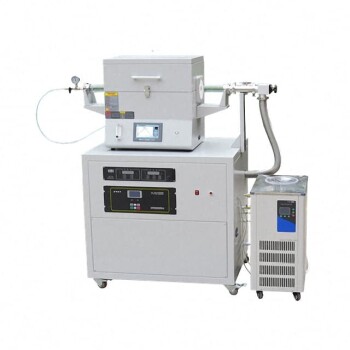
The precise control of thermal and atmospheric conditions provided by a tube furnace is the fundamental requirement for the synthesis of SiOx@TiON-C composites. It serves as the reaction chamber where precursors undergo thermal decomposition and in-situ transformation to create a bifunctional coating. This process ensures that the titanium oxynitride (TiON) and carbon layers encapsulate the SiOx particles uniformly, providing the structural stability and electrical conductivity necessary for advanced material performance.
Core Takeaway: A high vacuum or atmosphere control tube furnace acts as a critical chemical reactor that manages gas-phase chemistry and thermal energy to drive the uniform growth of protective coatings on silicon-based cores. Without this precise control, the material would suffer from uncontrolled oxidation, poor conductivity, and structural failure.
Facilitating Complex Chemical Transformations
The synthesis of SiOx@TiON-C relies on specific chemical reactions that only occur at elevated temperatures under controlled environments.
Driving Precursor Decomposition
The furnace provides the high-temperature environment required to break down chemical precursors into their reactive components. This thermal energy is essential for initiating the transition from raw starting materials into the final composite structure.
Enabling In-Situ Layer Generation
As precursors decompose, the furnace environment allows for the in-situ generation of TiON and carbon layers. Because this happens within the furnace, these layers grow directly onto the SiOx particles, ensuring a firm and integrated bond between the core and the coating.
Supporting Chemical Vapor Deposition (CVD)
Similar to the synthesis of carbon nanotubes, these furnaces provide the conditions necessary for reduction reactions and CVD. This allows carbon and nitrogen sources to interact precisely with the titanium and silicon components under the influence of heat.
Precise Atmospheric Management
The atmosphere within the tube furnace is just as critical as the temperature itself, as it dictates the chemical identity of the final product.
Preventing Unwanted Oxidation
Silicon and carbon components are highly sensitive to oxygen at high temperatures. By using a high vacuum or an inert gas (like Argon or Nitrogen), the furnace excludes oxygen, preventing the SiOx from degrading or the carbon layer from burning away.
Regulating Reactive Gases
In some stages, reactive gases are introduced to facilitate the formation of specific phases, such as the nitridation required for TiON. The furnace’s gas control system ensures the correct concentration and flow rate to achieve the desired stoichiometry.
Creating Oxygen Vacancies
As seen in other titanium-based composites, precise atmosphere control can be used to regulate oxygen vacancies. These vacancies are often critical for enhancing the electrocatalytic or electrochemical activity of the resulting material.
Structural Integrity and Morphological Control
Beyond the chemistry, the furnace plays a vital role in the physical architecture and durability of the composite.
Ensuring Uniform Encapsulation
The stable thermal zone within a tube furnace ensures that the bifunctional coating encapsulates the SiOx particles uniformly. This uniformity is vital for protecting the silicon core from volume expansion and ensuring consistent electrical pathways.
Promoting Elemental Diffusion
High-temperature treatment facilitates the mutual diffusion of elements between the different material layers. This diffusion strengthens the interlayer bonding, making the composite more resilient to mechanical stress during use.
Eliminating Internal Stresses
Heat treatment in a vacuum environment helps eliminate residual internal stresses within the crystalline structures. This "annealing" effect improves the overall crystallization quality and stabilizes the morphology of the nanostructures.
Understanding the Trade-offs
While high vacuum and atmosphere control furnaces are essential, they come with specific operational challenges.
Equipment Complexity and Cost
Maintaining a high vacuum or a high-purity gas environment requires sophisticated sealing and monitoring systems. This increases the complexity of the experimental setup and the overall cost of the synthesis process.
Thermal Gradient Challenges
In a tube furnace, achieving a perfectly uniform temperature across the entire sample can be difficult, especially at very high temperatures. Thermal gradients can lead to inconsistencies in the thickness or composition of the TiON-C coating across a large batch.
Processing Time
The requirement for slow heating, specific dwell times for diffusion, and controlled cooling to prevent thermal shock means that synthesis cycles can be lengthy. This throughput limitation must be balanced against the need for high-quality material.
How to Apply This to Your Project
To achieve the best results when synthesizing SiOx@TiON-C or similar composites, your furnace strategy should align with your specific material goals.
- If your primary focus is Maximum Conductivity: Prioritize a high-purity inert atmosphere (Argon) to ensure the carbon layer is highly graphitized and free of oxidative defects.
- If your primary focus is Structural Longevity: Focus on the annealing phase within the vacuum to eliminate internal stresses and ensure the TiON layer is firmly bonded to the SiOx core.
- If your primary focus is High-Throughput Synthesis: Opt for an atmosphere-controlled furnace with a larger tube diameter and multi-zone heating to minimize thermal gradients across larger batches.
The tube furnace is not merely a heater, but a sophisticated reactor that defines the chemical and physical boundaries of your composite material.
Summary Table:
| Furnace Function | Impact on SiOx@TiON-C Synthesis | Key Technical Requirement |
|---|---|---|
| Atmospheric Control | Prevents oxidation of Si and C; creates oxygen vacancies | High vacuum or inert gas (Ar/N2) |
| Thermal Decomposition | Drives precursor breakdown and in-situ layer generation | Precise multi-zone heating |
| Encapsulation Control | Ensures uniform TiON-C coating on silicon cores | Stable thermal zones |
| Annealing & Diffusion | Eliminates internal stresses and strengthens interlayer bonds | Controlled cooling & high-temp stability |
Elevate Your Material Research with KINTEK Precision
Precise control over thermal and atmospheric environments is non-negotiable for synthesizing advanced composites like SiOx@TiON-C. KINTEK specializes in providing high-performance laboratory solutions, offering an extensive range of high-temperature furnaces (vacuum, tube, CVD, and atmosphere control), high-pressure reactors, and specialized battery research tools designed to meet the rigorous demands of material science.
Whether you are focusing on uniform encapsulation, structural longevity, or maximizing conductivity, our equipment ensures the stability and precision your project requires. Contact KINTEK today to discuss your specific synthesis needs and discover how our advanced furnace systems and laboratory consumables can drive your next breakthrough.
References
- Xiuhuan Huang, Shanqing Zhang. Boosting lithium storage of SiOx via a dual-functional titanium oxynitride-carbon coating for robust and high-capacity lithium-ion batteries. DOI: 10.1007/s40843-023-2643-8
This article is also based on technical information from Kintek Solution Knowledge Base .
Related Products
- Vacuum Sealed Continuous Working Rotary Tube Furnace Rotating Tube Furnace
- Laboratory High Pressure Vacuum Tube Furnace
- Laboratory Vacuum Tilt Rotary Tube Furnace Rotating Tube Furnace
- Split Chamber CVD Tube Furnace with Vacuum Station Chemical Vapor Deposition System Equipment Machine
- 1200℃ Controlled Atmosphere Furnace Nitrogen Inert Atmosphere Furnace
People Also Ask
- What are the advantages of using a rotary tube furnace for MoVOx catalysts? Elevate Uniformity and Crystallinity
- What are the process advantages of using a rotary tube furnace for WS2 powder? Achieve Superior Material Crystallinity
- Why is a vacuum tube furnace with argon protection required for RGO/Cu? Ensure Conductivity and Material Purity
- Why is a rotary tube furnace preferred over a fixed tube furnace for the carbonization of asphaltenes? Superior Quality
- What is a rotary tube furnace? Achieve Superior Uniformity for Powders and Granules