The laboratory hydraulic press is a critical instrument for ensuring the electrical and mechanical integrity of electrode sheets. It applies controlled, consistent vertical pressure to compact active materials, conductive carbon black, and binders onto a current collector. This process is essential for minimizing contact resistance and maximizing the structural stability required for accurate electrochemical performance evaluation.
A laboratory hydraulic press transforms loose powders and coatings into a cohesive electrode by eliminating internal voids and establishing robust electrical pathways. This compaction ensures that the data collected during testing reflects the material's intrinsic properties rather than artifacts caused by poor physical contact.
Enhancing Electrical Connectivity and Efficiency
Reducing Interfacial and Contact Resistance
The primary function of the hydraulic press is to establish excellent Ohmic contact between the catalyst layer and the current collector. By applying high mechanical pressure, the press eliminates gaps at the interface, which significantly reduces interfacial resistance. This is vital for techniques like Electrochemical Impedance Spectroscopy (EIS), where minimizing contact resistance is necessary to accurately measure charge transfer resistance.
Optimizing Particle-to-Particle Contact
Within the electrode sheet, active material particles must be in close contact with conductive additives like carbon black. The hydraulic press forces these particles to rearrange and bond tightly, creating a continuous network for electron transport. This density is crucial for ensuring uniform current distribution across the entire electrode surface during testing.
Ensuring Mechanical Stability and Structural Integrity
Bonding Active Materials to the Current Collector
A hydraulic press ensures that the composite material is securely bonded to the substrate, such as copper foil, nickel sheets, or steel mesh. This mechanical adhesion prevents the active layer from delaminating or "shedding" during the physical stress of high-current charge and discharge cycles. Without this bond, the electrode would lose capacity rapidly due to the loss of electrical contact with the current collector.
Eliminating Internal Voids and Porosity
High-pressure physical molding—sometimes reaching pressures as high as 80 MPa—is used to eliminate internal voids within the powder mixture. By removing these air pockets, the press creates a dense pellet or layer with sufficient mechanical strength for subsequent handling. This structural density is particularly important for in-situ gas evolution testing, ensuring the material remains stable under pressure.
Impact on Data Accuracy and Characterization
Improving Characterization Precision
In photocatalysis and three-electrode cell testing, the press ensures the catalyst layer is firm enough to capture accurate photocurrent responses. It also allows for the creation of standardized dense pellets (e.g., 4 mm diameter) used to measure bulk resistivity. Consistent sample thickness and density are required to obtain reproducible Mott-Schottky band potential data.
Standardizing Sample Preparation
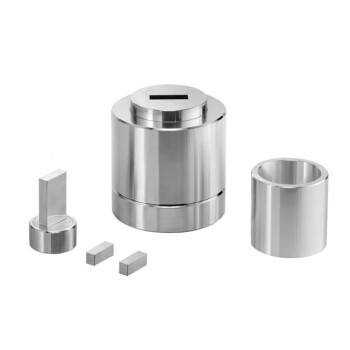
The use of specialized molding dies with a hydraulic press allows researchers to produce samples with consistent geometry and density. This standardization is essential for X-ray diffraction (XRD) analysis and other physical property measurements. It ensures that the experimental data reflects the intrinsic physical properties of the material rather than variations in preparation.
Understanding the Trade-offs
Risk of Over-Compaction
While high pressure reduces resistance, excessive force can lead to over-compaction, which may collapse the pores necessary for electrolyte infiltration. If the electrode is too dense, the ion transport pathways are restricted, potentially leading to poor rate performance despite low electrical resistance.
Substrate Deformation and Damage
Applying several tons of pressure to fragile current collectors or irregular substrates can cause mechanical deformation. Researchers must balance the need for high contact pressure with the structural limits of the substrate to avoid micro-cracks or tearing in the foil or mesh.
Applying Compaction to Your Project
When utilizing a laboratory hydraulic press, your specific research objectives should dictate the pressure settings and molding techniques.
- If your primary focus is cycle life stability: Ensure high-pressure bonding to the current collector to prevent delamination during the volume changes associated with long-term cycling.
- If your primary focus is precision impedance (EIS) measurements: Prioritize the elimination of interfacial voids to ensure the measured resistance reflects the material's electrochemical behavior.
- If your primary focus is gas evolution or OER/HER testing: Use high-pressure molding to ensure the electrode can withstand high current densities without losing structural integrity.
Properly calibrated hydraulic compaction is the foundation of reliable electrochemical data and robust electrode performance.
Summary Table:
| Key Function | Impact on Performance | Practical Benefit |
|---|---|---|
| Ohmic Contact | Reduces interfacial resistance | Accurate EIS and charge transfer measurements |
| Particle Bonding | Creates conductive pathways | Uniform current distribution and electron transport |
| Mechanical Adhesion | Prevents active material delamination | Stable cycle life during high-current testing |
| Void Elimination | Increases structural density | Reproducible Mott-Schottky and XRD characterization |
Elevate your battery research with KINTEK’s precision laboratory hydraulic presses. Whether you require manual, electric, hot, or isostatic presses for pelletizing and electrode preparation, our equipment ensures maximum structural integrity and data reproducibility. From minimizing contact resistance to ensuring stability under high current, KINTEK provides the specialized tools necessary for cutting-edge electrochemical analysis. Contact our technical team today to find the perfect compaction solution for your laboratory!
References
- Peng Yang, J.P. Cheng. Nanocapsule of MnS Nanopolyhedron Core@CoS Nanoparticle/Carbon Shell@Pure Carbon Shell as Anode Material for High-Performance Lithium Storage. DOI: 10.3390/molecules28020898
This article is also based on technical information from Kintek Solution Knowledge Base .
Related Products
- Laboratory Hydraulic Press Split Electric Lab Pellet Press
- Heated Hydraulic Press Machine with Integrated Manual Heated Plates for Lab Use
- Automatic Laboratory Hydraulic Press for XRF & KBR Pellet Press
- Automatic High Temperature Heated Hydraulic Press Machine with Heated Plates for Lab
- Manual High Temperature Heated Hydraulic Press Machine with Heated Plates for Lab
People Also Ask
- What role does a laboratory hydraulic press play in platinum recovery research? Enhancing Sample Precision
- What are the specific applications of a lab hydraulic press in biochar evaluation? Optimize density and data accuracy.
- What are the roles of a laboratory hydraulic press and stainless steel molds in the preparation of graphite samples?
- What is the role of a laboratory hydraulic press in electrode prep? Maximize Energy Density & Sealing Precision
- Why must a laboratory hydraulic press equipped with cylindrical molds be used when preparing BZY green bodies? High Density