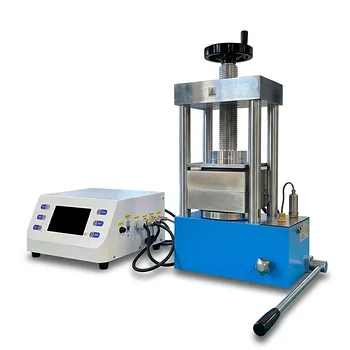
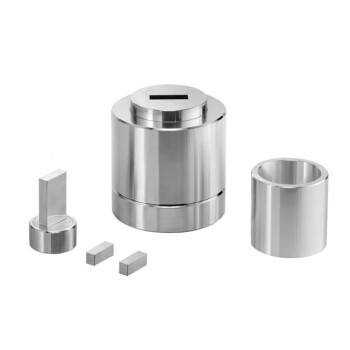
The laboratory hydraulic press serves as the fundamental mechanical catalyst in preparing ferrotitanium oxide precursors. It functions by applying high-precision, directional pressure to a mixture of titanium dioxide and iron powders, transforming loose particles into a cohesive, dense unit known as a "green pellet." This process is not merely about shaping materials; it is about physically forcing particles close enough together to ensure the success of future chemical reactions.
Core Takeaway: The press converts mechanical force into chemical potential by eliminating voids and maximizing particle-to-particle contact. This creates the necessary physical foundation for solid-state diffusion, ensuring that the subsequent high-temperature sintering results in a uniform phase structure rather than an incomplete reaction.
The Mechanics of Precursor Densification
Establishing Specific Geometry
The hydraulic press utilizes high-precision molds to define the exact shape and dimensions of the precursor material.
By confining the loose powder mixture within these molds, the press ensures uniformity across samples. This consistency in geometry is essential for predictable behavior during later processing stages.
Application of Directional Pressure
Unlike simple mixing, the press applies directional pressure to the titanium dioxide and iron powders.
This vector of force compacts the material efficiently, significantly reducing the volume of the powder. The result is a "green pellet"—a compacted solid that holds its shape but has not yet undergone thermal fusion.
Controlling Precursor Density
The magnitude of pressure applied directly correlates to the density of the resulting pellet.
Achieving a specific, high density is critical because it minimizes empty space within the material. A denser pellet contains more reactive material per unit of volume, setting the stage for a more efficient reaction.
Facilitating the Chemical Reaction
Maximizing Contact Area
For solid materials to react, they must physically touch. The hydraulic press significantly enhances the contact area between the titanium dioxide and iron particles.
Loose powders have limited contact points, which acts as a bottleneck for reactions. High-pressure compression forces these distinct particles into an intimate, interlocking arrangement.
Enabling Solid-State Diffusion
The ultimate goal of this preparation is to facilitate solid-state diffusion during the sintering phase.
Diffusion creates the final phase structure, but it can only occur effectively across very short distances. By pressing particles tightly together, the hydraulic press bridges the gap, allowing atoms to migrate and bond efficiently once heat is applied.
Establishing Bonding Strength
Before heating, the pellet relies on mechanical bonding strength to maintain its integrity.
The pressure creates mechanical interlocks between particles, ensuring the pellet helps the mixture survive handling and transfer to the furnace without crumbling. This physical stability is the precursor to chemical stability.
Understanding the Trade-offs
Mechanical Proximity vs. Chemical Bonding
It is vital to recognize that the hydraulic press creates physical proximity, not chemical bonds.
While the press creates a dense "green pellet," the material remains chemically unreacted until heat is applied. The press is a preparation tool, not a reaction vessel; relying solely on pressure without optimizing the subsequent thermal profile will result in a dense but unreacted block.
The Risk of Density Gradients
While directional pressure is effective, it must be applied uniformly to avoid density gradients.
If the pressure is not distributed evenly through the mold, the pellet may have dense outer shells and a porous core. This inconsistency can lead to uneven diffusion rates during sintering, potentially warping the final structure or leaving unreacted pockets of material.
Making the Right Choice for Your Goal
To obtain the best results when preparing ferrotitanium oxide precursors, align your pressing strategy with your final material requirements:
- If your primary focus is Phase Purity: Maximize the pressure to ensure the highest possible contact area, as this minimizes diffusion distances and ensures the reaction runs to completion.
- If your primary focus is Geometric Consistency: Prioritize the precision of your molds and the uniformity of the pressure application to ensure every green pellet has identical dimensions and density profiles.
Ultimately, the hydraulic press dictates the efficiency of the reaction by defining how intimately the reactants interact before the furnace is ever turned on.
Summary Table:
| Process Role | Impact on Precursor | Key Outcome |
|---|---|---|
| Densification | Reduces volume and eliminates voids | High-density "green pellet" formation |
| Contact Optimization | Maximizes particle-to-particle contact area | Faster and more complete chemical reactions |
| Solid-State Diffusion | Bridges the gap between reactant atoms | Enables efficient atom migration during sintering |
| Geometric Control | Defines precise shape and dimensions | Uniformity across experimental samples |
| Mechanical Bonding | Creates physical interlocking | Improved pellet integrity for handling |
Elevate Your Materials Research with KINTEK
Precision is the foundation of every successful chemical reaction. At KINTEK, we specialize in providing high-performance laboratory hydraulic presses (pellet, hot, and isostatic) designed to ensure the uniform density and structural integrity required for advanced research like ferrotitanium oxide preparation.
Our comprehensive range of equipment supports your entire workflow—from crushing and milling systems to high-temperature furnaces (muffle, vacuum, and CVD) and high-pressure reactors. Whether you are optimizing solid-state diffusion or developing new battery technologies, KINTEK offers the consumables and laboratory tools (including PTFE products, ceramics, and crucibles) to guarantee repeatable, high-quality results.
Ready to optimize your precursor preparation? Contact our experts today to find the perfect hydraulic press and laboratory solutions for your specific application.
References
- Mrutyunjay Panigrahi, Takashi Nakamura. An Overview of Production of Titanium and an Attempt to Titanium Production with Ferro-Titanium. DOI: 10.1515/htmp.2010.29.5-6.495
This article is also based on technical information from Kintek Solution Knowledge Base .
Related Products
- Laboratory Hydraulic Pellet Press for XRF KBR FTIR Lab Applications
- Automatic Laboratory Hydraulic Press for XRF & KBR Pellet Press
- Manual Lab Heat Press
- Heated Hydraulic Press Machine with Integrated Manual Heated Plates for Lab Use
- Laboratory Hydraulic Press Split Electric Lab Pellet Press
People Also Ask
- What is the role of a laboratory hydraulic pellet press and stainless steel molds in the fabrication of RuO2/NbC anodes?
- What is the necessity of using a laboratory hydraulic pellet press in the preparation of biomass fuel pellets? Guide
- How does a laboratory hydraulic pellet press contribute to SiCw/2024 aluminum composite preforms? Optimize Densification
- What is the significance of applying 200 MPa of pressure with a laboratory hydraulic pellet press for composite ceramics?
- What key role does a laboratory pellet press play in FTIR analysis? Master KBr Sample Preparation Excellence