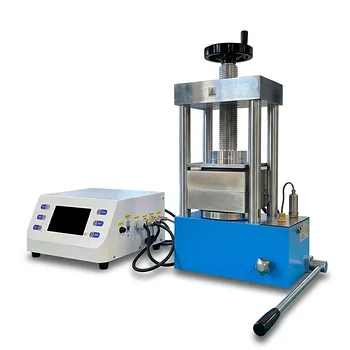
A laboratory hydraulic press acts as the critical consolidation tool in the production of Fe-Cr-Al-Si alloys. It functions by mechanically compressing proportioned pure metal powders of iron, chromium, aluminum, and silicon into dense, compact briquettes, transforming loose raw material into a solid feedstock suitable for melting.
Core Takeaway The hydraulic press does more than just shape the material; it fundamentally alters the physics of the melting process. By increasing particle contact and material density, it ensures stable electrical conductivity and uniform heat distribution, which are prerequisites for successful arc melting.
Transforming Loose Powder into Process-Ready Material
Increasing Contact Area and Density
The primary function of the press is to apply significant mechanical force to the loose powder mixture.
This compression drastically reduces the void space between particles. The result is a high-density "green body" where the iron, chromium, aluminum, and silicon particles are forced into intimate contact.
Creating a Stable Green Body
The press converts flowable powder into a cohesive solid with specific geometric strength.
This pre-forming step, often utilizing pressures such as 10 MPa, creates a "green compact." This compact is robust enough to maintain its shape during storage and handling, preventing the segregation of lighter elements like aluminum or silicon before processing begins.
Streamlining the Loading Process
Loose powders are voluminous and difficult to manage in a melting environment.
Compacted briquettes simplify the physical loading of the material into the melting furnace. This reduces material loss and ensures that the exact stoichiometric ratio of the Fe-Cr-Al-Si mixture reaches the crucible.
Enhancing the Arc Melting Process
Ensuring Electrical Stability
In arc melting, the material itself often acts as part of the electrical circuit.
The dense briquettes created by the hydraulic press ensure a continuous, low-resistance path for the electrical current. This prevents arc instability and interruptions during the volatile initial stages of melting.
Facilitating Rapid and Uniform Melting
Efficiency in melting requires consistent heat distribution.
By eliminating air gaps and increasing the packing density, the press improves thermal conductivity throughout the sample. This facilitates the rapid, uniform melting of all alloy components, which is critical for achieving a homogenous final alloy structure.
Understanding the Trade-offs
Balancing Density with Air Expulsion
While high pressure increases density, it is critical to allow for the escape of entrapped air.
If air is not properly expelled during the pressing phase, it can lead to outgassing during melting or structural weaknesses in the briquette. The goal is a dense compact, not a pressurized vessel of trapped gas.
Managing "Green Strength"
The pressed pellet must be strong, but pressure cannot be applied arbitrarily.
Insufficient pressure results in a briquette that crumbles during loading, defeating the purpose of the process. Conversely, excessive pressure on certain brittle powders can cause laminations or capping, where the pellet fractures horizontally.
Making the Right Choice for Your Goal
To maximize the quality of your Fe-Cr-Al-Si alloy, consider how you apply pressure based on your specific objectives:
- If your primary focus is Melting Stability: Prioritize maximizing the density of the briquette to ensure the most stable electrical path for the arc.
- If your primary focus is Material Handling: Focus on achieving sufficient "green strength" to ensure the pellets do not crumble or segregate during transfer to the furnace.
- If your primary focus is Chemical Homogeneity: Ensure the powders are perfectly mixed before pressing, as the hydraulic press locks the particle distribution in place.
The laboratory hydraulic press serves as the bridge between raw ingredients and refined alloy, ensuring that your feedstock is physically and electrically prepared for the rigors of synthesis.
Summary Table:
| Function | Role in Alloy Production | Benefit for Fe-Cr-Al-Si Synthesis |
|---|---|---|
| Consolidation | Compresses loose powders into green bodies | Eliminates material segregation and improves handling |
| Densification | Minimizes void space between particles | Enhances electrical stability and thermal conductivity |
| Pre-forming | Creates solid, process-ready briquettes | Simplifies furnace loading and maintains stoichiometry |
| Arc Melting Prep | Ensures continuous low-resistance paths | Prevents arc instability and promotes uniform melting |
Optimize Your Material Synthesis with KINTEK Precision
High-performance Fe-Cr-Al-Si alloys demand perfect feedstock preparation. KINTEK specializes in high-quality laboratory equipment, offering a robust range of hydraulic presses (pellet, hot, isostatic) designed to provide the precise mechanical force required for your green body consolidation.
Whether you are focusing on high-density briquettes for stable arc melting or require advanced solutions for battery research, high-temperature furnaces, or crushing and milling systems, KINTEK provides the reliability your research deserves.
Ready to enhance your lab's efficiency and material homogeneity? Contact our experts today to find the perfect pressing solution!
References
- B. A. Тарасов, M S Tarasova. Short-term Mechanical Properties of Fe-Cr-Al-Si Alloys. DOI: 10.18502/kms.v4i1.2202
This article is also based on technical information from Kintek Solution Knowledge Base .
Related Products
- Automatic Laboratory Hydraulic Press for XRF & KBR Pellet Press
- Ball Press Mold for Lab
- kbr pellet press 2t
- Assemble Square Lab Press Mold for Laboratory Applications
- Round Bidirectional Press Mold for Lab
People Also Ask
- What is the significance of applying 200 MPa of pressure with a laboratory hydraulic pellet press for composite ceramics?
- What is the role of a laboratory hydraulic pellet press and stainless steel molds in the fabrication of RuO2/NbC anodes?
- What is the necessity of using a laboratory hydraulic pellet press in the preparation of biomass fuel pellets? Guide
- How does a laboratory hydraulic pellet press contribute to SiCw/2024 aluminum composite preforms? Optimize Densification
- What role does a laboratory hydraulic pellet press play in fly ash utilization? Enhancing Adsorption and Flow Control